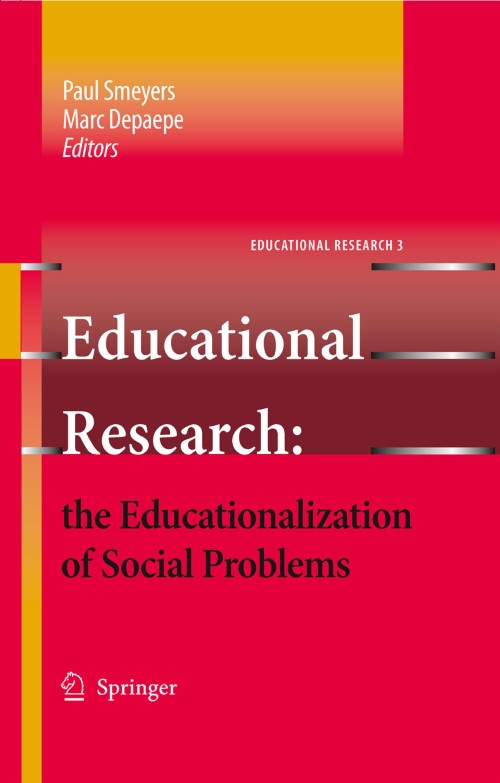
Educational Research: the Educationalization of Social Problems [electronic resource] / by Paul Smeyers ; edited by Marc Depaepe.
Erişim Adresi
ISBN
9781402097249
Dil Kodu
İngilizce
Yer Numarası
DK/11098
Yazar
Basım Bildirimi
1st ed. 2008.
Yayın Bilgisi
Dordrecht : Springer Netherlands : Imprint: Springer, 2008.
Fiziksel Niteleme
VI, 247 p. online resource.
Dizi
Educational Research, 2543-0653 ; 3
İçindekiler Notu
Introduction–Pushing Social Responsibilities: The Educationalization of Social Problems -- About Pedagogization: From the Perspective of the History of Education -- The Educationalization of the ModernWorld: Progress, Passion, and the Protestant Promise of Education -- Educationalising Trends in Societies of Control: Assessments, Problem-Based Learning and Empowerment -- Educationalization in a USA Present: A Historicist Rendering -- Cultural Capital as Educational Capital—The Need For a Reflection on the Educationalisation of Cultural Taste -- The ‘Educationalisation‘ of the Language of Progressivism Exploring the Nature of a True Alternative -- Parenting and the Art of Being a Parent -- The Educationalisation of Social Problems and the Educationalisation of Educational Research: The Example of Citizenship Education -- Higher Education and Hyperreality -- Education for the Knowledge Economy -- The Social, Psychological, and Education Sciences: From Educationalization to Pedagogicalization of the Family and the Child -- ‘It Makes Us Believe That It Is About Our Freedom’: Notes on the Irony of the Learning Apparatus -- The Päadagogisierung of Philosophy -- The Education Concept -- Afterword.
Özet, vb.
Pushing ‘social’ responsibilities on schools is a process that has been underway for a long time. This phenomenon has been studied more in Europe than in North America and the U.K. and has been labelled Pädagogisierung. The editors have chosen to use ‘Educationalization’ to identify the overall orientation or trend toward thinking about education as the focal point for addressing or solving larger human problems. The term describes these phenomena as a sub-process of the ‘modernization’ of society, but it also has negative connotations, such as increased dependence, patronization, and pampering. In this book distinguished philosophers and historians of education focus on ‘educationalization’ to expand its meaning through an engagement with educational theory. Topics discussed are the family and the child, the ‘learning society’, citizenship education, widening participation in higher education, progressive education, and schooling movements such as No Child Left Behind. ‘Smeyers’ and Depaepe's book offers great insights into one of the most ambivalent phenomena of today's educational world and especially educational policy. The contributions assembled represent perspectives of some of the most respected scholars in the field. Their manifold critiques of the educationalization of social problems are rather convincing. Our time is definitely ripe for such analysis!’ Roland Reichenbach, Center for Educational Studies, University of Basel, Switzerland ‘This is a challenging, critical and analytical treatment of the tendency of contemporary administrations to overburden educational institutions with the expectation that they will provide the solutions to an increasingly diverse range of social and economic problems. It brings together the theoretical resources of a distinguished international group of philosophers and historians of education and deserves the carefulattention of educational policy makers, practitioners and researchers alike.’ David Bridges, Von Hügel Institute, St Edmund’s College, Cambridge, England This publication is realized by the Research Community (FWO-Vlaanderen / Research Foundation Flanders, Belgium) Philosophy and History of the Discipline of Education: Evaluation and Evolution of the Criteria for Educational Research. Also realized by the Research Community are Educational Research: Why ‘What Works’ Doesn’t Work (2006) and Educational Research: Networks and Technologies (2007). .
Konu
Education __ Philosophy.
Philosophy and social sciences.
Educational Philosophy.
Philosophy of the Social Sciences.
Philosophy and social sciences.
Educational Philosophy.
Philosophy of the Social Sciences.
Diğer Yazarlar
Kurum Adı

Eseri Alıntıla
Referansları kullanmadan önce gözden geçirmeniz ve varsa gerekli düzeltmeleri yapmanız önerilir.
Dijital Kaynak
MARC Görünümü
LEADER 05556nam a22005055i 4500
001 809809
003 TR_AnAIT
005 20260131022209
007 cr nn 008mamaa
008 100301s2008 ne | s |||| 0|eng d
020 |a9781402097249|9978-1-4020-9724-9
024 7 |a10.1007/978-1-4020-9724-9|2doi
041 |aeng
049 |aTürk Tarih Kurumu Kütüphanesi
050 4|aLB1-3640
072 7|aJNA|2bicssc
072 7|aEDU040000|2bisacsh
072 7|aJNA|2thema
082 04|a370.1|223
090 |aDK/11098
100 1 |aSmeyers, Paul.|eauthor.|4aut|4http://id.loc.gov/vocabulary/relators/aut
245 10|aEducational Research: the Educationalization of Social Problems|h[electronic resource] /|cby Paul Smeyers ; edited by Marc Depaepe.
250 |a1st ed. 2008.
264 1|aDordrecht :|bSpringer Netherlands :|bImprint: Springer,|c2008.
300 |aVI, 247 p.|bonline resource.
336 |atext|btxt|2rdacontent
337 |acomputer|bc|2rdamedia
338 |aonline resource|bcr|2rdacarrier
347 |atext file|bPDF|2rda
490 1 |aEducational Research,|x2543-0653 ;|v3
505 0 |aIntroduction–Pushing Social Responsibilities: The Educationalization of Social Problems -- About Pedagogization: From the Perspective of the History of Education -- The Educationalization of the ModernWorld: Progress, Passion, and the Protestant Promise of Education -- Educationalising Trends in Societies of Control: Assessments, Problem-Based Learning and Empowerment -- Educationalization in a USA Present: A Historicist Rendering -- Cultural Capital as Educational Capital—The Need For a Reflection on the Educationalisation of Cultural Taste -- The ‘Educationalisation‘ of the Language of Progressivism Exploring the Nature of a True Alternative -- Parenting and the Art of Being a Parent -- The Educationalisation of Social Problems and the Educationalisation of Educational Research: The Example of Citizenship Education -- Higher Education and Hyperreality -- Education for the Knowledge Economy -- The Social, Psychological, and Education Sciences: From Educationalization to Pedagogicalization of the Family and the Child -- ‘It Makes Us Believe That It Is About Our Freedom’: Notes on the Irony of the Learning Apparatus -- The Päadagogisierung of Philosophy -- The Education Concept -- Afterword.
520 |aPushing ‘social’ responsibilities on schools is a process that has been underway for a long time. This phenomenon has been studied more in Europe than in North America and the U.K. and has been labelled Pädagogisierung. The editors have chosen to use ‘Educationalization’ to identify the overall orientation or trend toward thinking about education as the focal point for addressing or solving larger human problems. The term describes these phenomena as a sub-process of the ‘modernization’ of society, but it also has negative connotations, such as increased dependence, patronization, and pampering. In this book distinguished philosophers and historians of education focus on ‘educationalization’ to expand its meaning through an engagement with educational theory. Topics discussed are the family and the child, the ‘learning society’, citizenship education, widening participation in higher education, progressive education, and schooling movements such as No Child Left Behind. ‘Smeyers’ and Depaepe's book offers great insights into one of the most ambivalent phenomena of today's educational world and especially educational policy. The contributions assembled represent perspectives of some of the most respected scholars in the field. Their manifold critiques of the educationalization of social problems are rather convincing. Our time is definitely ripe for such analysis!’ Roland Reichenbach, Center for Educational Studies, University of Basel, Switzerland ‘This is a challenging, critical and analytical treatment of the tendency of contemporary administrations to overburden educational institutions with the expectation that they will provide the solutions to an increasingly diverse range of social and economic problems. It brings together the theoretical resources of a distinguished international group of philosophers and historians of education and deserves the carefulattention of educational policy makers, practitioners and researchers alike.’ David Bridges, Von Hügel Institute, St Edmund’s College, Cambridge, England This publication is realized by the Research Community (FWO-Vlaanderen / Research Foundation Flanders, Belgium) Philosophy and History of the Discipline of Education: Evaluation and Evolution of the Criteria for Educational Research. Also realized by the Research Community are Educational Research: Why ‘What Works’ Doesn’t Work (2006) and Educational Research: Networks and Technologies (2007). .
650 0|aEducation|xPhilosophy.
650 0|aPhilosophy and social sciences.
650 14|aEducational Philosophy.
650 24|aPhilosophy of the Social Sciences.
700 1 |aDepaepe, Marc.|eeditor.|4edt|4http://id.loc.gov/vocabulary/relators/edt
710 2 |aSpringerLink (Online service)
773 0 |tSpringer Nature eBook
776 08|iPrinted edition:|z9781402097225
776 08|iPrinted edition:|z9781402097232
776 08|iPrinted edition:|z9789048181933
830 0|aEducational Research,|x2543-0653 ;|v3
856 40|uhttps://doi.org/10.1007/978-1-4020-9724-9
912 |aZDB-2-SHU
912 |aZDB-2-SXED
950 |aHumanities, Social Sciences and Law (SpringerNature-11648)
950 |aEducation (R0) (SpringerNature-43721)
001 809809
003 TR_AnAIT
005 20260131022209
007 cr nn 008mamaa
008 100301s2008 ne | s |||| 0|eng d
020 |a9781402097249|9978-1-4020-9724-9
024 7 |a10.1007/978-1-4020-9724-9|2doi
041 |aeng
049 |aTürk Tarih Kurumu Kütüphanesi
050 4|aLB1-3640
072 7|aJNA|2bicssc
072 7|aEDU040000|2bisacsh
072 7|aJNA|2thema
082 04|a370.1|223
090 |aDK/11098
100 1 |aSmeyers, Paul.|eauthor.|4aut|4http://id.loc.gov/vocabulary/relators/aut
245 10|aEducational Research: the Educationalization of Social Problems|h[electronic resource] /|cby Paul Smeyers ; edited by Marc Depaepe.
250 |a1st ed. 2008.
264 1|aDordrecht :|bSpringer Netherlands :|bImprint: Springer,|c2008.
300 |aVI, 247 p.|bonline resource.
336 |atext|btxt|2rdacontent
337 |acomputer|bc|2rdamedia
338 |aonline resource|bcr|2rdacarrier
347 |atext file|bPDF|2rda
490 1 |aEducational Research,|x2543-0653 ;|v3
505 0 |aIntroduction–Pushing Social Responsibilities: The Educationalization of Social Problems -- About Pedagogization: From the Perspective of the History of Education -- The Educationalization of the ModernWorld: Progress, Passion, and the Protestant Promise of Education -- Educationalising Trends in Societies of Control: Assessments, Problem-Based Learning and Empowerment -- Educationalization in a USA Present: A Historicist Rendering -- Cultural Capital as Educational Capital—The Need For a Reflection on the Educationalisation of Cultural Taste -- The ‘Educationalisation‘ of the Language of Progressivism Exploring the Nature of a True Alternative -- Parenting and the Art of Being a Parent -- The Educationalisation of Social Problems and the Educationalisation of Educational Research: The Example of Citizenship Education -- Higher Education and Hyperreality -- Education for the Knowledge Economy -- The Social, Psychological, and Education Sciences: From Educationalization to Pedagogicalization of the Family and the Child -- ‘It Makes Us Believe That It Is About Our Freedom’: Notes on the Irony of the Learning Apparatus -- The Päadagogisierung of Philosophy -- The Education Concept -- Afterword.
520 |aPushing ‘social’ responsibilities on schools is a process that has been underway for a long time. This phenomenon has been studied more in Europe than in North America and the U.K. and has been labelled Pädagogisierung. The editors have chosen to use ‘Educationalization’ to identify the overall orientation or trend toward thinking about education as the focal point for addressing or solving larger human problems. The term describes these phenomena as a sub-process of the ‘modernization’ of society, but it also has negative connotations, such as increased dependence, patronization, and pampering. In this book distinguished philosophers and historians of education focus on ‘educationalization’ to expand its meaning through an engagement with educational theory. Topics discussed are the family and the child, the ‘learning society’, citizenship education, widening participation in higher education, progressive education, and schooling movements such as No Child Left Behind. ‘Smeyers’ and Depaepe's book offers great insights into one of the most ambivalent phenomena of today's educational world and especially educational policy. The contributions assembled represent perspectives of some of the most respected scholars in the field. Their manifold critiques of the educationalization of social problems are rather convincing. Our time is definitely ripe for such analysis!’ Roland Reichenbach, Center for Educational Studies, University of Basel, Switzerland ‘This is a challenging, critical and analytical treatment of the tendency of contemporary administrations to overburden educational institutions with the expectation that they will provide the solutions to an increasingly diverse range of social and economic problems. It brings together the theoretical resources of a distinguished international group of philosophers and historians of education and deserves the carefulattention of educational policy makers, practitioners and researchers alike.’ David Bridges, Von Hügel Institute, St Edmund’s College, Cambridge, England This publication is realized by the Research Community (FWO-Vlaanderen / Research Foundation Flanders, Belgium) Philosophy and History of the Discipline of Education: Evaluation and Evolution of the Criteria for Educational Research. Also realized by the Research Community are Educational Research: Why ‘What Works’ Doesn’t Work (2006) and Educational Research: Networks and Technologies (2007). .
650 0|aEducation|xPhilosophy.
650 0|aPhilosophy and social sciences.
650 14|aEducational Philosophy.
650 24|aPhilosophy of the Social Sciences.
700 1 |aDepaepe, Marc.|eeditor.|4edt|4http://id.loc.gov/vocabulary/relators/edt
710 2 |aSpringerLink (Online service)
773 0 |tSpringer Nature eBook
776 08|iPrinted edition:|z9781402097225
776 08|iPrinted edition:|z9781402097232
776 08|iPrinted edition:|z9789048181933
830 0|aEducational Research,|x2543-0653 ;|v3
856 40|uhttps://doi.org/10.1007/978-1-4020-9724-9
912 |aZDB-2-SHU
912 |aZDB-2-SXED
950 |aHumanities, Social Sciences and Law (SpringerNature-11648)
950 |aEducation (R0) (SpringerNature-43721)
Materyaller
Depodan talep edilen materyal sadece kütüphane içerisinde kullanılmaktadır.
Materyal dışarıya ödünç verilmemektedir.
