

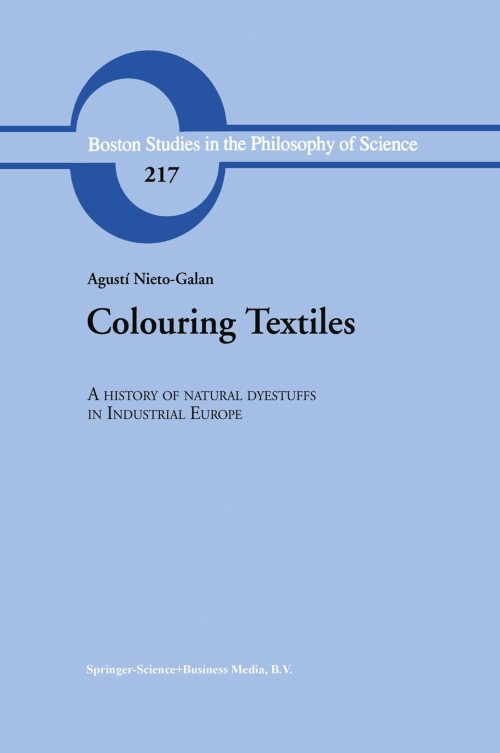
Colouring Textiles [electronic resource] : A History of Natural Dyestuffs in Industrial Europe / by A. Nieto-Galan.
Erişim Adresi
ISBN
9789401710817
Dil Kodu
İngilizce
Yer Numarası
DK/11138
Yazar
Basım Bildirimi
1st ed. 2001.
Yayın Bilgisi
Dordrecht : Springer Netherlands : Imprint: Springer, 2001.
Fiziksel Niteleme
XXVI, 246 p. online resource.
Dizi
Boston Studies in the Philosophy and History of Science, 2214-7942 ; 217
İçindekiler Notu
1: Natural Dyestuffs and the Kingdoms of Nature -- 2: Sites of Dyeing and Printing Textiles: From the Workshop to the Factory System -- 3: The “Science” of Natural Dyestuffs in the Laboratory -- 4: Circulating Skills in a European Network: The “Republic of Chemist-Dyers” -- 5: Artisans and Artists in Dyeing and Printing -- 6: Towards the “Artificial”: A Long-Standing Technological Change -- 1. Archives and libraries -- 2. Primary source journals and newspapers -- 3. Primary sources -- 4. Secondary sources -- List of Illustrations and Tables.
Özet, vb.
Colouring Textiles is an attempt to provide a new cross-cultural comparative approach to the art of dyeing and printing with natural dyestuffs in the eighteenth and nineteenth centuries. Divided into thematic chapters, it uncovers new data from the vast historical heritage of natural dyestuffs from a range of European cities, to present new historiographic insights for the understanding of this technology. Through a sort of anatomic dissection, the book explores the study and cultivation of dye-plants in botanical gardens and plantations, and the tacit values hidden in dyeing workshops, factories, laboratories, or national and international exhibitions. It metaphorically submits the natural dyestuffs of the eighteenth and nineteenth centuries to a series of systematic historical tests, and traces back the circulation of those sources of colours through colonial spaces, dye works, cross-cultural networks, schools of artistic design, and science-based industries for the making of synthetic colorants. Colouring Textiles contributes to a better understanding of the role of natural dyestuffs in the processes of industrialization in Western Europe. Audience: Historians of science and technology, historians of chemistry, philosophers, economic historians, professional chemists, arts and crafts historians, and cultural anthropologists.
Konu
History.
Chemistry.
Technology __ Philosophy.
Economics __ History.
Chemistry, Organic.
History.
Chemistry.
Philosophy of Technology.
History of Economic Thought and Methodology.
Organic Chemistry.
Chemistry.
Technology __ Philosophy.
Economics __ History.
Chemistry, Organic.
History.
Chemistry.
Philosophy of Technology.
History of Economic Thought and Methodology.
Organic Chemistry.
Kurum Adı
