LEADER 03663nam a22004815i 4500
001 809862
003 TR_AnAIT
005 20260131022032
007 cr nn 008mamaa
008 100301s2010 ne | s |||| 0|eng d
020 |a9789048133390|9978-90-481-3339-0
024 7 |a10.1007/978-90-481-3339-0|2doi
041 |aeng
049 |aTürk Tarih Kurumu Kütüphanesi
050 4|aBJ1-1725
072 7|aHPQ|2bicssc
072 7|aPHI005000|2bisacsh
072 7|aQDTQ|2thema
082 04|a170|223
090 |aDK/11151
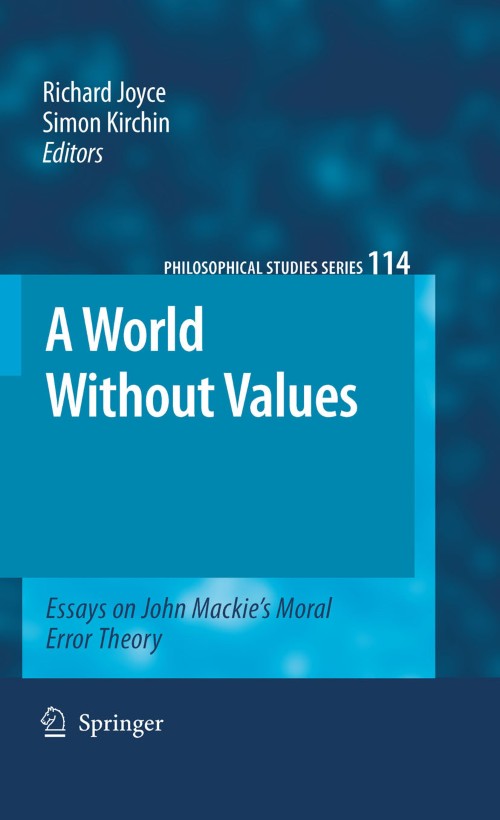
245 12|aA World Without Values|h[electronic resource] :|bEssays on John Mackie's Moral Error Theory /|cedited by Richard Joyce, Simon Kirchin.
250 |a1st ed. 2010.
264 1|aDordrecht :|bSpringer Netherlands :|bImprint: Springer,|c2010.
300 |aXXIV, 238 p.|bonline resource.
336 |atext|btxt|2rdacontent
337 |acomputer|bc|2rdamedia
338 |aonline resource|bcr|2rdacarrier
347 |atext file|bPDF|2rda
490 1 |aPhilosophical Studies Series,|x2542-8349 ;|v114
505 0 |aAgainst Ethics -- Nihilism, Nietzsche, and the Doppelganger Problem -- Patterns of Objectification -- Mackie's Internalisms -- Mackie's Realism: Queer Pigs and the Web of Belief -- Mackie on Practical Reason -- The Argument from Moral Experience -- Beyond the Error Theory -- Normativity, Deliberation, and Queerness -- A Tension in the Moral Error Theory -- Business as Usual? The Error Theory, Internalism, and the Function of Morality -- The Fictionalist's Attitude Problem -- Abolishing Morality.
520 |aFor centuries, certain moral philosophers have maintained that morality is an illusion, comparable to talking of ghosts or unicorns. These moral skeptics claim that the world simply doesn’t contain the sort of properties (such as moral badness, moral obligation, etc.) necessary to render moral statements true. Even seemingly obvious moral claims, such as "killing innocents is morally wrong" fail to be true. What would lead someone to adopt such a radical viewpoint? Are the arguments in its favor defensible or plausible? What impact would embracing such a view have on one’s practical life? Taking as its point of departure the work of moral philosopher John Mackie (1917-1981), A World Without Values is a collection of essays on moral skepticism by leading contemporary philosophers, some of whom are sympathetic to Mackie’s views, some of whom are opposed. Rather than treating moral skepticism as something to dismiss as quickly as possible, this anthology is a comprehensive exploration of the topic, and as such will be a valuable resource for students of moral philosophy at all levels, as well as professionals in the field of meta-ethics. A World Without Values presents state-of-the-art arguments that advance the ongoing philosophical debate on several fronts, and will enjoy an important place on any meta-ethicist’s bookshelf for some years to come.
650 0|aEthics.
650 14|aMoral Philosophy and Applied Ethics.
700 1 |aJoyce, Richard.|eeditor.|4edt|4http://id.loc.gov/vocabulary/relators/edt
700 1 |aKirchin, Simon.|eeditor.|4edt|4http://id.loc.gov/vocabulary/relators/edt
710 2 |aSpringerLink (Online service)
773 0 |tSpringer Nature eBook
776 08|iPrinted edition:|z9789048133383
776 08|iPrinted edition:|z9789048133710
776 08|iPrinted edition:|z9789400730991
830 0|aPhilosophical Studies Series,|x2542-8349 ;|v114
856 40|uhttps://doi.org/10.1007/978-90-481-3339-0
912 |aZDB-2-SHU
912 |aZDB-2-SXPR
950 |aHumanities, Social Sciences and Law (SpringerNature-11648)
950 |aPhilosophy and Religion (R0) (SpringerNature-43725)