

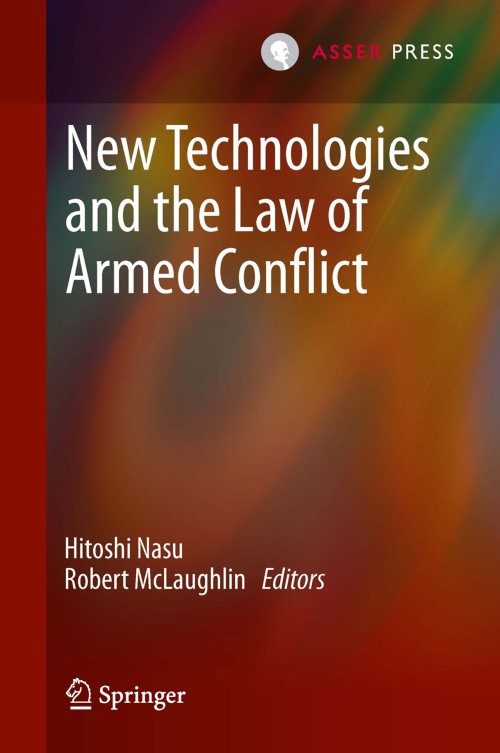
New Technologies and the Law of Armed Conflict [electronic resource] / edited by Hitoshi Nasu, Robert McLaughlin.
Erişim Adresi
ISBN
9789067049337
Dil Kodu
İngilizce
Yer Numarası
DK/11194
Basım Bildirimi
1st ed. 2014.
Yayın Bilgisi
The Hague : T.M.C. Asser Press : Imprint: T.M.C. Asser Press, 2014.
Fiziksel Niteleme
XX, 259 p. 1 illus. online resource.
İçindekiler Notu
Introduction: Conundrum of New Technologies in the Law of Armed Conflict -- The Legal Challenges of New Technologies: An Overview -- Ethical Challenges of New Military Technologies -- Legal Review of New Technology Weapons -- Where Do Cyber Hostilities Fit in the International Law Maze? Geography, Territory and Sovereignty in Cyber Warfare -- Military Strategic Use of Outer Space -- The Law Applicable to Military Strategic Use of Outer Space -- Nanotechnology and the Law of Armed Conflict -- Anticipating the Biological Proliferation Threat of Nanotechnology: Challenges for international Arms Control Regimes -- Nanotechnology and Military Attacks on Photosynthesis -- Unmanned Aerial Vehicles: Do They Pose Legal Challenges? Examining Autonomous Weapon Systems from a Law of Armed Conflict Perspective -- Unmanned Naval Vehicles and the Law of Naval Warfare -- Conclusion: Challenges of New Technologies for the Law of Armed Conflict.
Özet, vb.
With a Foreword by Michael N. Schmitt, Charles H. Stockton Professor and Chairman, United States Naval War College. Modern technological development has been both rapid and fundamentally transformative of the means and methods of warfare, and of the broader environment in which warfare is conducted. In many cases, technological development has been stimulated by, and dedicated to, addressing military requirements. On other occasions, technological developments outside the military sphere affect or inform the conduct of warfare and military expectations. The introduction of new technologies such as information technology, space technologies, nanotechnology and robotic technologies into our civil life, and into warfare, is expected to influence the application and interpretation of the existing rules of the law of armed conflict. In this book, scholars and practitioners working in the fields critically examine the potential legal challenges arising from the use of new technologies and future directions of legal development in light of the specific characteristics and challenges each technology presents with regard to foreseeable humanitarian impacts upon the battlespace. New Technologies and the Law of Armed Conflict is highly recommended to everyone involved in the ongoing weapons debates, as well as those interested in the broader relationship between law and war. Hitoshi Nasu and Robert McLaughlin are Senior Lecturer and Associate Professor respectively at the ANU College of Law, AustralianNational University, Canberra ACT, Australia.
Konu
International law.
Computers __ Law and legislation.
Information technology __ Law and legislation.
Mass media __ Law and legislation.
Sources and Subjects of International Law, International Organizations.
Legal Aspects of Computing.
IT Law, Media Law, Intellectual Property.
Computers __ Law and legislation.
Information technology __ Law and legislation.
Mass media __ Law and legislation.
Sources and Subjects of International Law, International Organizations.
Legal Aspects of Computing.
IT Law, Media Law, Intellectual Property.
Diğer Yazarlar
Kurum Adı
Eseri Alıntıla
Referansları kullanmadan önce gözden geçirmeniz ve varsa gerekli düzeltmeleri yapmanız önerilir.
Dijital Kaynak
MARC Görünümü
LEADER 05186nam a22005295i 4500
001 809911
003 TR_AnAIT
005 20260131021913
007 cr nn 008mamaa
008 131223s2014 ne | s |||| 0|eng d
020 |a9789067049337|9978-90-6704-933-7
024 7 |a10.1007/978-90-6704-933-7|2doi
041 |aeng
049 |aTürk Tarih Kurumu Kütüphanesi
050 4|aKZ
072 7|aLBB|2bicssc
072 7|aLAW051000|2bisacsh
072 7|aLBB|2thema
082 04|a341|223
090 |aDK/11194
245 10|aNew Technologies and the Law of Armed Conflict|h[electronic resource] /|cedited by Hitoshi Nasu, Robert McLaughlin.
250 |a1st ed. 2014.
264 1|aThe Hague :|bT.M.C. Asser Press :|bImprint: T.M.C. Asser Press,|c2014.
300 |aXX, 259 p. 1 illus.|bonline resource.
336 |atext|btxt|2rdacontent
337 |acomputer|bc|2rdamedia
338 |aonline resource|bcr|2rdacarrier
347 |atext file|bPDF|2rda
505 0 |aIntroduction: Conundrum of New Technologies in the Law of Armed Conflict -- The Legal Challenges of New Technologies: An Overview -- Ethical Challenges of New Military Technologies -- Legal Review of New Technology Weapons -- Where Do Cyber Hostilities Fit in the International Law Maze? Geography, Territory and Sovereignty in Cyber Warfare -- Military Strategic Use of Outer Space -- The Law Applicable to Military Strategic Use of Outer Space -- Nanotechnology and the Law of Armed Conflict -- Anticipating the Biological Proliferation Threat of Nanotechnology: Challenges for international Arms Control Regimes -- Nanotechnology and Military Attacks on Photosynthesis -- Unmanned Aerial Vehicles: Do They Pose Legal Challenges? Examining Autonomous Weapon Systems from a Law of Armed Conflict Perspective -- Unmanned Naval Vehicles and the Law of Naval Warfare -- Conclusion: Challenges of New Technologies for the Law of Armed Conflict.
520 |aWith a Foreword by Michael N. Schmitt, Charles H. Stockton Professor and Chairman, United States Naval War College. Modern technological development has been both rapid and fundamentally transformative of the means and methods of warfare, and of the broader environment in which warfare is conducted. In many cases, technological development has been stimulated by, and dedicated to, addressing military requirements. On other occasions, technological developments outside the military sphere affect or inform the conduct of warfare and military expectations. The introduction of new technologies such as information technology, space technologies, nanotechnology and robotic technologies into our civil life, and into warfare, is expected to influence the application and interpretation of the existing rules of the law of armed conflict. In this book, scholars and practitioners working in the fields critically examine the potential legal challenges arising from the use of new technologies and future directions of legal development in light of the specific characteristics and challenges each technology presents with regard to foreseeable humanitarian impacts upon the battlespace. New Technologies and the Law of Armed Conflict is highly recommended to everyone involved in the ongoing weapons debates, as well as those interested in the broader relationship between law and war. Hitoshi Nasu and Robert McLaughlin are Senior Lecturer and Associate Professor respectively at the ANU College of Law, AustralianNational University, Canberra ACT, Australia.
532 8 |aAccessibility summary: This PDF eBook is produced by a third-party. We have requested that the file be made accessible and compliant with the European Accessibility Act (EAA). However, we have not been able to fully verify its compliance with recognized accessibility standards (such as PDF/UA or WCAG). For detailed accessibility information, please refer to the original publisher’s website. If you require an accessible version of this content, please contact accessibilitysupport@springernature.com. We are committed to improving accessibility and will work with the publisher to meet your needs wherever possible.
532 8 |aPublisher contact for further accessibility information: accessibilitysupport@springernature.com
650 0|aInternational law.
650 0|aComputers|xLaw and legislation.
650 0|aInformation technology|xLaw and legislation.
650 0|aMass media|xLaw and legislation.
650 14|aSources and Subjects of International Law, International Organizations.
650 24|aLegal Aspects of Computing.
650 24|aIT Law, Media Law, Intellectual Property.
700 1 |aNasu, Hitoshi.|eeditor.|4edt|4http://id.loc.gov/vocabulary/relators/edt
700 1 |aMcLaughlin, Robert.|eeditor.|4edt|4http://id.loc.gov/vocabulary/relators/edt
710 2 |aSpringerLink (Online service)
773 0 |tSpringer Nature eBook
776 08|iPrinted edition:|z9789067049320
776 08|iPrinted edition:|z9789067049344
856 40|uhttps://doi.org/10.1007/978-90-6704-933-7
912 |aZDB-2-SHU
912 |aZDB-2-SXLC
950 |aHumanities, Social Sciences and Law (SpringerNature-11648)
950 |aLaw and Criminology (R0) (SpringerNature-43727)
001 809911
003 TR_AnAIT
005 20260131021913
007 cr nn 008mamaa
008 131223s2014 ne | s |||| 0|eng d
020 |a9789067049337|9978-90-6704-933-7
024 7 |a10.1007/978-90-6704-933-7|2doi
041 |aeng
049 |aTürk Tarih Kurumu Kütüphanesi
050 4|aKZ
072 7|aLBB|2bicssc
072 7|aLAW051000|2bisacsh
072 7|aLBB|2thema
082 04|a341|223
090 |aDK/11194
245 10|aNew Technologies and the Law of Armed Conflict|h[electronic resource] /|cedited by Hitoshi Nasu, Robert McLaughlin.
250 |a1st ed. 2014.
264 1|aThe Hague :|bT.M.C. Asser Press :|bImprint: T.M.C. Asser Press,|c2014.
300 |aXX, 259 p. 1 illus.|bonline resource.
336 |atext|btxt|2rdacontent
337 |acomputer|bc|2rdamedia
338 |aonline resource|bcr|2rdacarrier
347 |atext file|bPDF|2rda
505 0 |aIntroduction: Conundrum of New Technologies in the Law of Armed Conflict -- The Legal Challenges of New Technologies: An Overview -- Ethical Challenges of New Military Technologies -- Legal Review of New Technology Weapons -- Where Do Cyber Hostilities Fit in the International Law Maze? Geography, Territory and Sovereignty in Cyber Warfare -- Military Strategic Use of Outer Space -- The Law Applicable to Military Strategic Use of Outer Space -- Nanotechnology and the Law of Armed Conflict -- Anticipating the Biological Proliferation Threat of Nanotechnology: Challenges for international Arms Control Regimes -- Nanotechnology and Military Attacks on Photosynthesis -- Unmanned Aerial Vehicles: Do They Pose Legal Challenges? Examining Autonomous Weapon Systems from a Law of Armed Conflict Perspective -- Unmanned Naval Vehicles and the Law of Naval Warfare -- Conclusion: Challenges of New Technologies for the Law of Armed Conflict.
520 |aWith a Foreword by Michael N. Schmitt, Charles H. Stockton Professor and Chairman, United States Naval War College. Modern technological development has been both rapid and fundamentally transformative of the means and methods of warfare, and of the broader environment in which warfare is conducted. In many cases, technological development has been stimulated by, and dedicated to, addressing military requirements. On other occasions, technological developments outside the military sphere affect or inform the conduct of warfare and military expectations. The introduction of new technologies such as information technology, space technologies, nanotechnology and robotic technologies into our civil life, and into warfare, is expected to influence the application and interpretation of the existing rules of the law of armed conflict. In this book, scholars and practitioners working in the fields critically examine the potential legal challenges arising from the use of new technologies and future directions of legal development in light of the specific characteristics and challenges each technology presents with regard to foreseeable humanitarian impacts upon the battlespace. New Technologies and the Law of Armed Conflict is highly recommended to everyone involved in the ongoing weapons debates, as well as those interested in the broader relationship between law and war. Hitoshi Nasu and Robert McLaughlin are Senior Lecturer and Associate Professor respectively at the ANU College of Law, AustralianNational University, Canberra ACT, Australia.
532 8 |aAccessibility summary: This PDF eBook is produced by a third-party. We have requested that the file be made accessible and compliant with the European Accessibility Act (EAA). However, we have not been able to fully verify its compliance with recognized accessibility standards (such as PDF/UA or WCAG). For detailed accessibility information, please refer to the original publisher’s website. If you require an accessible version of this content, please contact accessibilitysupport@springernature.com. We are committed to improving accessibility and will work with the publisher to meet your needs wherever possible.
532 8 |aPublisher contact for further accessibility information: accessibilitysupport@springernature.com
650 0|aInternational law.
650 0|aComputers|xLaw and legislation.
650 0|aInformation technology|xLaw and legislation.
650 0|aMass media|xLaw and legislation.
650 14|aSources and Subjects of International Law, International Organizations.
650 24|aLegal Aspects of Computing.
650 24|aIT Law, Media Law, Intellectual Property.
700 1 |aNasu, Hitoshi.|eeditor.|4edt|4http://id.loc.gov/vocabulary/relators/edt
700 1 |aMcLaughlin, Robert.|eeditor.|4edt|4http://id.loc.gov/vocabulary/relators/edt
710 2 |aSpringerLink (Online service)
773 0 |tSpringer Nature eBook
776 08|iPrinted edition:|z9789067049320
776 08|iPrinted edition:|z9789067049344
856 40|uhttps://doi.org/10.1007/978-90-6704-933-7
912 |aZDB-2-SHU
912 |aZDB-2-SXLC
950 |aHumanities, Social Sciences and Law (SpringerNature-11648)
950 |aLaw and Criminology (R0) (SpringerNature-43727)
Materyaller
Depodan talep edilen materyal sadece kütüphane içerisinde kullanılmaktadır.
Materyal dışarıya ödünç verilmemektedir.
Materyal dışarıya ödünç verilmemektedir.
