

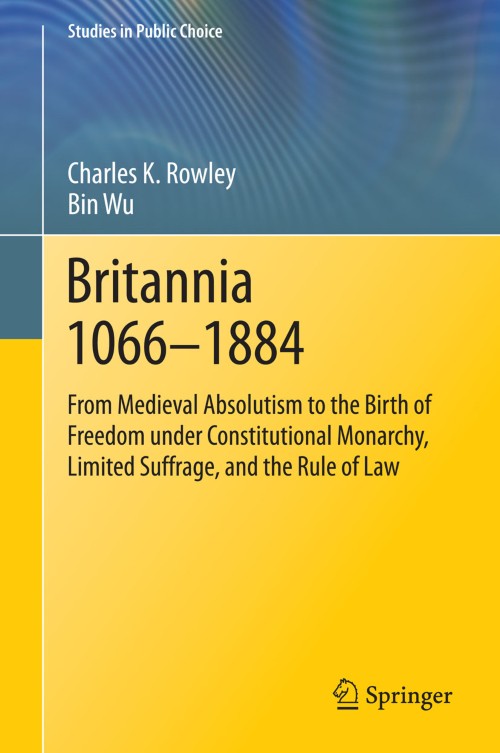
Britannia 1066-1884 [electronic resource] : From Medieval Absolutism to the Birth of Freedom under Constitutional Monarchy, Limited Suffrage, and the Rule of Law / by Charles K. Rowley, Bin Wu.
Erişim Adresi
ISBN
9783319046846
Dil Kodu
İngilizce
Yer Numarası
DK/11198
Yazar
Basım Bildirimi
1st ed. 2014.
Yayın Bilgisi
Cham : Springer International Publishing : Imprint: Springer, 2014.
Fiziksel Niteleme
XI, 165 p. 3 illus. online resource.
Dizi
Studies in Public Choice, 2731-5258 ; 30
İçindekiler Notu
The Modern Tools for Analytical History: Economics, Political Science, Public Choice, Philosophy, and the Law -- The Evolution of Absolutism in Medieval England: 1066-1485 -- The Tudor Dynasty: Perfecting Absolutism in the Era of the Renaissance and the Reformation, 1485-1603 -- The Stuart and the Cromwell Doom: The Hinge of Fate for Absolutist Autocrats, 1603-1688 -- The Seventeenth Century Philosophical Divide: Unity versus Liberty -- The Demise of the Divine Right of Kings, the Decline of Monarchic Power, and the Rise of Parliament, 1689-1775 -- Hugo Grotius, John Locke and Cato’s Letters: Evolution of Philosophy from the Glorious Revolution to the American Revolution -- Freedoms Flourish under Constitutional Monarchy, Limited Suffrage, Laissez-Faire Capitalism, Free Trade, and the Rule of Law, 1776-1884 -- The Zenith of Classical Liberal Philosophy in Britannia: From the Scottish Enlightenment to John Stuart Mill.
Özet, vb.
This book offers an analytic history of Britannia (first England and Wales and then Great Britain) over eight hundred years of political turmoil, intermingled with economic stagnation, followed by the engine of the industrial revolution. The book draws on economics, political science, public choice, philosophy and the law to probe in depth into the evolution of Britannia from an impoverished feudal and then post-feudal autocracy into a constitutional monarchy with limited suffrage that provided the fulcrum for industrial and commercial success, making Britannia, by 1884, the richest nation, per capita, on the planet. The book challenges head-on the Whiggist liberal notion of Macaulay and Trevelyan that the path from oppression to freedom was one of unimpeded progress. Among its novel features, the book draws upon the dictator’s handbook, as modeled by Bueno de Mesquita and Alistair Smith to evaluate the period of varying autocracy, 1066-1688. The book draws upon modern public choice theory and legal history to evaluate the fragile, corrupt constitutional monarchy that oversaw the initial phase of post-Glorious Revolution Britannia, 1689-1775. At each stage, the philosophical battle between those who sought order and unity and those who sought individual liberty is meticulously outlined. The book draws on the contributions of the Scottish Enlightenment (Hume, Ferguson and Smith) and of classical liberal philosophy (John Stuart Mill) to explain the final vault of Britannia from a weak and corrupt to a robust and admired constitutional monarchy grounded on the rule of law, over the period 1776-1884.
Konu
Political science.
Comparative government.
Europe __ Economic integration.
Political Theory.
Comparative Politics.
European Economic Integration.
Comparative government.
Europe __ Economic integration.
Political Theory.
Comparative Politics.
European Economic Integration.
Diğer Yazarlar
Kurum Adı
Eseri Alıntıla
Referansları kullanmadan önce gözden geçirmeniz ve varsa gerekli düzeltmeleri yapmanız önerilir.
Dijital Kaynak
MARC Görünümü
LEADER 04596nam a22005295i 4500
001 809915
003 TR_AnAIT
005 20260131021901
007 cr nn 008mamaa
008 140430s2014 sz | s |||| 0|eng d
020 |a9783319046846|9978-3-319-04684-6
024 7 |a10.1007/978-3-319-04684-6|2doi
041 |aeng
049 |aTürk Tarih Kurumu Kütüphanesi
050 4|aJC11-607
072 7|aJPA|2bicssc
072 7|aPOL010000|2bisacsh
072 7|aJPA|2thema
082 04|a320.01|223
090 |aDK/11198
100 1 |aRowley, Charles K.|eauthor.|4aut|4http://id.loc.gov/vocabulary/relators/aut
245 10|aBritannia 1066-1884|h[electronic resource] :|bFrom Medieval Absolutism to the Birth of Freedom under Constitutional Monarchy, Limited Suffrage, and the Rule of Law /|cby Charles K. Rowley, Bin Wu.
250 |a1st ed. 2014.
264 1|aCham :|bSpringer International Publishing :|bImprint: Springer,|c2014.
300 |aXI, 165 p. 3 illus.|bonline resource.
336 |atext|btxt|2rdacontent
337 |acomputer|bc|2rdamedia
338 |aonline resource|bcr|2rdacarrier
347 |atext file|bPDF|2rda
490 1 |aStudies in Public Choice,|x2731-5258 ;|v30
505 0 |aThe Modern Tools for Analytical History: Economics, Political Science, Public Choice, Philosophy, and the Law -- The Evolution of Absolutism in Medieval England: 1066-1485 -- The Tudor Dynasty: Perfecting Absolutism in the Era of the Renaissance and the Reformation, 1485-1603 -- The Stuart and the Cromwell Doom: The Hinge of Fate for Absolutist Autocrats, 1603-1688 -- The Seventeenth Century Philosophical Divide: Unity versus Liberty -- The Demise of the Divine Right of Kings, the Decline of Monarchic Power, and the Rise of Parliament, 1689-1775 -- Hugo Grotius, John Locke and Cato’s Letters: Evolution of Philosophy from the Glorious Revolution to the American Revolution -- Freedoms Flourish under Constitutional Monarchy, Limited Suffrage, Laissez-Faire Capitalism, Free Trade, and the Rule of Law, 1776-1884 -- The Zenith of Classical Liberal Philosophy in Britannia: From the Scottish Enlightenment to John Stuart Mill.
520 |aThis book offers an analytic history of Britannia (first England and Wales and then Great Britain) over eight hundred years of political turmoil, intermingled with economic stagnation, followed by the engine of the industrial revolution. The book draws on economics, political science, public choice, philosophy and the law to probe in depth into the evolution of Britannia from an impoverished feudal and then post-feudal autocracy into a constitutional monarchy with limited suffrage that provided the fulcrum for industrial and commercial success, making Britannia, by 1884, the richest nation, per capita, on the planet. The book challenges head-on the Whiggist liberal notion of Macaulay and Trevelyan that the path from oppression to freedom was one of unimpeded progress. Among its novel features, the book draws upon the dictator’s handbook, as modeled by Bueno de Mesquita and Alistair Smith to evaluate the period of varying autocracy, 1066-1688. The book draws upon modern public choice theory and legal history to evaluate the fragile, corrupt constitutional monarchy that oversaw the initial phase of post-Glorious Revolution Britannia, 1689-1775. At each stage, the philosophical battle between those who sought order and unity and those who sought individual liberty is meticulously outlined. The book draws on the contributions of the Scottish Enlightenment (Hume, Ferguson and Smith) and of classical liberal philosophy (John Stuart Mill) to explain the final vault of Britannia from a weak and corrupt to a robust and admired constitutional monarchy grounded on the rule of law, over the period 1776-1884.
650 0|aPolitical science.
650 0|aComparative government.
650 0|aEurope|xEconomic integration.
650 14|aPolitical Theory.
650 24|aComparative Politics.
650 24|aEuropean Economic Integration.
700 1 |aWu, Bin.|eauthor.|4aut|4http://id.loc.gov/vocabulary/relators/aut
710 2 |aSpringerLink (Online service)
773 0 |tSpringer Nature eBook
776 08|iPrinted edition:|z9783319046839
776 08|iPrinted edition:|z9783319046853
776 08|iPrinted edition:|z9783319377681
830 0|aStudies in Public Choice,|x2731-5258 ;|v30
856 40|uhttps://doi.org/10.1007/978-3-319-04684-6
912 |aZDB-2-SHU
912 |aZDB-2-SXPI
950 |aHumanities, Social Sciences and Law (SpringerNature-11648)
950 |aPolitical Science and International Studies (R0) (SpringerNature-43724)
001 809915
003 TR_AnAIT
005 20260131021901
007 cr nn 008mamaa
008 140430s2014 sz | s |||| 0|eng d
020 |a9783319046846|9978-3-319-04684-6
024 7 |a10.1007/978-3-319-04684-6|2doi
041 |aeng
049 |aTürk Tarih Kurumu Kütüphanesi
050 4|aJC11-607
072 7|aJPA|2bicssc
072 7|aPOL010000|2bisacsh
072 7|aJPA|2thema
082 04|a320.01|223
090 |aDK/11198
100 1 |aRowley, Charles K.|eauthor.|4aut|4http://id.loc.gov/vocabulary/relators/aut
245 10|aBritannia 1066-1884|h[electronic resource] :|bFrom Medieval Absolutism to the Birth of Freedom under Constitutional Monarchy, Limited Suffrage, and the Rule of Law /|cby Charles K. Rowley, Bin Wu.
250 |a1st ed. 2014.
264 1|aCham :|bSpringer International Publishing :|bImprint: Springer,|c2014.
300 |aXI, 165 p. 3 illus.|bonline resource.
336 |atext|btxt|2rdacontent
337 |acomputer|bc|2rdamedia
338 |aonline resource|bcr|2rdacarrier
347 |atext file|bPDF|2rda
490 1 |aStudies in Public Choice,|x2731-5258 ;|v30
505 0 |aThe Modern Tools for Analytical History: Economics, Political Science, Public Choice, Philosophy, and the Law -- The Evolution of Absolutism in Medieval England: 1066-1485 -- The Tudor Dynasty: Perfecting Absolutism in the Era of the Renaissance and the Reformation, 1485-1603 -- The Stuart and the Cromwell Doom: The Hinge of Fate for Absolutist Autocrats, 1603-1688 -- The Seventeenth Century Philosophical Divide: Unity versus Liberty -- The Demise of the Divine Right of Kings, the Decline of Monarchic Power, and the Rise of Parliament, 1689-1775 -- Hugo Grotius, John Locke and Cato’s Letters: Evolution of Philosophy from the Glorious Revolution to the American Revolution -- Freedoms Flourish under Constitutional Monarchy, Limited Suffrage, Laissez-Faire Capitalism, Free Trade, and the Rule of Law, 1776-1884 -- The Zenith of Classical Liberal Philosophy in Britannia: From the Scottish Enlightenment to John Stuart Mill.
520 |aThis book offers an analytic history of Britannia (first England and Wales and then Great Britain) over eight hundred years of political turmoil, intermingled with economic stagnation, followed by the engine of the industrial revolution. The book draws on economics, political science, public choice, philosophy and the law to probe in depth into the evolution of Britannia from an impoverished feudal and then post-feudal autocracy into a constitutional monarchy with limited suffrage that provided the fulcrum for industrial and commercial success, making Britannia, by 1884, the richest nation, per capita, on the planet. The book challenges head-on the Whiggist liberal notion of Macaulay and Trevelyan that the path from oppression to freedom was one of unimpeded progress. Among its novel features, the book draws upon the dictator’s handbook, as modeled by Bueno de Mesquita and Alistair Smith to evaluate the period of varying autocracy, 1066-1688. The book draws upon modern public choice theory and legal history to evaluate the fragile, corrupt constitutional monarchy that oversaw the initial phase of post-Glorious Revolution Britannia, 1689-1775. At each stage, the philosophical battle between those who sought order and unity and those who sought individual liberty is meticulously outlined. The book draws on the contributions of the Scottish Enlightenment (Hume, Ferguson and Smith) and of classical liberal philosophy (John Stuart Mill) to explain the final vault of Britannia from a weak and corrupt to a robust and admired constitutional monarchy grounded on the rule of law, over the period 1776-1884.
650 0|aPolitical science.
650 0|aComparative government.
650 0|aEurope|xEconomic integration.
650 14|aPolitical Theory.
650 24|aComparative Politics.
650 24|aEuropean Economic Integration.
700 1 |aWu, Bin.|eauthor.|4aut|4http://id.loc.gov/vocabulary/relators/aut
710 2 |aSpringerLink (Online service)
773 0 |tSpringer Nature eBook
776 08|iPrinted edition:|z9783319046839
776 08|iPrinted edition:|z9783319046853
776 08|iPrinted edition:|z9783319377681
830 0|aStudies in Public Choice,|x2731-5258 ;|v30
856 40|uhttps://doi.org/10.1007/978-3-319-04684-6
912 |aZDB-2-SHU
912 |aZDB-2-SXPI
950 |aHumanities, Social Sciences and Law (SpringerNature-11648)
950 |aPolitical Science and International Studies (R0) (SpringerNature-43724)
Materyaller
Depodan talep edilen materyal sadece kütüphane içerisinde kullanılmaktadır.
Materyal dışarıya ödünç verilmemektedir.
Materyal dışarıya ödünç verilmemektedir.
