

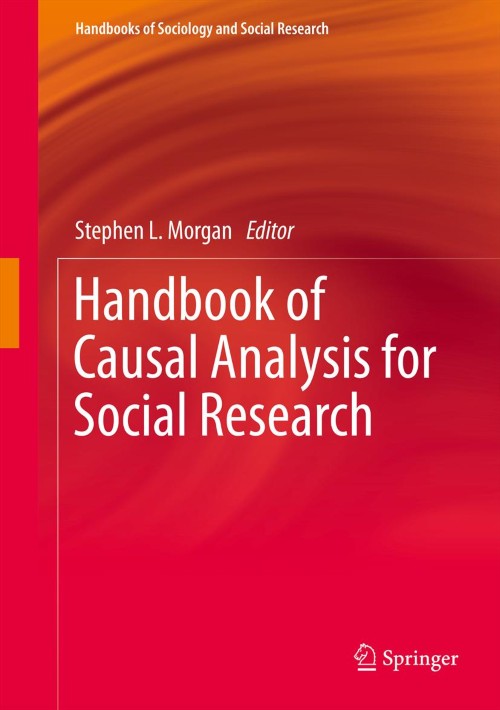
Handbook of Causal Analysis for Social Research [electronic resource] / edited by Stephen L. Morgan.
Erişim Adresi
ISBN
9789400760943
Dil Kodu
İngilizce
Yer Numarası
DK/11248
Basım Bildirimi
1st ed. 2013.
Yayın Bilgisi
Dordrecht : Springer Netherlands : Imprint: Springer, 2013.
Fiziksel Niteleme
XI, 424 p. 63 illus. online resource.
Dizi
Handbooks of Sociology and Social Research, 2542-839X
İçindekiler Notu
Preface -- Chapter 1. Introduction; Stephen L. Morgan -- Part I. Background and Approaches to Analysis -- Chapter 2. A History of Causal Analysis in the Social Sciences; Sondra N. Barringer, Erin Leahey and Scott R. Eliason -- Chapter 3. Types of Causes; Jeremy Freese and J. Alex Kevern -- Part II. Design and Modeling Choices -- Chapter 4. Research Design: Toward a Realistic Role for Causal Analysis; Herbert L. Smith -- Chapter 5. Causal Models and Counterfactuals; James Mahoney, Gary Goertz and Charles C. Ragin -- Chapter 6. Mixed Models and Counterfactuals; David J. Harding and Kristin S. Seefeldt -- Part III. Beyond Conventional Regression Models -- Chapter 7. Fixed Effects, Random Effects, and Hybrid Models for Causal Analysis; Glenn Firebaugh, Cody Warner, and Michael Massoglia -- Chapter 8. Heteroscedastic Regression Models for the Systematic Analysis of Residual Variance; Hui Zheng, Yang Yang and Kenneth C. Land -- Chapter 9. Group Differences in Generalized Linear Models; Tim F. Liao.-Chapter 10. Counterfactual Causal Analysis and Non-Linear Probability Models; Richard Breen and Kristian Bernt Karlson -- Chapter 11. Causal Effect Heterogeneity; Jennie E. Brand and Juli Simon Thomas -- Chapter12. New Perspectives on Causal Mediation Analysis; Xiaolu Wang and Michael E. Sobel -- Part IV. Systems and Causal Relationships -- Chapter 13. Graphical Causal Models; Felix Elwert -- Chapter 14. The Causal Implications of Mechanistic Thinking: Identification Using Directed Acyclic Graphs (DAGs); Carly R. Knight and Christopher Winship -- Chapter 15. Eight Myths about Causality and Structural Equation Models; Kenneth A. Bollen and Judea Pearl -- Part V. Influence and Interference -- Chapter 16. Heterogeneous Agents, Social Interactions, and Causal Inference; Guanglei Hong and Stephen W. Raudenbush -- Chapter 17. Social Networks and Causal Inference; Tyler J. VanderWeele and Weihua An -- Part VI. Retreat From Effect Identification -- Chapter 18. Partial Identification and Sensitivity Analysis; Markus Gangl -- Chapter 19. What You can Learn from Wrong Causal Models; Richard Berk, Lawrence Brown, Edward George, Emil Pitkin, Mikhail Traskin, Kai Zhang and Linda Zhao.
Özet, vb.
What constitutes a causal explanation, and must an explanation be causal? What warrants a causal inference, as opposed to a descriptive regularity? What techniques are available to detect when causal effects are present, and when can these techniques be used to identify the relative importance of these effects? What complications do the interactions of individuals create for these techniques? When can mixed methods of analysis be used to deepen causal accounts? Must causal claims include generative mechanisms, and how effective are empirical methods designed to discover them? The Handbook of Causal Analysis for Social Research tackles these questions with nineteen chapters from leading scholars in sociology, statistics, public health, computer science, and human development. .
Konu
Sociology.
Sociology __ Methodology.
Social sciences __ Statistical methods.
Sociology.
Sociological Methods.
Statistics in Social Sciences, Humanities, Law, Education, Behavorial Sciences, Public Policy.
Sociology __ Methodology.
Social sciences __ Statistical methods.
Sociology.
Sociological Methods.
Statistics in Social Sciences, Humanities, Law, Education, Behavorial Sciences, Public Policy.
Diğer Yazarlar
Kurum Adı
Eseri Alıntıla
Referansları kullanmadan önce gözden geçirmeniz ve varsa gerekli düzeltmeleri yapmanız önerilir.
Dijital Kaynak
MARC Görünümü
LEADER 04956nam a22005415i 4500
001 809965
003 TR_AnAIT
005 20260131021721
007 cr nn 008mamaa
008 130423s2013 ne | s |||| 0|eng d
020 |a9789400760943|9978-94-007-6094-3
024 7 |a10.1007/978-94-007-6094-3|2doi
041 |aeng
049 |aTürk Tarih Kurumu Kütüphanesi
050 4|aHM
072 7|aJHB|2bicssc
072 7|aJHB|2bicssc
072 7|aSOC026000|2bisacsh
072 7|aJHB|2thema
072 7|aJHB|2thema
082 04|a301|223
090 |aDK/11248
245 10|aHandbook of Causal Analysis for Social Research|h[electronic resource] /|cedited by Stephen L. Morgan.
250 |a1st ed. 2013.
264 1|aDordrecht :|bSpringer Netherlands :|bImprint: Springer,|c2013.
300 |aXI, 424 p. 63 illus.|bonline resource.
336 |atext|btxt|2rdacontent
337 |acomputer|bc|2rdamedia
338 |aonline resource|bcr|2rdacarrier
347 |atext file|bPDF|2rda
490 1 |aHandbooks of Sociology and Social Research,|x2542-839X
505 0 |aPreface -- Chapter 1. Introduction; Stephen L. Morgan -- Part I. Background and Approaches to Analysis -- Chapter 2. A History of Causal Analysis in the Social Sciences; Sondra N. Barringer, Erin Leahey and Scott R. Eliason -- Chapter 3. Types of Causes; Jeremy Freese and J. Alex Kevern -- Part II. Design and Modeling Choices -- Chapter 4. Research Design: Toward a Realistic Role for Causal Analysis; Herbert L. Smith -- Chapter 5. Causal Models and Counterfactuals; James Mahoney, Gary Goertz and Charles C. Ragin -- Chapter 6. Mixed Models and Counterfactuals; David J. Harding and Kristin S. Seefeldt -- Part III. Beyond Conventional Regression Models -- Chapter 7. Fixed Effects, Random Effects, and Hybrid Models for Causal Analysis; Glenn Firebaugh, Cody Warner, and Michael Massoglia -- Chapter 8. Heteroscedastic Regression Models for the Systematic Analysis of Residual Variance; Hui Zheng, Yang Yang and Kenneth C. Land -- Chapter 9. Group Differences in Generalized Linear Models; Tim F. Liao.-Chapter 10. Counterfactual Causal Analysis and Non-Linear Probability Models; Richard Breen and Kristian Bernt Karlson -- Chapter 11. Causal Effect Heterogeneity; Jennie E. Brand and Juli Simon Thomas -- Chapter12. New Perspectives on Causal Mediation Analysis; Xiaolu Wang and Michael E. Sobel -- Part IV. Systems and Causal Relationships -- Chapter 13. Graphical Causal Models; Felix Elwert -- Chapter 14. The Causal Implications of Mechanistic Thinking: Identification Using Directed Acyclic Graphs (DAGs); Carly R. Knight and Christopher Winship -- Chapter 15. Eight Myths about Causality and Structural Equation Models; Kenneth A. Bollen and Judea Pearl -- Part V. Influence and Interference -- Chapter 16. Heterogeneous Agents, Social Interactions, and Causal Inference; Guanglei Hong and Stephen W. Raudenbush -- Chapter 17. Social Networks and Causal Inference; Tyler J. VanderWeele and Weihua An -- Part VI. Retreat From Effect Identification -- Chapter 18. Partial Identification and Sensitivity Analysis; Markus Gangl -- Chapter 19. What You can Learn from Wrong Causal Models; Richard Berk, Lawrence Brown, Edward George, Emil Pitkin, Mikhail Traskin, Kai Zhang and Linda Zhao.
520 |aWhat constitutes a causal explanation, and must an explanation be causal? What warrants a causal inference, as opposed to a descriptive regularity? What techniques are available to detect when causal effects are present, and when can these techniques be used to identify the relative importance of these effects? What complications do the interactions of individuals create for these techniques? When can mixed methods of analysis be used to deepen causal accounts? Must causal claims include generative mechanisms, and how effective are empirical methods designed to discover them? The Handbook of Causal Analysis for Social Research tackles these questions with nineteen chapters from leading scholars in sociology, statistics, public health, computer science, and human development. .
650 0|aSociology.
650 0|aSociology|xMethodology.
650 0|aSocial sciences|xStatistical methods.
650 14|aSociology.
650 24|aSociological Methods.
650 24|aStatistics in Social Sciences, Humanities, Law, Education, Behavorial Sciences, Public Policy.
700 1 |aMorgan, Stephen L.|eeditor.|4edt|4http://id.loc.gov/vocabulary/relators/edt
710 2 |aSpringerLink (Online service)
773 0 |tSpringer Nature eBook
776 08|iPrinted edition:|z9789400760936
776 08|iPrinted edition:|z9789400760950
776 08|iPrinted edition:|z9789401794077
830 0|aHandbooks of Sociology and Social Research,|x2542-839X
856 40|uhttps://doi.org/10.1007/978-94-007-6094-3
912 |aZDB-2-SHU
912 |aZDB-2-SXS
950 |aHumanities, Social Sciences and Law (SpringerNature-11648)
950 |aSocial Sciences (R0) (SpringerNature-43726)
001 809965
003 TR_AnAIT
005 20260131021721
007 cr nn 008mamaa
008 130423s2013 ne | s |||| 0|eng d
020 |a9789400760943|9978-94-007-6094-3
024 7 |a10.1007/978-94-007-6094-3|2doi
041 |aeng
049 |aTürk Tarih Kurumu Kütüphanesi
050 4|aHM
072 7|aJHB|2bicssc
072 7|aJHB|2bicssc
072 7|aSOC026000|2bisacsh
072 7|aJHB|2thema
072 7|aJHB|2thema
082 04|a301|223
090 |aDK/11248
245 10|aHandbook of Causal Analysis for Social Research|h[electronic resource] /|cedited by Stephen L. Morgan.
250 |a1st ed. 2013.
264 1|aDordrecht :|bSpringer Netherlands :|bImprint: Springer,|c2013.
300 |aXI, 424 p. 63 illus.|bonline resource.
336 |atext|btxt|2rdacontent
337 |acomputer|bc|2rdamedia
338 |aonline resource|bcr|2rdacarrier
347 |atext file|bPDF|2rda
490 1 |aHandbooks of Sociology and Social Research,|x2542-839X
505 0 |aPreface -- Chapter 1. Introduction; Stephen L. Morgan -- Part I. Background and Approaches to Analysis -- Chapter 2. A History of Causal Analysis in the Social Sciences; Sondra N. Barringer, Erin Leahey and Scott R. Eliason -- Chapter 3. Types of Causes; Jeremy Freese and J. Alex Kevern -- Part II. Design and Modeling Choices -- Chapter 4. Research Design: Toward a Realistic Role for Causal Analysis; Herbert L. Smith -- Chapter 5. Causal Models and Counterfactuals; James Mahoney, Gary Goertz and Charles C. Ragin -- Chapter 6. Mixed Models and Counterfactuals; David J. Harding and Kristin S. Seefeldt -- Part III. Beyond Conventional Regression Models -- Chapter 7. Fixed Effects, Random Effects, and Hybrid Models for Causal Analysis; Glenn Firebaugh, Cody Warner, and Michael Massoglia -- Chapter 8. Heteroscedastic Regression Models for the Systematic Analysis of Residual Variance; Hui Zheng, Yang Yang and Kenneth C. Land -- Chapter 9. Group Differences in Generalized Linear Models; Tim F. Liao.-Chapter 10. Counterfactual Causal Analysis and Non-Linear Probability Models; Richard Breen and Kristian Bernt Karlson -- Chapter 11. Causal Effect Heterogeneity; Jennie E. Brand and Juli Simon Thomas -- Chapter12. New Perspectives on Causal Mediation Analysis; Xiaolu Wang and Michael E. Sobel -- Part IV. Systems and Causal Relationships -- Chapter 13. Graphical Causal Models; Felix Elwert -- Chapter 14. The Causal Implications of Mechanistic Thinking: Identification Using Directed Acyclic Graphs (DAGs); Carly R. Knight and Christopher Winship -- Chapter 15. Eight Myths about Causality and Structural Equation Models; Kenneth A. Bollen and Judea Pearl -- Part V. Influence and Interference -- Chapter 16. Heterogeneous Agents, Social Interactions, and Causal Inference; Guanglei Hong and Stephen W. Raudenbush -- Chapter 17. Social Networks and Causal Inference; Tyler J. VanderWeele and Weihua An -- Part VI. Retreat From Effect Identification -- Chapter 18. Partial Identification and Sensitivity Analysis; Markus Gangl -- Chapter 19. What You can Learn from Wrong Causal Models; Richard Berk, Lawrence Brown, Edward George, Emil Pitkin, Mikhail Traskin, Kai Zhang and Linda Zhao.
520 |aWhat constitutes a causal explanation, and must an explanation be causal? What warrants a causal inference, as opposed to a descriptive regularity? What techniques are available to detect when causal effects are present, and when can these techniques be used to identify the relative importance of these effects? What complications do the interactions of individuals create for these techniques? When can mixed methods of analysis be used to deepen causal accounts? Must causal claims include generative mechanisms, and how effective are empirical methods designed to discover them? The Handbook of Causal Analysis for Social Research tackles these questions with nineteen chapters from leading scholars in sociology, statistics, public health, computer science, and human development. .
650 0|aSociology.
650 0|aSociology|xMethodology.
650 0|aSocial sciences|xStatistical methods.
650 14|aSociology.
650 24|aSociological Methods.
650 24|aStatistics in Social Sciences, Humanities, Law, Education, Behavorial Sciences, Public Policy.
700 1 |aMorgan, Stephen L.|eeditor.|4edt|4http://id.loc.gov/vocabulary/relators/edt
710 2 |aSpringerLink (Online service)
773 0 |tSpringer Nature eBook
776 08|iPrinted edition:|z9789400760936
776 08|iPrinted edition:|z9789400760950
776 08|iPrinted edition:|z9789401794077
830 0|aHandbooks of Sociology and Social Research,|x2542-839X
856 40|uhttps://doi.org/10.1007/978-94-007-6094-3
912 |aZDB-2-SHU
912 |aZDB-2-SXS
950 |aHumanities, Social Sciences and Law (SpringerNature-11648)
950 |aSocial Sciences (R0) (SpringerNature-43726)
Materyaller
Depodan talep edilen materyal sadece kütüphane içerisinde kullanılmaktadır.
Materyal dışarıya ödünç verilmemektedir.
Materyal dışarıya ödünç verilmemektedir.
