

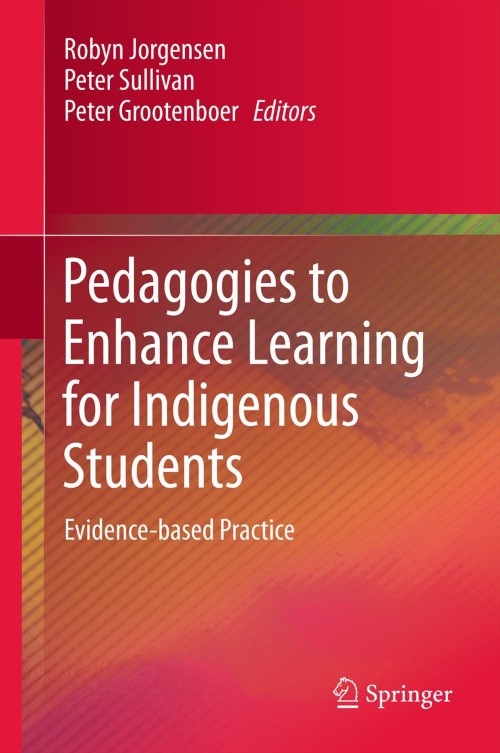
Pedagogies to Enhance Learning for Indigenous Students [electronic resource] : Evidence-based Practice / edited by Robyn Jorgensen, Peter Sullivan, Peter Grootenboer.
Erişim Adresi
ISBN
9789814021845
Dil Kodu
İngilizce
Yer Numarası
DK/11264
Basım Bildirimi
1st ed. 2013.
Yayın Bilgisi
Singapore : Springer Nature Singapore : Imprint: Springer, 2013.
Fiziksel Niteleme
XII, 224 p. online resource.
İçindekiler Notu
Foreword Paul Hughes -- Preface Robyn Jorgensen, Peter Sullivan and Peter Grootenboer -- Chapter 1: An Aboriginal perspective on education –Policy and practice Dale Kerwin and Harry van Issum -- Chapter 2: A systemic evidence-based strategy to improve Indigenous students’ numeracy and literacy Thelma Perso -- Chapter 3: Indigenous Education Workers: A special case of educational assistant Bob Funnell -- Chapter 4: Combating role discontinuity for principals of remote Indigenous schools Richard Niesche -- Chapter 5: Teacher s’ beliefs and practices in teaching mathematics in remote Aboriginal schools Robyn Jorgensen, Peter Grootenboer and Richard Niesche -- Chapter 6: Language for Learning in Indigenous Classrooms: Foundations for Literacy and Numeracy Rod Gardner and Ilana Mushin -- Chapter 7: Naming method: “This is it, maybe, but youshould talk to …” Lisa Lunney-Borden and Dave Wagner -- Chapter 8: A three-level intervention pedagogy to enhance the academic achievement of Indigenous students: Evidence from QuickSmart John Pegg and Lorraine Graham -- Chapter 9: Building confidence and fostering engagement in Aboriginal learners Peter Sullivan and Niek van Riel -- Chapter 10: Connecting children, community and curriculum Jennifer Rennie -- Chapter 11: Evaluating Indigenous science education programs: Applying the Ininiwi-kiskānītamowin Indigenous science education model to an informal education program Dawn Sutherland and Natalie Swayze -- Chapter 12: Using digital media to mediate learning in remote Aboriginal communities Robyn Jorgensen.
Özet, vb.
This book describes research undertaken by leading Australian researcher in Indigenous communities. While the chapters are Australian in their focus, the issues that are discussed are similar to those in other countries where there are indigenous people. In most cases, in Australia and internationally, Indigenous learners are not succeeding in school, thus making the transition into work and adulthood quite tenuous in terms of mainstream measures. The importance of being literate and numerate are critical in success in school and life in general, thus making this collection an important contribution to the international literature. The collection of works describes a wide range of projects where the focus has been on improving the literacy and numeracy outcomes for Indigenous students. The chapters take various approaches to improving these outcomes, and have very different foci. These foci include aspects of literacy, numeracy, curriculum leadership, ICTs, whole school planning, policy, linguistics and Indigenous perspectives. Most of the chapters report on large scale projects that have used some innovation in their focus. The book draws together these projects so that a more connected sense of the complexities and diversity of approaches can be gleaned.
Konu
Learning, Psychology of.
Literacy.
Instructional Psychology.
Literacy.
Literacy.
Instructional Psychology.
Literacy.
Diğer Yazarlar
Kurum Adı
Eseri Alıntıla
Referansları kullanmadan önce gözden geçirmeniz ve varsa gerekli düzeltmeleri yapmanız önerilir.
Dijital Kaynak
MARC Görünümü
LEADER 04702nam a22004935i 4500
001 809981
003 TR_AnAIT
005 20260131021621
007 cr nn 008mamaa
008 121118s2013 si | s |||| 0|eng d
020 |a9789814021845|9978-981-4021-84-5
024 7 |a10.1007/978-981-4021-84-5|2doi
041 |aeng
049 |aTürk Tarih Kurumu Kütüphanesi
050 4|aLB1060-1077
072 7|aJNC|2bicssc
072 7|aEDU009000|2bisacsh
072 7|aJNC|2thema
082 04|a370.15|223
090 |aDK/11264
245 10|aPedagogies to Enhance Learning for Indigenous Students|h[electronic resource] :|bEvidence-based Practice /|cedited by Robyn Jorgensen, Peter Sullivan, Peter Grootenboer.
250 |a1st ed. 2013.
264 1|aSingapore :|bSpringer Nature Singapore :|bImprint: Springer,|c2013.
300 |aXII, 224 p.|bonline resource.
336 |atext|btxt|2rdacontent
337 |acomputer|bc|2rdamedia
338 |aonline resource|bcr|2rdacarrier
347 |atext file|bPDF|2rda
505 0 |aForeword Paul Hughes -- Preface Robyn Jorgensen, Peter Sullivan and Peter Grootenboer -- Chapter 1: An Aboriginal perspective on education –Policy and practice Dale Kerwin and Harry van Issum -- Chapter 2: A systemic evidence-based strategy to improve Indigenous students’ numeracy and literacy Thelma Perso -- Chapter 3: Indigenous Education Workers: A special case of educational assistant Bob Funnell -- Chapter 4: Combating role discontinuity for principals of remote Indigenous schools Richard Niesche -- Chapter 5: Teacher s’ beliefs and practices in teaching mathematics in remote Aboriginal schools Robyn Jorgensen, Peter Grootenboer and Richard Niesche -- Chapter 6: Language for Learning in Indigenous Classrooms: Foundations for Literacy and Numeracy Rod Gardner and Ilana Mushin -- Chapter 7: Naming method: “This is it, maybe, but youshould talk to …” Lisa Lunney-Borden and Dave Wagner -- Chapter 8: A three-level intervention pedagogy to enhance the academic achievement of Indigenous students: Evidence from QuickSmart John Pegg and Lorraine Graham -- Chapter 9: Building confidence and fostering engagement in Aboriginal learners Peter Sullivan and Niek van Riel -- Chapter 10: Connecting children, community and curriculum Jennifer Rennie -- Chapter 11: Evaluating Indigenous science education programs: Applying the Ininiwi-kiskānītamowin Indigenous science education model to an informal education program Dawn Sutherland and Natalie Swayze -- Chapter 12: Using digital media to mediate learning in remote Aboriginal communities Robyn Jorgensen.
520 |aThis book describes research undertaken by leading Australian researcher in Indigenous communities. While the chapters are Australian in their focus, the issues that are discussed are similar to those in other countries where there are indigenous people. In most cases, in Australia and internationally, Indigenous learners are not succeeding in school, thus making the transition into work and adulthood quite tenuous in terms of mainstream measures. The importance of being literate and numerate are critical in success in school and life in general, thus making this collection an important contribution to the international literature. The collection of works describes a wide range of projects where the focus has been on improving the literacy and numeracy outcomes for Indigenous students. The chapters take various approaches to improving these outcomes, and have very different foci. These foci include aspects of literacy, numeracy, curriculum leadership, ICTs, whole school planning, policy, linguistics and Indigenous perspectives. Most of the chapters report on large scale projects that have used some innovation in their focus. The book draws together these projects so that a more connected sense of the complexities and diversity of approaches can be gleaned.
650 0|aLearning, Psychology of.
650 0|aLiteracy.
650 14|aInstructional Psychology.
650 24|aLiteracy.
700 1 |aJorgensen, Robyn.|eeditor.|4edt|4http://id.loc.gov/vocabulary/relators/edt
700 1 |aSullivan, Peter.|eeditor.|4edt|4http://id.loc.gov/vocabulary/relators/edt
700 1 |aGrootenboer, Peter.|eeditor.|4edt|4http://id.loc.gov/vocabulary/relators/edt
710 2 |aSpringerLink (Online service)
773 0 |tSpringer Nature eBook
776 08|iPrinted edition:|z9789814021838
776 08|iPrinted edition:|z9789814021852
776 08|iPrinted edition:|z9789814560894
856 40|uhttps://doi.org/10.1007/978-981-4021-84-5
912 |aZDB-2-SHU
912 |aZDB-2-SXED
950 |aHumanities, Social Sciences and Law (SpringerNature-11648)
950 |aEducation (R0) (SpringerNature-43721)
001 809981
003 TR_AnAIT
005 20260131021621
007 cr nn 008mamaa
008 121118s2013 si | s |||| 0|eng d
020 |a9789814021845|9978-981-4021-84-5
024 7 |a10.1007/978-981-4021-84-5|2doi
041 |aeng
049 |aTürk Tarih Kurumu Kütüphanesi
050 4|aLB1060-1077
072 7|aJNC|2bicssc
072 7|aEDU009000|2bisacsh
072 7|aJNC|2thema
082 04|a370.15|223
090 |aDK/11264
245 10|aPedagogies to Enhance Learning for Indigenous Students|h[electronic resource] :|bEvidence-based Practice /|cedited by Robyn Jorgensen, Peter Sullivan, Peter Grootenboer.
250 |a1st ed. 2013.
264 1|aSingapore :|bSpringer Nature Singapore :|bImprint: Springer,|c2013.
300 |aXII, 224 p.|bonline resource.
336 |atext|btxt|2rdacontent
337 |acomputer|bc|2rdamedia
338 |aonline resource|bcr|2rdacarrier
347 |atext file|bPDF|2rda
505 0 |aForeword Paul Hughes -- Preface Robyn Jorgensen, Peter Sullivan and Peter Grootenboer -- Chapter 1: An Aboriginal perspective on education –Policy and practice Dale Kerwin and Harry van Issum -- Chapter 2: A systemic evidence-based strategy to improve Indigenous students’ numeracy and literacy Thelma Perso -- Chapter 3: Indigenous Education Workers: A special case of educational assistant Bob Funnell -- Chapter 4: Combating role discontinuity for principals of remote Indigenous schools Richard Niesche -- Chapter 5: Teacher s’ beliefs and practices in teaching mathematics in remote Aboriginal schools Robyn Jorgensen, Peter Grootenboer and Richard Niesche -- Chapter 6: Language for Learning in Indigenous Classrooms: Foundations for Literacy and Numeracy Rod Gardner and Ilana Mushin -- Chapter 7: Naming method: “This is it, maybe, but youshould talk to …” Lisa Lunney-Borden and Dave Wagner -- Chapter 8: A three-level intervention pedagogy to enhance the academic achievement of Indigenous students: Evidence from QuickSmart John Pegg and Lorraine Graham -- Chapter 9: Building confidence and fostering engagement in Aboriginal learners Peter Sullivan and Niek van Riel -- Chapter 10: Connecting children, community and curriculum Jennifer Rennie -- Chapter 11: Evaluating Indigenous science education programs: Applying the Ininiwi-kiskānītamowin Indigenous science education model to an informal education program Dawn Sutherland and Natalie Swayze -- Chapter 12: Using digital media to mediate learning in remote Aboriginal communities Robyn Jorgensen.
520 |aThis book describes research undertaken by leading Australian researcher in Indigenous communities. While the chapters are Australian in their focus, the issues that are discussed are similar to those in other countries where there are indigenous people. In most cases, in Australia and internationally, Indigenous learners are not succeeding in school, thus making the transition into work and adulthood quite tenuous in terms of mainstream measures. The importance of being literate and numerate are critical in success in school and life in general, thus making this collection an important contribution to the international literature. The collection of works describes a wide range of projects where the focus has been on improving the literacy and numeracy outcomes for Indigenous students. The chapters take various approaches to improving these outcomes, and have very different foci. These foci include aspects of literacy, numeracy, curriculum leadership, ICTs, whole school planning, policy, linguistics and Indigenous perspectives. Most of the chapters report on large scale projects that have used some innovation in their focus. The book draws together these projects so that a more connected sense of the complexities and diversity of approaches can be gleaned.
650 0|aLearning, Psychology of.
650 0|aLiteracy.
650 14|aInstructional Psychology.
650 24|aLiteracy.
700 1 |aJorgensen, Robyn.|eeditor.|4edt|4http://id.loc.gov/vocabulary/relators/edt
700 1 |aSullivan, Peter.|eeditor.|4edt|4http://id.loc.gov/vocabulary/relators/edt
700 1 |aGrootenboer, Peter.|eeditor.|4edt|4http://id.loc.gov/vocabulary/relators/edt
710 2 |aSpringerLink (Online service)
773 0 |tSpringer Nature eBook
776 08|iPrinted edition:|z9789814021838
776 08|iPrinted edition:|z9789814021852
776 08|iPrinted edition:|z9789814560894
856 40|uhttps://doi.org/10.1007/978-981-4021-84-5
912 |aZDB-2-SHU
912 |aZDB-2-SXED
950 |aHumanities, Social Sciences and Law (SpringerNature-11648)
950 |aEducation (R0) (SpringerNature-43721)
Materyaller
Depodan talep edilen materyal sadece kütüphane içerisinde kullanılmaktadır.
Materyal dışarıya ödünç verilmemektedir.
Materyal dışarıya ödünç verilmemektedir.
