

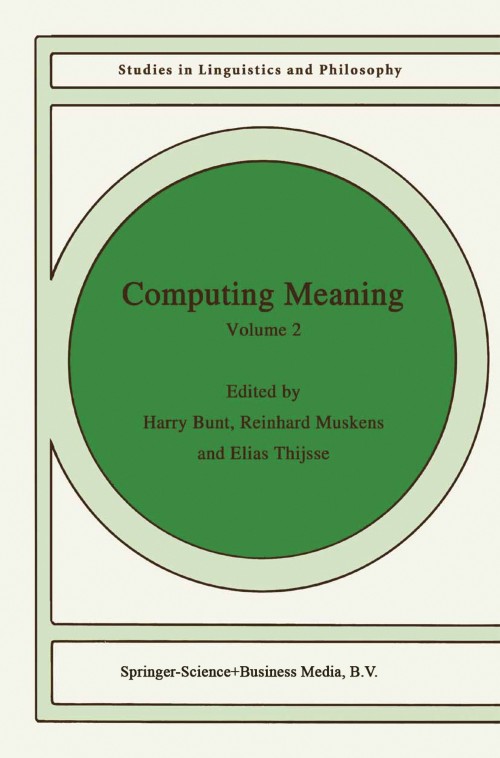
Computing Meaning [electronic resource] : Volume 2 / edited by H. Bunt, Reinhard Muskens, E. Thijsse.
Erişim Adresi
ISBN
9789401005722
Dil Kodu
İngilizce
Yer Numarası
DK/11266
Basım Bildirimi
1st ed. 2001.
Yayın Bilgisi
Dordrecht : Springer Netherlands : Imprint: Springer, 2001.
Fiziksel Niteleme
VI, 306 p. online resource.
Dizi
Studies in Linguistics and Philosophy, 2215-034X ; 77
İçindekiler Notu
From Lexical Items to Discourse Meaning: Computational and Representational Tools -- Inference and Computational Semantics -- Building a Semantic Lexicon: Structuring and Generating Concepts -- In Search of the Semantic Value of an Occurrence: An Example and a Framework -- Agent-dependent Metonymy in a Context-change Model of Communication -- Weak Lexical Semantics and Multiple Views -- Underspecified Lexical Conceptual Structures for Sense Variations -- The Availability of Partial Scopings in an Underspecified Semantic Representation -- Compositional Semantics with Lexicalized Tree-Adjoining Grammar (LTAG): How Much Underspecification is Necessary? -- Glue, Underspecification and Translation -- Two Functional Approaches for Interpreting D-Tree Grammar Derivations -- Tree Descriptions, Constraints and Incrementality -- Multiple Discourse Connectives in a Lexicalized Grammar for Discourse -- Fragmenting Meaning: Clarification Ellipsis and Nominal Anaphora -- Event Coreference between Two Sentences -- Authors’ Addresses -- Author Index.
Özet, vb.
This book is a collection of papers written by outstanding researchers in the newly emerging field of computational semantics. Computational semantics is concerned with the computation of the meanings of linguistic objects such as text fragments, spoken dialogue utterances, and e-mail messages. The meaning of such an object is determined partly by linguistic information and partly by information from the context in which the object occurs. The information from these sources is combined by processes that infer which interpretation of the object applies in the given context. This applies not only to notoriously difficult aspects of interpreting linguistic objects, such as indexicals, anaphora, and metonymy, but also to establishing the precise reference of common nouns and the scopes of noun phrases. The central issue in computational semantics is how processes of finding and combining the relevant linguistic and contextual information into contextually appropriate meanings can be organised. Traditional approaches of applying context information to disambiguated natural language expressions do not work well, due to the massive ambiguity in natural language. Recent work in computational semantics suggests, alternatively, to represent linguistic semantic information in formal structures with underspecification, and to apply context information in inference processes that result in further specification of these representations. Underspecified representation and inference are therefore the key topics in this book. The book is aimed at those linguists, computer scientists, and logicians who take an interest in the computation of meaning, and who want to know what is happening in this exciting field of research.
Konu
Semiotics.
Computational linguistics.
Logic.
Artificial intelligence.
Semiotics.
Computational Linguistics.
Logic.
Artificial Intelligence.
Computational linguistics.
Logic.
Artificial intelligence.
Semiotics.
Computational Linguistics.
Logic.
Artificial Intelligence.
Diğer Yazarlar
Kurum Adı
Eseri Alıntıla
Referansları kullanmadan önce gözden geçirmeniz ve varsa gerekli düzeltmeleri yapmanız önerilir.
Dijital Kaynak
MARC Görünümü
LEADER 05608nam a22006255i 4500
001 809983
003 TR_AnAIT
005 20260131021619
007 cr nn 008mamaa
008 121227s2001 ne | s |||| 0|eng d
020 |a9789401005722|9978-94-010-0572-2
024 7 |a10.1007/978-94-010-0572-2|2doi
041 |aeng
049 |aTürk Tarih Kurumu Kütüphanesi
050 4|aP99-99.4
072 7|aGTE|2bicssc
072 7|aLIT006000|2bisacsh
072 7|aGTD|2thema
082 04|a401.4|223
090 |aDK/11266
245 10|aComputing Meaning|h[electronic resource] :|bVolume 2 /|cedited by H. Bunt, Reinhard Muskens, E. Thijsse.
250 |a1st ed. 2001.
264 1|aDordrecht :|bSpringer Netherlands :|bImprint: Springer,|c2001.
300 |aVI, 306 p.|bonline resource.
336 |atext|btxt|2rdacontent
337 |acomputer|bc|2rdamedia
338 |aonline resource|bcr|2rdacarrier
347 |atext file|bPDF|2rda
490 1 |aStudies in Linguistics and Philosophy,|x2215-034X ;|v77
505 0 |aFrom Lexical Items to Discourse Meaning: Computational and Representational Tools -- Inference and Computational Semantics -- Building a Semantic Lexicon: Structuring and Generating Concepts -- In Search of the Semantic Value of an Occurrence: An Example and a Framework -- Agent-dependent Metonymy in a Context-change Model of Communication -- Weak Lexical Semantics and Multiple Views -- Underspecified Lexical Conceptual Structures for Sense Variations -- The Availability of Partial Scopings in an Underspecified Semantic Representation -- Compositional Semantics with Lexicalized Tree-Adjoining Grammar (LTAG): How Much Underspecification is Necessary? -- Glue, Underspecification and Translation -- Two Functional Approaches for Interpreting D-Tree Grammar Derivations -- Tree Descriptions, Constraints and Incrementality -- Multiple Discourse Connectives in a Lexicalized Grammar for Discourse -- Fragmenting Meaning: Clarification Ellipsis and Nominal Anaphora -- Event Coreference between Two Sentences -- Authors’ Addresses -- Author Index.
520 |aThis book is a collection of papers written by outstanding researchers in the newly emerging field of computational semantics. Computational semantics is concerned with the computation of the meanings of linguistic objects such as text fragments, spoken dialogue utterances, and e-mail messages. The meaning of such an object is determined partly by linguistic information and partly by information from the context in which the object occurs. The information from these sources is combined by processes that infer which interpretation of the object applies in the given context. This applies not only to notoriously difficult aspects of interpreting linguistic objects, such as indexicals, anaphora, and metonymy, but also to establishing the precise reference of common nouns and the scopes of noun phrases. The central issue in computational semantics is how processes of finding and combining the relevant linguistic and contextual information into contextually appropriate meanings can be organised. Traditional approaches of applying context information to disambiguated natural language expressions do not work well, due to the massive ambiguity in natural language. Recent work in computational semantics suggests, alternatively, to represent linguistic semantic information in formal structures with underspecification, and to apply context information in inference processes that result in further specification of these representations. Underspecified representation and inference are therefore the key topics in this book. The book is aimed at those linguists, computer scientists, and logicians who take an interest in the computation of meaning, and who want to know what is happening in this exciting field of research.
532 8 |aAccessibility summary: This PDF is not accessible. It is based on scanned pages and does not support features such as screen reader compatibility or described non-text content (images, graphs etc). However, it likely supports searchable and selectable text based on OCR (Optical Character Recognition). Users with accessibility needs may not be able to use this content effectively. Please contact us at accessibilitysupport@springernature.com if you require assistance or an alternative format.
532 8 |aInaccessible, or known limited accessibility
532 8 |aNo reading system accessibility options actively disabled
532 8 |aPublisher contact for further accessibility information: accessibilitysupport@springernature.com
650 0|aSemiotics.
650 0|aComputational linguistics.
650 0|aLogic.
650 0|aArtificial intelligence.
650 14|aSemiotics.
650 24|aComputational Linguistics.
650 24|aLogic.
650 24|aArtificial Intelligence.
700 1 |aBunt, H.|eeditor.|4edt|4http://id.loc.gov/vocabulary/relators/edt
700 1 |aMuskens, Reinhard.|eeditor.|4edt|4http://id.loc.gov/vocabulary/relators/edt
700 1 |aThijsse, E.|eeditor.|4edt|4http://id.loc.gov/vocabulary/relators/edt
710 2 |aSpringerLink (Online service)
773 0 |tSpringer Nature eBook
776 08|iPrinted edition:|z9781402001758
776 08|iPrinted edition:|z9781402004513
776 08|iPrinted edition:|z9789401005739
830 0|aStudies in Linguistics and Philosophy,|x2215-034X ;|v77
856 40|uhttps://doi.org/10.1007/978-94-010-0572-2
912 |aZDB-2-SHU
912 |aZDB-2-SXS
912 |aZDB-2-BAE
950 |aHumanities, Social Sciences and Law (SpringerNature-11648)
950 |aSocial Sciences (R0) (SpringerNature-43726)
001 809983
003 TR_AnAIT
005 20260131021619
007 cr nn 008mamaa
008 121227s2001 ne | s |||| 0|eng d
020 |a9789401005722|9978-94-010-0572-2
024 7 |a10.1007/978-94-010-0572-2|2doi
041 |aeng
049 |aTürk Tarih Kurumu Kütüphanesi
050 4|aP99-99.4
072 7|aGTE|2bicssc
072 7|aLIT006000|2bisacsh
072 7|aGTD|2thema
082 04|a401.4|223
090 |aDK/11266
245 10|aComputing Meaning|h[electronic resource] :|bVolume 2 /|cedited by H. Bunt, Reinhard Muskens, E. Thijsse.
250 |a1st ed. 2001.
264 1|aDordrecht :|bSpringer Netherlands :|bImprint: Springer,|c2001.
300 |aVI, 306 p.|bonline resource.
336 |atext|btxt|2rdacontent
337 |acomputer|bc|2rdamedia
338 |aonline resource|bcr|2rdacarrier
347 |atext file|bPDF|2rda
490 1 |aStudies in Linguistics and Philosophy,|x2215-034X ;|v77
505 0 |aFrom Lexical Items to Discourse Meaning: Computational and Representational Tools -- Inference and Computational Semantics -- Building a Semantic Lexicon: Structuring and Generating Concepts -- In Search of the Semantic Value of an Occurrence: An Example and a Framework -- Agent-dependent Metonymy in a Context-change Model of Communication -- Weak Lexical Semantics and Multiple Views -- Underspecified Lexical Conceptual Structures for Sense Variations -- The Availability of Partial Scopings in an Underspecified Semantic Representation -- Compositional Semantics with Lexicalized Tree-Adjoining Grammar (LTAG): How Much Underspecification is Necessary? -- Glue, Underspecification and Translation -- Two Functional Approaches for Interpreting D-Tree Grammar Derivations -- Tree Descriptions, Constraints and Incrementality -- Multiple Discourse Connectives in a Lexicalized Grammar for Discourse -- Fragmenting Meaning: Clarification Ellipsis and Nominal Anaphora -- Event Coreference between Two Sentences -- Authors’ Addresses -- Author Index.
520 |aThis book is a collection of papers written by outstanding researchers in the newly emerging field of computational semantics. Computational semantics is concerned with the computation of the meanings of linguistic objects such as text fragments, spoken dialogue utterances, and e-mail messages. The meaning of such an object is determined partly by linguistic information and partly by information from the context in which the object occurs. The information from these sources is combined by processes that infer which interpretation of the object applies in the given context. This applies not only to notoriously difficult aspects of interpreting linguistic objects, such as indexicals, anaphora, and metonymy, but also to establishing the precise reference of common nouns and the scopes of noun phrases. The central issue in computational semantics is how processes of finding and combining the relevant linguistic and contextual information into contextually appropriate meanings can be organised. Traditional approaches of applying context information to disambiguated natural language expressions do not work well, due to the massive ambiguity in natural language. Recent work in computational semantics suggests, alternatively, to represent linguistic semantic information in formal structures with underspecification, and to apply context information in inference processes that result in further specification of these representations. Underspecified representation and inference are therefore the key topics in this book. The book is aimed at those linguists, computer scientists, and logicians who take an interest in the computation of meaning, and who want to know what is happening in this exciting field of research.
532 8 |aAccessibility summary: This PDF is not accessible. It is based on scanned pages and does not support features such as screen reader compatibility or described non-text content (images, graphs etc). However, it likely supports searchable and selectable text based on OCR (Optical Character Recognition). Users with accessibility needs may not be able to use this content effectively. Please contact us at accessibilitysupport@springernature.com if you require assistance or an alternative format.
532 8 |aInaccessible, or known limited accessibility
532 8 |aNo reading system accessibility options actively disabled
532 8 |aPublisher contact for further accessibility information: accessibilitysupport@springernature.com
650 0|aSemiotics.
650 0|aComputational linguistics.
650 0|aLogic.
650 0|aArtificial intelligence.
650 14|aSemiotics.
650 24|aComputational Linguistics.
650 24|aLogic.
650 24|aArtificial Intelligence.
700 1 |aBunt, H.|eeditor.|4edt|4http://id.loc.gov/vocabulary/relators/edt
700 1 |aMuskens, Reinhard.|eeditor.|4edt|4http://id.loc.gov/vocabulary/relators/edt
700 1 |aThijsse, E.|eeditor.|4edt|4http://id.loc.gov/vocabulary/relators/edt
710 2 |aSpringerLink (Online service)
773 0 |tSpringer Nature eBook
776 08|iPrinted edition:|z9781402001758
776 08|iPrinted edition:|z9781402004513
776 08|iPrinted edition:|z9789401005739
830 0|aStudies in Linguistics and Philosophy,|x2215-034X ;|v77
856 40|uhttps://doi.org/10.1007/978-94-010-0572-2
912 |aZDB-2-SHU
912 |aZDB-2-SXS
912 |aZDB-2-BAE
950 |aHumanities, Social Sciences and Law (SpringerNature-11648)
950 |aSocial Sciences (R0) (SpringerNature-43726)
Materyaller
Depodan talep edilen materyal sadece kütüphane içerisinde kullanılmaktadır.
Materyal dışarıya ödünç verilmemektedir.
Materyal dışarıya ödünç verilmemektedir.
