

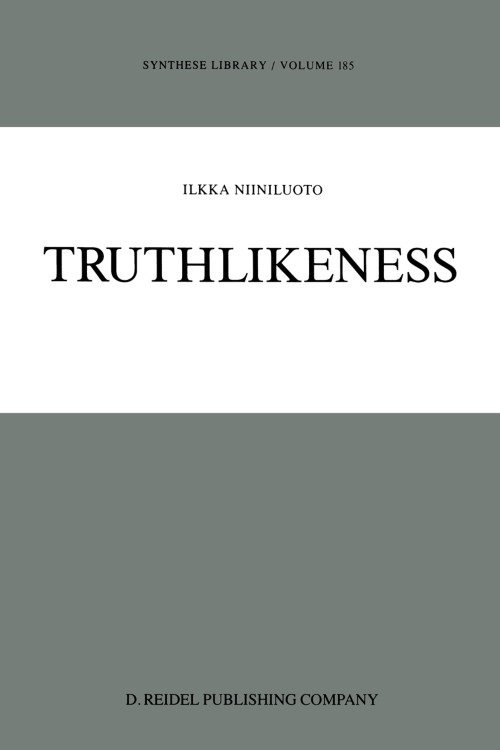
Truthlikeness [electronic resource] / by I. Niiniluoto.
Erişim Adresi
ISBN
9789400937390
Dil Kodu
İngilizce
Yer Numarası
DK/11284
Yazar
Basım Bildirimi
1st ed. 1987.
Yayın Bilgisi
Dordrecht : Springer Netherlands : Imprint: Springer, 1987.
Fiziksel Niteleme
XVII, 525 p. online resource.
Dizi
Synthese Library, Studies in Epistemology, Logic, Methodology, and Philosophy of Science, 2542-8292 ; 185
İçindekiler Notu
1. Distance and Similarity -- 1.1. Metric Spaces and Distances -- 1.2. Topological Spaces and Uniformities -- 1.3. Degrees of Similarity -- 1.4. The Pragmatic Relativity of Similarity Relations -- 2. Logical Tools -- 2.1. Monadic Languages NL -- 2.2. Q-Predicates -- 2.3. State Descriptions -- 2.4. Structure Descriptions -- 2.5. Monadic Constituents -- 2.6. Monadic Languages with Identity -- 2.7. Polyadic Constituents -- 2.8. Distributive Normal Forms -- 2.9. First-Order Theories -- 2.10. Inductive Logic -- 2.11. Nomic Constituents -- 3. Quantities, State Spaces, and Laws -- 3.1. Quantities and Metrization -- 3.2. From Conceptual Systems to State Spaces -- 3.3. Laws of Coexistence -- 3.4. Laws of Succession -- 3.5. Probabilistic Laws -- 4. Cognitive Problems, Truth, and Information -- 4.1. Open and Closed Questions -- 4.2. Cognitive Problems -- 4.3. Truth -- 4.4. Vagueness -- 4.5. Semantic Information -- 5. The Concept of Truthlikeness -- 5.1. Truth, Error, and Fallibilism -- 5.2. Probability and Verisimilitude -- 5.3. Approach to the Truth -- 5.4. Truth: Parts and Degrees -- 5.5. Degrees of Truth: Attempted Definitions -- 5.6. Popper’s Qualitative Theory of Truth-likeness -- 5.7. Quantitative Measures of Verisimilitude -- 6. The Similarity Approach to TruthLikeness -- 6.1. Spheres of Similarity -- 6.2. Targets -- 6.3. Distance on Cognitive Problems -- 6.4. Closeness to the Truth -- 6.5. Degrees of Truthlikeness -- 6.6. Comparison with the Tichý—Oddie Approach -- 6.7. Distance between Statements -- 6.8. Distance from Indefinite Truth -- 6.9. Cognitive Problems with False Presuppositions -- 7. Estimation of Truthlikeness -- 7.1. The Epistemic Problem of Truthlikeness -- 7.2. Estimated Degrees of Truthlikeness -- 7.3. Probable Verisimilitude -- 7.4. Errors of Observation -- 7.5. Counterfactual Presuppositions andApproximate Validity -- 8. Singular Statements -- 8.1. Simple Qualitative Singular Statements -- 8.2. Distance between State Descriptions -- 8.3. Distance between Structure Descriptions -- 8.4. Quantitative Singular Statements -- 9. Monadic Generalizations -- 9.1. Distance between Monadic Constituents -- 9.2. Monadic Constituents with Identity -- 9.3. Tichý—Oddie Distances -- 9.4. Existential and Universal Generalizations -- 9.5. Estimation Problem for Generalizations -- 10. Polyadic Theories -- 10.1. Distance between Polyadic Constituents -- 10.2. Complete Theories -- 10.3. Distance between Possible Worlds -- 10.4. First-Order Theories -- 11. Legisimilitude -- 11.1. Verisimilitude vs Legisimilitude -- 11.2. Distance between Nomic Constituents -- 11.3. Distance between Quantitative Laws -- 11.4. Approximation and Idealization -- 11.5. Probabilistic Laws -- 12. Verisimilitude as an Epistemic Utility -- 12.1. Cognitive Decision Theory -- 12.2. Epistemic Utilities: Truth, Information, and Truthlikeness -- 12.3. Comparison with Levi’s Theory -- 12.4. Theoretical and Pragmatic Preference -- 12.5. Bayesian Estimation -- 13. Objections Answered -- 13.1. Verisimilitude as a Programme -- 13.2. The Problem of Linguistic Variance -- 13.3. Progress and Incommensurability -- 13.4. Truthlikeness and Logical Pragmatics -- Notes -- Index of Names -- Index of Subjects.
Özet, vb.
The modern discussion on the concept of truthlikeness was started in 1960. In his influential Word and Object, W. V. O. Quine argued that Charles Peirce's definition of truth as the limit of inquiry is faulty for the reason that the notion 'nearer than' is only "defined for numbers and not for theories". In his contribution to the 1960 International Congress for Logic, Methodology, and Philosophy of Science at Stan ford, Karl Popper defended the opposite view by defining a compara tive notion of verisimilitude for theories. was originally introduced by the The concept of verisimilitude Ancient sceptics to moderate their radical thesis of the inaccessibility of truth. But soon verisimilitudo, indicating likeness to the truth, was confused with probabilitas, which expresses an opiniotative attitude weaker than full certainty. The idea of truthlikeness fell in disrepute also as a result of the careless, often confused and metaphysically loaded way in which many philosophers used - and still use - such concepts as 'degree of truth', 'approximate truth', 'partial truth', and 'approach to the truth'. Popper's great achievement was his insight that the criticism against truthlikeness - by those who urge that it is meaningless to speak about 'closeness to truth' - is more based on prejudice than argument.
Konu
Logic.
Linguistics.
Mathematical logic.
Logic.
Theoretical Linguistics / Grammar.
Mathematical Logic and Foundations.
Linguistics.
Mathematical logic.
Logic.
Theoretical Linguistics / Grammar.
Mathematical Logic and Foundations.
Kurum Adı
Eseri Alıntıla
Referansları kullanmadan önce gözden geçirmeniz ve varsa gerekli düzeltmeleri yapmanız önerilir.
Dijital Kaynak
MARC Görünümü
LEADER 07210nam a22005775i 4500
001 810001
003 TR_AnAIT
005 20260131021601
007 cr nn 008mamaa
008 121227s1987 ne | s |||| 0|eng d
020 |a9789400937390|9978-94-009-3739-0
024 7 |a10.1007/978-94-009-3739-0|2doi
041 |aeng
049 |aTürk Tarih Kurumu Kütüphanesi
050 4|aBC1-199
072 7|aHPL|2bicssc
072 7|aPHI011000|2bisacsh
072 7|aQDTL|2thema
082 04|a160|223
090 |aDK/11284
100 1 |aNiiniluoto, I.|eauthor.|4aut|4http://id.loc.gov/vocabulary/relators/aut
245 10|aTruthlikeness|h[electronic resource] /|cby I. Niiniluoto.
250 |a1st ed. 1987.
264 1|aDordrecht :|bSpringer Netherlands :|bImprint: Springer,|c1987.
300 |aXVII, 525 p.|bonline resource.
336 |atext|btxt|2rdacontent
337 |acomputer|bc|2rdamedia
338 |aonline resource|bcr|2rdacarrier
347 |atext file|bPDF|2rda
490 1 |aSynthese Library, Studies in Epistemology, Logic, Methodology, and Philosophy of Science,|x2542-8292 ;|v185
505 0 |a1. Distance and Similarity -- 1.1. Metric Spaces and Distances -- 1.2. Topological Spaces and Uniformities -- 1.3. Degrees of Similarity -- 1.4. The Pragmatic Relativity of Similarity Relations -- 2. Logical Tools -- 2.1. Monadic Languages NL -- 2.2. Q-Predicates -- 2.3. State Descriptions -- 2.4. Structure Descriptions -- 2.5. Monadic Constituents -- 2.6. Monadic Languages with Identity -- 2.7. Polyadic Constituents -- 2.8. Distributive Normal Forms -- 2.9. First-Order Theories -- 2.10. Inductive Logic -- 2.11. Nomic Constituents -- 3. Quantities, State Spaces, and Laws -- 3.1. Quantities and Metrization -- 3.2. From Conceptual Systems to State Spaces -- 3.3. Laws of Coexistence -- 3.4. Laws of Succession -- 3.5. Probabilistic Laws -- 4. Cognitive Problems, Truth, and Information -- 4.1. Open and Closed Questions -- 4.2. Cognitive Problems -- 4.3. Truth -- 4.4. Vagueness -- 4.5. Semantic Information -- 5. The Concept of Truthlikeness -- 5.1. Truth, Error, and Fallibilism -- 5.2. Probability and Verisimilitude -- 5.3. Approach to the Truth -- 5.4. Truth: Parts and Degrees -- 5.5. Degrees of Truth: Attempted Definitions -- 5.6. Popper’s Qualitative Theory of Truth-likeness -- 5.7. Quantitative Measures of Verisimilitude -- 6. The Similarity Approach to TruthLikeness -- 6.1. Spheres of Similarity -- 6.2. Targets -- 6.3. Distance on Cognitive Problems -- 6.4. Closeness to the Truth -- 6.5. Degrees of Truthlikeness -- 6.6. Comparison with the Tichý—Oddie Approach -- 6.7. Distance between Statements -- 6.8. Distance from Indefinite Truth -- 6.9. Cognitive Problems with False Presuppositions -- 7. Estimation of Truthlikeness -- 7.1. The Epistemic Problem of Truthlikeness -- 7.2. Estimated Degrees of Truthlikeness -- 7.3. Probable Verisimilitude -- 7.4. Errors of Observation -- 7.5. Counterfactual Presuppositions andApproximate Validity -- 8. Singular Statements -- 8.1. Simple Qualitative Singular Statements -- 8.2. Distance between State Descriptions -- 8.3. Distance between Structure Descriptions -- 8.4. Quantitative Singular Statements -- 9. Monadic Generalizations -- 9.1. Distance between Monadic Constituents -- 9.2. Monadic Constituents with Identity -- 9.3. Tichý—Oddie Distances -- 9.4. Existential and Universal Generalizations -- 9.5. Estimation Problem for Generalizations -- 10. Polyadic Theories -- 10.1. Distance between Polyadic Constituents -- 10.2. Complete Theories -- 10.3. Distance between Possible Worlds -- 10.4. First-Order Theories -- 11. Legisimilitude -- 11.1. Verisimilitude vs Legisimilitude -- 11.2. Distance between Nomic Constituents -- 11.3. Distance between Quantitative Laws -- 11.4. Approximation and Idealization -- 11.5. Probabilistic Laws -- 12. Verisimilitude as an Epistemic Utility -- 12.1. Cognitive Decision Theory -- 12.2. Epistemic Utilities: Truth, Information, and Truthlikeness -- 12.3. Comparison with Levi’s Theory -- 12.4. Theoretical and Pragmatic Preference -- 12.5. Bayesian Estimation -- 13. Objections Answered -- 13.1. Verisimilitude as a Programme -- 13.2. The Problem of Linguistic Variance -- 13.3. Progress and Incommensurability -- 13.4. Truthlikeness and Logical Pragmatics -- Notes -- Index of Names -- Index of Subjects.
520 |aThe modern discussion on the concept of truthlikeness was started in 1960. In his influential Word and Object, W. V. O. Quine argued that Charles Peirce's definition of truth as the limit of inquiry is faulty for the reason that the notion 'nearer than' is only "defined for numbers and not for theories". In his contribution to the 1960 International Congress for Logic, Methodology, and Philosophy of Science at Stan ford, Karl Popper defended the opposite view by defining a compara tive notion of verisimilitude for theories. was originally introduced by the The concept of verisimilitude Ancient sceptics to moderate their radical thesis of the inaccessibility of truth. But soon verisimilitudo, indicating likeness to the truth, was confused with probabilitas, which expresses an opiniotative attitude weaker than full certainty. The idea of truthlikeness fell in disrepute also as a result of the careless, often confused and metaphysically loaded way in which many philosophers used - and still use - such concepts as 'degree of truth', 'approximate truth', 'partial truth', and 'approach to the truth'. Popper's great achievement was his insight that the criticism against truthlikeness - by those who urge that it is meaningless to speak about 'closeness to truth' - is more based on prejudice than argument.
532 8 |aAccessibility summary: This PDF is not accessible. It is based on scanned pages and does not support features such as screen reader compatibility or described non-text content (images, graphs etc). However, it likely supports searchable and selectable text based on OCR (Optical Character Recognition). Users with accessibility needs may not be able to use this content effectively. Please contact us at accessibilitysupport@springernature.com if you require assistance or an alternative format.
532 8 |aInaccessible, or known limited accessibility
532 8 |aNo reading system accessibility options actively disabled
532 8 |aPublisher contact for further accessibility information: accessibilitysupport@springernature.com
650 0|aLogic.
650 0|aLinguistics.
650 0|aMathematical logic.
650 14|aLogic.
650 24|aTheoretical Linguistics / Grammar.
650 24|aMathematical Logic and Foundations.
710 2 |aSpringerLink (Online service)
773 0 |tSpringer Nature eBook
776 08|iPrinted edition:|z9789027723543
776 08|iPrinted edition:|z9789400937406
776 08|iPrinted edition:|z9789401081702
830 0|aSynthese Library, Studies in Epistemology, Logic, Methodology, and Philosophy of Science,|x2542-8292 ;|v185
856 40|uhttps://doi.org/10.1007/978-94-009-3739-0
912 |aZDB-2-SHU
912 |aZDB-2-SXPR
912 |aZDB-2-BAE
950 |aHumanities, Social Sciences and Law (SpringerNature-11648)
950 |aPhilosophy and Religion (R0) (SpringerNature-43725)
001 810001
003 TR_AnAIT
005 20260131021601
007 cr nn 008mamaa
008 121227s1987 ne | s |||| 0|eng d
020 |a9789400937390|9978-94-009-3739-0
024 7 |a10.1007/978-94-009-3739-0|2doi
041 |aeng
049 |aTürk Tarih Kurumu Kütüphanesi
050 4|aBC1-199
072 7|aHPL|2bicssc
072 7|aPHI011000|2bisacsh
072 7|aQDTL|2thema
082 04|a160|223
090 |aDK/11284
100 1 |aNiiniluoto, I.|eauthor.|4aut|4http://id.loc.gov/vocabulary/relators/aut
245 10|aTruthlikeness|h[electronic resource] /|cby I. Niiniluoto.
250 |a1st ed. 1987.
264 1|aDordrecht :|bSpringer Netherlands :|bImprint: Springer,|c1987.
300 |aXVII, 525 p.|bonline resource.
336 |atext|btxt|2rdacontent
337 |acomputer|bc|2rdamedia
338 |aonline resource|bcr|2rdacarrier
347 |atext file|bPDF|2rda
490 1 |aSynthese Library, Studies in Epistemology, Logic, Methodology, and Philosophy of Science,|x2542-8292 ;|v185
505 0 |a1. Distance and Similarity -- 1.1. Metric Spaces and Distances -- 1.2. Topological Spaces and Uniformities -- 1.3. Degrees of Similarity -- 1.4. The Pragmatic Relativity of Similarity Relations -- 2. Logical Tools -- 2.1. Monadic Languages NL -- 2.2. Q-Predicates -- 2.3. State Descriptions -- 2.4. Structure Descriptions -- 2.5. Monadic Constituents -- 2.6. Monadic Languages with Identity -- 2.7. Polyadic Constituents -- 2.8. Distributive Normal Forms -- 2.9. First-Order Theories -- 2.10. Inductive Logic -- 2.11. Nomic Constituents -- 3. Quantities, State Spaces, and Laws -- 3.1. Quantities and Metrization -- 3.2. From Conceptual Systems to State Spaces -- 3.3. Laws of Coexistence -- 3.4. Laws of Succession -- 3.5. Probabilistic Laws -- 4. Cognitive Problems, Truth, and Information -- 4.1. Open and Closed Questions -- 4.2. Cognitive Problems -- 4.3. Truth -- 4.4. Vagueness -- 4.5. Semantic Information -- 5. The Concept of Truthlikeness -- 5.1. Truth, Error, and Fallibilism -- 5.2. Probability and Verisimilitude -- 5.3. Approach to the Truth -- 5.4. Truth: Parts and Degrees -- 5.5. Degrees of Truth: Attempted Definitions -- 5.6. Popper’s Qualitative Theory of Truth-likeness -- 5.7. Quantitative Measures of Verisimilitude -- 6. The Similarity Approach to TruthLikeness -- 6.1. Spheres of Similarity -- 6.2. Targets -- 6.3. Distance on Cognitive Problems -- 6.4. Closeness to the Truth -- 6.5. Degrees of Truthlikeness -- 6.6. Comparison with the Tichý—Oddie Approach -- 6.7. Distance between Statements -- 6.8. Distance from Indefinite Truth -- 6.9. Cognitive Problems with False Presuppositions -- 7. Estimation of Truthlikeness -- 7.1. The Epistemic Problem of Truthlikeness -- 7.2. Estimated Degrees of Truthlikeness -- 7.3. Probable Verisimilitude -- 7.4. Errors of Observation -- 7.5. Counterfactual Presuppositions andApproximate Validity -- 8. Singular Statements -- 8.1. Simple Qualitative Singular Statements -- 8.2. Distance between State Descriptions -- 8.3. Distance between Structure Descriptions -- 8.4. Quantitative Singular Statements -- 9. Monadic Generalizations -- 9.1. Distance between Monadic Constituents -- 9.2. Monadic Constituents with Identity -- 9.3. Tichý—Oddie Distances -- 9.4. Existential and Universal Generalizations -- 9.5. Estimation Problem for Generalizations -- 10. Polyadic Theories -- 10.1. Distance between Polyadic Constituents -- 10.2. Complete Theories -- 10.3. Distance between Possible Worlds -- 10.4. First-Order Theories -- 11. Legisimilitude -- 11.1. Verisimilitude vs Legisimilitude -- 11.2. Distance between Nomic Constituents -- 11.3. Distance between Quantitative Laws -- 11.4. Approximation and Idealization -- 11.5. Probabilistic Laws -- 12. Verisimilitude as an Epistemic Utility -- 12.1. Cognitive Decision Theory -- 12.2. Epistemic Utilities: Truth, Information, and Truthlikeness -- 12.3. Comparison with Levi’s Theory -- 12.4. Theoretical and Pragmatic Preference -- 12.5. Bayesian Estimation -- 13. Objections Answered -- 13.1. Verisimilitude as a Programme -- 13.2. The Problem of Linguistic Variance -- 13.3. Progress and Incommensurability -- 13.4. Truthlikeness and Logical Pragmatics -- Notes -- Index of Names -- Index of Subjects.
520 |aThe modern discussion on the concept of truthlikeness was started in 1960. In his influential Word and Object, W. V. O. Quine argued that Charles Peirce's definition of truth as the limit of inquiry is faulty for the reason that the notion 'nearer than' is only "defined for numbers and not for theories". In his contribution to the 1960 International Congress for Logic, Methodology, and Philosophy of Science at Stan ford, Karl Popper defended the opposite view by defining a compara tive notion of verisimilitude for theories. was originally introduced by the The concept of verisimilitude Ancient sceptics to moderate their radical thesis of the inaccessibility of truth. But soon verisimilitudo, indicating likeness to the truth, was confused with probabilitas, which expresses an opiniotative attitude weaker than full certainty. The idea of truthlikeness fell in disrepute also as a result of the careless, often confused and metaphysically loaded way in which many philosophers used - and still use - such concepts as 'degree of truth', 'approximate truth', 'partial truth', and 'approach to the truth'. Popper's great achievement was his insight that the criticism against truthlikeness - by those who urge that it is meaningless to speak about 'closeness to truth' - is more based on prejudice than argument.
532 8 |aAccessibility summary: This PDF is not accessible. It is based on scanned pages and does not support features such as screen reader compatibility or described non-text content (images, graphs etc). However, it likely supports searchable and selectable text based on OCR (Optical Character Recognition). Users with accessibility needs may not be able to use this content effectively. Please contact us at accessibilitysupport@springernature.com if you require assistance or an alternative format.
532 8 |aInaccessible, or known limited accessibility
532 8 |aNo reading system accessibility options actively disabled
532 8 |aPublisher contact for further accessibility information: accessibilitysupport@springernature.com
650 0|aLogic.
650 0|aLinguistics.
650 0|aMathematical logic.
650 14|aLogic.
650 24|aTheoretical Linguistics / Grammar.
650 24|aMathematical Logic and Foundations.
710 2 |aSpringerLink (Online service)
773 0 |tSpringer Nature eBook
776 08|iPrinted edition:|z9789027723543
776 08|iPrinted edition:|z9789400937406
776 08|iPrinted edition:|z9789401081702
830 0|aSynthese Library, Studies in Epistemology, Logic, Methodology, and Philosophy of Science,|x2542-8292 ;|v185
856 40|uhttps://doi.org/10.1007/978-94-009-3739-0
912 |aZDB-2-SHU
912 |aZDB-2-SXPR
912 |aZDB-2-BAE
950 |aHumanities, Social Sciences and Law (SpringerNature-11648)
950 |aPhilosophy and Religion (R0) (SpringerNature-43725)
Materyaller
Depodan talep edilen materyal sadece kütüphane içerisinde kullanılmaktadır.
Materyal dışarıya ödünç verilmemektedir.
Materyal dışarıya ödünç verilmemektedir.
