

Multiple Perspectives on Problem Solving and Learning in the Digital Age [electronic resource] / edited by Dirk Ifenthaler, J. Michael Spector, Kinshuk, Pedro Isaias, Demetrios G. Sampson.
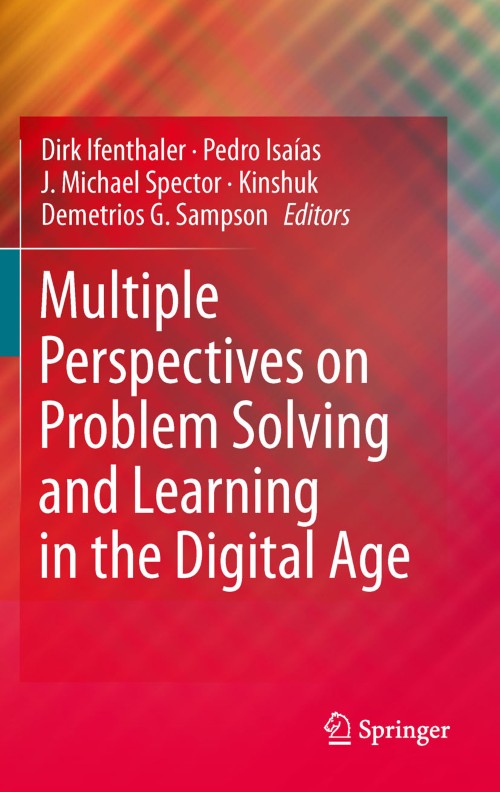
Erişim Adresi
ISBN
9781441976123
Dil Kodu
İngilizce
Yer Numarası
DK/11286
Basım Bildirimi
1st ed. 2011.
Yayın Bilgisi
New York, NY : Springer New York : Imprint: Springer, 2011.
Fiziksel Niteleme
XIX, 398 p. online resource.
İçindekiler Notu
Investigating an online museum’s information system -- A framework for matching aims, processes, learner expertise and technologies -- Web-based learning objects in school education -- A monitoring and experience sharing tool.– Constructing a knowledge base according to a text comprehension model -- First-person education and the nature of knowing, understanding, and affect -- Socio-cognitive regulation strategies in cooperative learning tasks in virtual contexts -- Collaborative cognitive tools for shared representations -- Automating the measurement of critical thinking for individuals particIpating in discussion forums -- Alternative assessment strategies for complex problem solving in game-based learning environments -- Concept map based intelligent knowledge assessment system: experience of development and practical use -- Technologies to support the assessment of complex learning in capstone units: Two case studies -- Text-guided automated self -- Comparing the impact of electronic performance support and web-based training -- Moving beyond teaching and learning into a human development paradigm -- Leaders for the 21st century: Preparation, experiences, and roles in technology implementation -- Pedagogy and content knowledge based podcasting project for preservice teachers -- Simulation game as a learning experience: An analysis of learning style and attitude -- Implementation of an online social annotation tool in a college english course -- Self-direction indicators for evaluating the design-based elearning course with social software -- Employing virtual collaborative exchanges to expand global awareness -- Ideas and concepts of ViCaDiS – A virtual learning environment for digital students.
Özet, vb.
Multiple Perspectives on Problem-Solving and Learning in the Digital Age Dirk Ifenthaler, Kinshuk, Pedro Isaias, Demetrios G. Sampson, J. Michael Spector, editors Have computers made problem-solving easier? The answer is a resounding yes and no: while we can access more information and increasingly sophisticated search engines, problems themselves are more complicated, and often more vague. Accordingly, new strategies for teaching problem-solving should be technologically astute, engage learners, and encourage progressive development of skills. The perspectives represented in Multiple Perspectives on Problem-Solving and Learning in the Digital Age include instructional design, cognition, assessment, schooling/teaching, and virtual environments, with emphasis on technologies that not only promote problem-solving, but also address new problems created by rapidly changing technology. Innovative new tools such as MAPLET (a learner-focused framework for integrating technology into curricula), the virtual learning environment ViCaDiS, and interactive online museum exhibits demonstrate the complex nature of problem-solving and the diverse ways in which learners—and instructors—achieve expertise. A sampling of the topics covered: • Pedagogical usability issues in Web-based learning objects. • Collaborative cognitive tools for shared representation. • Automated measurement of critical thinking for discussion forum participants. • Expanding global awareness with virtual collaboration. • Simulation games as learning experience. • Beyond teaching and learning: the human development paradigm. Multiple Perspectives on Problem-Solving and Learning in the Digital Age re-draws the boundaries of curriculum design and distributed knowledge. This volume will be a welcome addition to education libraries, and a forward-looking reference for academics and professionals in the field of technology integration in learning and instruction.
Konu
Educational technology.
Educational psychology.
Learning, Psychology of.
Digital Education and Educational Technology.
Educational Psychology.
Instructional Psychology.
Educational psychology.
Learning, Psychology of.
Digital Education and Educational Technology.
Educational Psychology.
Instructional Psychology.
Diğer Yazarlar
Kurum Adı
Eseri Alıntıla
Referansları kullanmadan önce gözden geçirmeniz ve varsa gerekli düzeltmeleri yapmanız önerilir.
Dijital Kaynak
MARC Görünümü
LEADER 06060nam a22005415i 4500
001 810003
003 TR_AnAIT
005 20260131021557
007 cr nn 008mamaa
008 101113s2011 xxu| s |||| 0|eng d
020 |a9781441976123|9978-1-4419-7612-3
024 7 |a10.1007/978-1-4419-7612-3|2doi
041 |aeng
049 |aTürk Tarih Kurumu Kütüphanesi
050 4|aLB1028.3
072 7|aJNV|2bicssc
072 7|aEDU000000|2bisacsh
072 7|aJNV|2thema
082 04|a371.33|223
090 |aDK/11286
245 10|aMultiple Perspectives on Problem Solving and Learning in the Digital Age|h[electronic resource] /|cedited by Dirk Ifenthaler, J. Michael Spector, Kinshuk, Pedro Isaias, Demetrios G. Sampson.
250 |a1st ed. 2011.
264 1|aNew York, NY :|bSpringer New York :|bImprint: Springer,|c2011.
300 |aXIX, 398 p.|bonline resource.
336 |atext|btxt|2rdacontent
337 |acomputer|bc|2rdamedia
338 |aonline resource|bcr|2rdacarrier
347 |atext file|bPDF|2rda
505 0 |aInvestigating an online museum’s information system -- A framework for matching aims, processes, learner expertise and technologies -- Web-based learning objects in school education -- A monitoring and experience sharing tool.– Constructing a knowledge base according to a text comprehension model -- First-person education and the nature of knowing, understanding, and affect -- Socio-cognitive regulation strategies in cooperative learning tasks in virtual contexts -- Collaborative cognitive tools for shared representations -- Automating the measurement of critical thinking for individuals particIpating in discussion forums -- Alternative assessment strategies for complex problem solving in game-based learning environments -- Concept map based intelligent knowledge assessment system: experience of development and practical use -- Technologies to support the assessment of complex learning in capstone units: Two case studies -- Text-guided automated self -- Comparing the impact of electronic performance support and web-based training -- Moving beyond teaching and learning into a human development paradigm -- Leaders for the 21st century: Preparation, experiences, and roles in technology implementation -- Pedagogy and content knowledge based podcasting project for preservice teachers -- Simulation game as a learning experience: An analysis of learning style and attitude -- Implementation of an online social annotation tool in a college english course -- Self-direction indicators for evaluating the design-based elearning course with social software -- Employing virtual collaborative exchanges to expand global awareness -- Ideas and concepts of ViCaDiS – A virtual learning environment for digital students.
520 |aMultiple Perspectives on Problem-Solving and Learning in the Digital Age Dirk Ifenthaler, Kinshuk, Pedro Isaias, Demetrios G. Sampson, J. Michael Spector, editors Have computers made problem-solving easier? The answer is a resounding yes and no: while we can access more information and increasingly sophisticated search engines, problems themselves are more complicated, and often more vague. Accordingly, new strategies for teaching problem-solving should be technologically astute, engage learners, and encourage progressive development of skills. The perspectives represented in Multiple Perspectives on Problem-Solving and Learning in the Digital Age include instructional design, cognition, assessment, schooling/teaching, and virtual environments, with emphasis on technologies that not only promote problem-solving, but also address new problems created by rapidly changing technology. Innovative new tools such as MAPLET (a learner-focused framework for integrating technology into curricula), the virtual learning environment ViCaDiS, and interactive online museum exhibits demonstrate the complex nature of problem-solving and the diverse ways in which learners—and instructors—achieve expertise. A sampling of the topics covered: • Pedagogical usability issues in Web-based learning objects. • Collaborative cognitive tools for shared representation. • Automated measurement of critical thinking for discussion forum participants. • Expanding global awareness with virtual collaboration. • Simulation games as learning experience. • Beyond teaching and learning: the human development paradigm. Multiple Perspectives on Problem-Solving and Learning in the Digital Age re-draws the boundaries of curriculum design and distributed knowledge. This volume will be a welcome addition to education libraries, and a forward-looking reference for academics and professionals in the field of technology integration in learning and instruction.
650 0|aEducational technology.
650 0|aEducational psychology.
650 0|aLearning, Psychology of.
650 14|aDigital Education and Educational Technology.
650 24|aEducational Psychology.
650 24|aInstructional Psychology.
700 1 |aIfenthaler, Dirk.|eeditor.|0(orcid)0000-0002-2446-6548|1https://orcid.org/0000-0002-2446-6548|4edt|4http://id.loc.gov/vocabulary/relators/edt
700 1 |aSpector, J. Michael.|eeditor.|0(orcid)0000-0002-6270-3073|1https://orcid.org/0000-0002-6270-3073|4edt|4http://id.loc.gov/vocabulary/relators/edt
700 1 |aKinshuk.|eeditor.|4edt|4http://id.loc.gov/vocabulary/relators/edt
700 1 |aIsaias, Pedro.|eeditor.|4edt|4http://id.loc.gov/vocabulary/relators/edt
700 1 |aSampson, Demetrios G.|eeditor.|0(orcid)0000-0002-0174-0137|1https://orcid.org/0000-0002-0174-0137|4edt|4http://id.loc.gov/vocabulary/relators/edt
710 2 |aSpringerLink (Online service)
773 0 |tSpringer Nature eBook
776 08|iPrinted edition:|z9781441976116
776 08|iPrinted edition:|z9781441976130
776 08|iPrinted edition:|z9781489981769
856 40|uhttps://doi.org/10.1007/978-1-4419-7612-3
912 |aZDB-2-SHU
912 |aZDB-2-SXED
950 |aHumanities, Social Sciences and Law (SpringerNature-11648)
950 |aEducation (R0) (SpringerNature-43721)
001 810003
003 TR_AnAIT
005 20260131021557
007 cr nn 008mamaa
008 101113s2011 xxu| s |||| 0|eng d
020 |a9781441976123|9978-1-4419-7612-3
024 7 |a10.1007/978-1-4419-7612-3|2doi
041 |aeng
049 |aTürk Tarih Kurumu Kütüphanesi
050 4|aLB1028.3
072 7|aJNV|2bicssc
072 7|aEDU000000|2bisacsh
072 7|aJNV|2thema
082 04|a371.33|223
090 |aDK/11286
245 10|aMultiple Perspectives on Problem Solving and Learning in the Digital Age|h[electronic resource] /|cedited by Dirk Ifenthaler, J. Michael Spector, Kinshuk, Pedro Isaias, Demetrios G. Sampson.
250 |a1st ed. 2011.
264 1|aNew York, NY :|bSpringer New York :|bImprint: Springer,|c2011.
300 |aXIX, 398 p.|bonline resource.
336 |atext|btxt|2rdacontent
337 |acomputer|bc|2rdamedia
338 |aonline resource|bcr|2rdacarrier
347 |atext file|bPDF|2rda
505 0 |aInvestigating an online museum’s information system -- A framework for matching aims, processes, learner expertise and technologies -- Web-based learning objects in school education -- A monitoring and experience sharing tool.– Constructing a knowledge base according to a text comprehension model -- First-person education and the nature of knowing, understanding, and affect -- Socio-cognitive regulation strategies in cooperative learning tasks in virtual contexts -- Collaborative cognitive tools for shared representations -- Automating the measurement of critical thinking for individuals particIpating in discussion forums -- Alternative assessment strategies for complex problem solving in game-based learning environments -- Concept map based intelligent knowledge assessment system: experience of development and practical use -- Technologies to support the assessment of complex learning in capstone units: Two case studies -- Text-guided automated self -- Comparing the impact of electronic performance support and web-based training -- Moving beyond teaching and learning into a human development paradigm -- Leaders for the 21st century: Preparation, experiences, and roles in technology implementation -- Pedagogy and content knowledge based podcasting project for preservice teachers -- Simulation game as a learning experience: An analysis of learning style and attitude -- Implementation of an online social annotation tool in a college english course -- Self-direction indicators for evaluating the design-based elearning course with social software -- Employing virtual collaborative exchanges to expand global awareness -- Ideas and concepts of ViCaDiS – A virtual learning environment for digital students.
520 |aMultiple Perspectives on Problem-Solving and Learning in the Digital Age Dirk Ifenthaler, Kinshuk, Pedro Isaias, Demetrios G. Sampson, J. Michael Spector, editors Have computers made problem-solving easier? The answer is a resounding yes and no: while we can access more information and increasingly sophisticated search engines, problems themselves are more complicated, and often more vague. Accordingly, new strategies for teaching problem-solving should be technologically astute, engage learners, and encourage progressive development of skills. The perspectives represented in Multiple Perspectives on Problem-Solving and Learning in the Digital Age include instructional design, cognition, assessment, schooling/teaching, and virtual environments, with emphasis on technologies that not only promote problem-solving, but also address new problems created by rapidly changing technology. Innovative new tools such as MAPLET (a learner-focused framework for integrating technology into curricula), the virtual learning environment ViCaDiS, and interactive online museum exhibits demonstrate the complex nature of problem-solving and the diverse ways in which learners—and instructors—achieve expertise. A sampling of the topics covered: • Pedagogical usability issues in Web-based learning objects. • Collaborative cognitive tools for shared representation. • Automated measurement of critical thinking for discussion forum participants. • Expanding global awareness with virtual collaboration. • Simulation games as learning experience. • Beyond teaching and learning: the human development paradigm. Multiple Perspectives on Problem-Solving and Learning in the Digital Age re-draws the boundaries of curriculum design and distributed knowledge. This volume will be a welcome addition to education libraries, and a forward-looking reference for academics and professionals in the field of technology integration in learning and instruction.
650 0|aEducational technology.
650 0|aEducational psychology.
650 0|aLearning, Psychology of.
650 14|aDigital Education and Educational Technology.
650 24|aEducational Psychology.
650 24|aInstructional Psychology.
700 1 |aIfenthaler, Dirk.|eeditor.|0(orcid)0000-0002-2446-6548|1https://orcid.org/0000-0002-2446-6548|4edt|4http://id.loc.gov/vocabulary/relators/edt
700 1 |aSpector, J. Michael.|eeditor.|0(orcid)0000-0002-6270-3073|1https://orcid.org/0000-0002-6270-3073|4edt|4http://id.loc.gov/vocabulary/relators/edt
700 1 |aKinshuk.|eeditor.|4edt|4http://id.loc.gov/vocabulary/relators/edt
700 1 |aIsaias, Pedro.|eeditor.|4edt|4http://id.loc.gov/vocabulary/relators/edt
700 1 |aSampson, Demetrios G.|eeditor.|0(orcid)0000-0002-0174-0137|1https://orcid.org/0000-0002-0174-0137|4edt|4http://id.loc.gov/vocabulary/relators/edt
710 2 |aSpringerLink (Online service)
773 0 |tSpringer Nature eBook
776 08|iPrinted edition:|z9781441976116
776 08|iPrinted edition:|z9781441976130
776 08|iPrinted edition:|z9781489981769
856 40|uhttps://doi.org/10.1007/978-1-4419-7612-3
912 |aZDB-2-SHU
912 |aZDB-2-SXED
950 |aHumanities, Social Sciences and Law (SpringerNature-11648)
950 |aEducation (R0) (SpringerNature-43721)
Materyaller
Depodan talep edilen materyal sadece kütüphane içerisinde kullanılmaktadır.
Materyal dışarıya ödünç verilmemektedir.
Materyal dışarıya ödünç verilmemektedir.
