

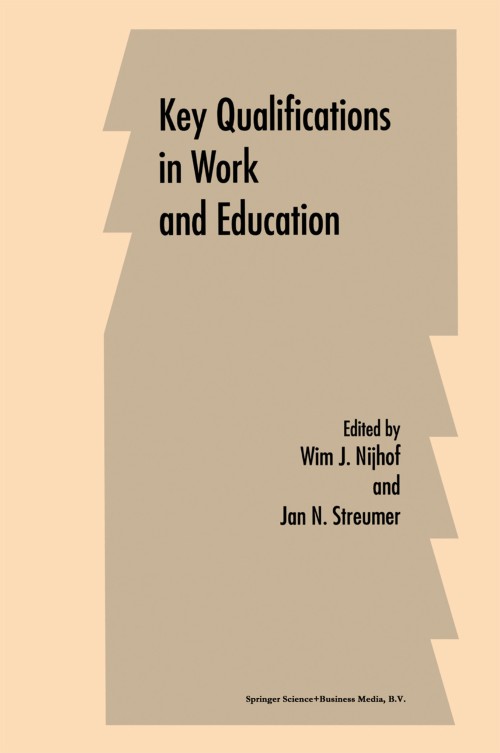
Key Qualifications in Work and Education [electronic resource] / edited by W.J. Nijhof, J.N. Streumer.
Erişim Adresi
ISBN
9789401152044
Dil Kodu
İngilizce
Yer Numarası
DK/11288
Basım Bildirimi
1st ed. 1998.
Yayın Bilgisi
Dordrecht : Springer Netherlands : Imprint: Springer, 1998.
Fiziksel Niteleme
274 p. online resource.
İçindekiler Notu
1. The Demarcation Issue: Introduction -- 1: The meaning of key qualifications -- 2. Qualifying for the Future -- 3. The Many Meanings of Occupational Competence and Qualification -- 4. Qualification and Labour Markets: Institutionalisation and Individualisation -- 5. The German ‘Berufsprinzip’ as a Model for Regulating Training Content and Qualification Standards -- 2: Qualification systems and programmes -- 6. The Demarcation Line in Funding for School-Based Vocational Education and Training in the United States -- 7. A Converging System? Explaining Difference in the Academic and Vocational Tracks in England -- 8. New Structures and New Contents in Dutch Vocational Education -- 9. General Versus Vocational Education — Demarcation and Integration -- 3: Key qualifications in research and practice -- 10. Occupational Standards and Business Ethics -- 11. Designing Effective Learning Programs for the Development of a Broad Occupational Competence -- 12. Generic Skills at Work: Implications for Occupationally-Oriented Education -- 13. Competence Based Assessment. Does it Shift the Demarcation Lines? -- 14. The Knowledge and Skills of Economics Graduates and their Significance on the Labour Market -- 4: Reflections -- 15. Moving Beyond Traditional Vocational Education and Training: Emerging Issues -- List of Contributors.
Özet, vb.
In today's rapidly changing world a constant renewal of knowledge and skills in every human endeavour can be observed. The characteristics of workers and the jobs that they perform have been attended by technological, social, and political change on a global scale. New forms of employment have made work more mobile to an extent never experienced before. An increasing proportion of workers no longer need come to their employer's job site in order to do their work. The instability of employment is creating a new breed of workers who know how to move efficiently from one job to another. As a consequence workers need flexible qualifications to perform jobs. Key qualifications are the answer! Key qualifications provide the key to rapid and effective acquisition of new knowledge and skills. First, qualifications enable workers to react effectively to, and exercise initiative in, changes to their work. Second, qualifications enable workers to shape their own career in a time of diminishing job security, nowadays frequently defined as `employability'.
Konu
Education.
Personnel management.
Education __ Curricula.
Labor economics.
Education.
Human Resource Management.
Curriculum Studies.
Labor Economics.
Personnel management.
Education __ Curricula.
Labor economics.
Education.
Human Resource Management.
Curriculum Studies.
Labor Economics.
Diğer Yazarlar
Kurum Adı
Eseri Alıntıla
Referansları kullanmadan önce gözden geçirmeniz ve varsa gerekli düzeltmeleri yapmanız önerilir.
Dijital Kaynak
MARC Görünümü
LEADER 04988nam a22005895i 4500
001 810005
003 TR_AnAIT
005 20260131021553
007 cr nn 008mamaa
008 121227s1998 ne | s |||| 0|eng d
020 |a9789401152044|9978-94-011-5204-4
024 7 |a10.1007/978-94-011-5204-4|2doi
041 |aeng
049 |aTürk Tarih Kurumu Kütüphanesi
050 4|aL1-991
072 7|aJN|2bicssc
072 7|aEDU000000|2bisacsh
072 7|aJN|2thema
082 04|a370|223
090 |aDK/11288
245 10|aKey Qualifications in Work and Education|h[electronic resource] /|cedited by W.J. Nijhof, J.N. Streumer.
250 |a1st ed. 1998.
264 1|aDordrecht :|bSpringer Netherlands :|bImprint: Springer,|c1998.
300 |a274 p.|bonline resource.
336 |atext|btxt|2rdacontent
337 |acomputer|bc|2rdamedia
338 |aonline resource|bcr|2rdacarrier
347 |atext file|bPDF|2rda
505 0 |a1. The Demarcation Issue: Introduction -- 1: The meaning of key qualifications -- 2. Qualifying for the Future -- 3. The Many Meanings of Occupational Competence and Qualification -- 4. Qualification and Labour Markets: Institutionalisation and Individualisation -- 5. The German ‘Berufsprinzip’ as a Model for Regulating Training Content and Qualification Standards -- 2: Qualification systems and programmes -- 6. The Demarcation Line in Funding for School-Based Vocational Education and Training in the United States -- 7. A Converging System? Explaining Difference in the Academic and Vocational Tracks in England -- 8. New Structures and New Contents in Dutch Vocational Education -- 9. General Versus Vocational Education — Demarcation and Integration -- 3: Key qualifications in research and practice -- 10. Occupational Standards and Business Ethics -- 11. Designing Effective Learning Programs for the Development of a Broad Occupational Competence -- 12. Generic Skills at Work: Implications for Occupationally-Oriented Education -- 13. Competence Based Assessment. Does it Shift the Demarcation Lines? -- 14. The Knowledge and Skills of Economics Graduates and their Significance on the Labour Market -- 4: Reflections -- 15. Moving Beyond Traditional Vocational Education and Training: Emerging Issues -- List of Contributors.
520 |aIn today's rapidly changing world a constant renewal of knowledge and skills in every human endeavour can be observed. The characteristics of workers and the jobs that they perform have been attended by technological, social, and political change on a global scale. New forms of employment have made work more mobile to an extent never experienced before. An increasing proportion of workers no longer need come to their employer's job site in order to do their work. The instability of employment is creating a new breed of workers who know how to move efficiently from one job to another. As a consequence workers need flexible qualifications to perform jobs. Key qualifications are the answer! Key qualifications provide the key to rapid and effective acquisition of new knowledge and skills. First, qualifications enable workers to react effectively to, and exercise initiative in, changes to their work. Second, qualifications enable workers to shape their own career in a time of diminishing job security, nowadays frequently defined as `employability'.
532 8 |aAccessibility summary: This PDF is not accessible. It is based on scanned pages and does not support features such as screen reader compatibility or described non-text content (images, graphs etc). However, it likely supports searchable and selectable text based on OCR (Optical Character Recognition). Users with accessibility needs may not be able to use this content effectively. Please contact us at accessibilitysupport@springernature.com if you require assistance or an alternative format.
532 8 |aInaccessible, or known limited accessibility
532 8 |aNo reading system accessibility options actively disabled
532 8 |aPublisher contact for further accessibility information: accessibilitysupport@springernature.com
650 0|aEducation.
650 0|aPersonnel management.
650 0|aEducation|xCurricula.
650 0|aLabor economics.
650 14|aEducation.
650 24|aHuman Resource Management.
650 24|aCurriculum Studies.
650 24|aLabor Economics.
700 1 |aNijhof, W.J.|eeditor.|4edt|4http://id.loc.gov/vocabulary/relators/edt
700 1 |aStreumer, J.N.|eeditor.|4edt|4http://id.loc.gov/vocabulary/relators/edt
710 2 |aSpringerLink (Online service)
773 0 |tSpringer Nature eBook
776 08|iPrinted edition:|z9780792348641
776 08|iPrinted edition:|z9789401152051
776 08|iPrinted edition:|z9789401061902
856 40|uhttps://doi.org/10.1007/978-94-011-5204-4
912 |aZDB-2-SHU
912 |aZDB-2-SXED
912 |aZDB-2-BAE
950 |aHumanities, Social Sciences and Law (SpringerNature-11648)
950 |aEducation (R0) (SpringerNature-43721)
001 810005
003 TR_AnAIT
005 20260131021553
007 cr nn 008mamaa
008 121227s1998 ne | s |||| 0|eng d
020 |a9789401152044|9978-94-011-5204-4
024 7 |a10.1007/978-94-011-5204-4|2doi
041 |aeng
049 |aTürk Tarih Kurumu Kütüphanesi
050 4|aL1-991
072 7|aJN|2bicssc
072 7|aEDU000000|2bisacsh
072 7|aJN|2thema
082 04|a370|223
090 |aDK/11288
245 10|aKey Qualifications in Work and Education|h[electronic resource] /|cedited by W.J. Nijhof, J.N. Streumer.
250 |a1st ed. 1998.
264 1|aDordrecht :|bSpringer Netherlands :|bImprint: Springer,|c1998.
300 |a274 p.|bonline resource.
336 |atext|btxt|2rdacontent
337 |acomputer|bc|2rdamedia
338 |aonline resource|bcr|2rdacarrier
347 |atext file|bPDF|2rda
505 0 |a1. The Demarcation Issue: Introduction -- 1: The meaning of key qualifications -- 2. Qualifying for the Future -- 3. The Many Meanings of Occupational Competence and Qualification -- 4. Qualification and Labour Markets: Institutionalisation and Individualisation -- 5. The German ‘Berufsprinzip’ as a Model for Regulating Training Content and Qualification Standards -- 2: Qualification systems and programmes -- 6. The Demarcation Line in Funding for School-Based Vocational Education and Training in the United States -- 7. A Converging System? Explaining Difference in the Academic and Vocational Tracks in England -- 8. New Structures and New Contents in Dutch Vocational Education -- 9. General Versus Vocational Education — Demarcation and Integration -- 3: Key qualifications in research and practice -- 10. Occupational Standards and Business Ethics -- 11. Designing Effective Learning Programs for the Development of a Broad Occupational Competence -- 12. Generic Skills at Work: Implications for Occupationally-Oriented Education -- 13. Competence Based Assessment. Does it Shift the Demarcation Lines? -- 14. The Knowledge and Skills of Economics Graduates and their Significance on the Labour Market -- 4: Reflections -- 15. Moving Beyond Traditional Vocational Education and Training: Emerging Issues -- List of Contributors.
520 |aIn today's rapidly changing world a constant renewal of knowledge and skills in every human endeavour can be observed. The characteristics of workers and the jobs that they perform have been attended by technological, social, and political change on a global scale. New forms of employment have made work more mobile to an extent never experienced before. An increasing proportion of workers no longer need come to their employer's job site in order to do their work. The instability of employment is creating a new breed of workers who know how to move efficiently from one job to another. As a consequence workers need flexible qualifications to perform jobs. Key qualifications are the answer! Key qualifications provide the key to rapid and effective acquisition of new knowledge and skills. First, qualifications enable workers to react effectively to, and exercise initiative in, changes to their work. Second, qualifications enable workers to shape their own career in a time of diminishing job security, nowadays frequently defined as `employability'.
532 8 |aAccessibility summary: This PDF is not accessible. It is based on scanned pages and does not support features such as screen reader compatibility or described non-text content (images, graphs etc). However, it likely supports searchable and selectable text based on OCR (Optical Character Recognition). Users with accessibility needs may not be able to use this content effectively. Please contact us at accessibilitysupport@springernature.com if you require assistance or an alternative format.
532 8 |aInaccessible, or known limited accessibility
532 8 |aNo reading system accessibility options actively disabled
532 8 |aPublisher contact for further accessibility information: accessibilitysupport@springernature.com
650 0|aEducation.
650 0|aPersonnel management.
650 0|aEducation|xCurricula.
650 0|aLabor economics.
650 14|aEducation.
650 24|aHuman Resource Management.
650 24|aCurriculum Studies.
650 24|aLabor Economics.
700 1 |aNijhof, W.J.|eeditor.|4edt|4http://id.loc.gov/vocabulary/relators/edt
700 1 |aStreumer, J.N.|eeditor.|4edt|4http://id.loc.gov/vocabulary/relators/edt
710 2 |aSpringerLink (Online service)
773 0 |tSpringer Nature eBook
776 08|iPrinted edition:|z9780792348641
776 08|iPrinted edition:|z9789401152051
776 08|iPrinted edition:|z9789401061902
856 40|uhttps://doi.org/10.1007/978-94-011-5204-4
912 |aZDB-2-SHU
912 |aZDB-2-SXED
912 |aZDB-2-BAE
950 |aHumanities, Social Sciences and Law (SpringerNature-11648)
950 |aEducation (R0) (SpringerNature-43721)
Materyaller
Depodan talep edilen materyal sadece kütüphane içerisinde kullanılmaktadır.
Materyal dışarıya ödünç verilmemektedir.
Materyal dışarıya ödünç verilmemektedir.
