

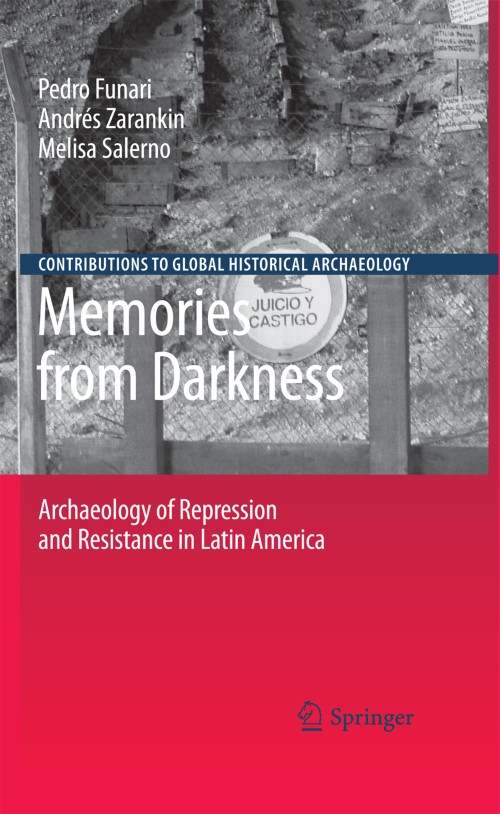
Memories from Darkness [electronic resource] : Archaeology of Repression and Resistance in Latin America / edited by Pedro Funari, Andres Zarankin, Melissa Salerno.
Erişim Adresi
ISBN
9781441906793
Dil Kodu
İngilizce
Yer Numarası
DK/11311
Basım Bildirimi
1st ed. 2010.
Yayın Bilgisi
New York, NY : Springer New York : Imprint: Springer, 2010.
Fiziksel Niteleme
XXVIII, 191 p. 43 illus. online resource.
Dizi
Contributions To Global Historical Archaeology
İçindekiler Notu
Theoretical Discussions -- Torture, Truth, Repression and Archaeology -- Archaeology and Left in Colombia -- The Archaeology of Conflict in Brazil -- An Archaeological View of Political Repression in Uruguay (1971–1985) -- Search for and Identification of Desaparecidos -- Forensic Archaeology and Anthropology: A Balance Sheet -- Clandestine detention centers -- The Materialization of Sadism; Archaeology of Architecture in Clandestine Detention Centers (Argentinean Military Dictatorship, 1976–1983) -- Objects and Representations -- “They Must Have Done Something Wrong…”: The Construction of “Subversion” as a Social Category and the Reshaping of Identities Through Body and Dress (Argentina, 1976–1983) -- Scratching Behind the Walls; Graffiti and Symbolic Political Imagination at Cuartel San Carlos (Caracas, Venezuela) -- Emblematic Case Studies -- The Archaeology of a Search: An Archaeological Search; The History of the Finding of “Che” Guevara’s Remains -- “Mexico, 1968”: Among Olympic Fanfares, Government Repression and Genocide.
Özet, vb.
The study of Archaeology in Latin America has been strongly affected by the socio-political setting of the region. The history of state repression in the 1960s-1980s is particularly challenging to study, with many holes in the traditional accounts of events. Several dictatorships (especially military governments) emerged during this period dominated by the development of the Cold War and the consequences of the Cuban Revolution. Repressive regimes remained in power for decades, until internal and international changes allowed democracy to take over a firm hold. State terrorism included censorship, exile, detention, torture, murder, and forced disappearance. Written documents on political violence are scarce and fragmentary, with many of these sources deliberately destroyed by government authorities. New archaeological methods must be employed to reconstruct the history of the period, helping to disclose the silenced voice of victims, relatives and society as a whole. The contributions in this important volume show the socio-political commitment of Archaeology in Latin American to shed light on the specific case of dictatorship and repression in the region. The techniques described will also provide a valuable resource for archaeologists working to understand the nature of political violence worldwide and reconstruct other historical periods without reliable written sources.
Konu
Archaeology.
History.
Political science.
Archaeology.
History.
Political Science.
History.
Political science.
Archaeology.
History.
Political Science.
Diğer Yazarlar
Kurum Adı
Eseri Alıntıla
Referansları kullanmadan önce gözden geçirmeniz ve varsa gerekli düzeltmeleri yapmanız önerilir.
Dijital Kaynak
MARC Görünümü
LEADER 04480nam a22005415i 4500
001 810028
003 TR_AnAIT
005 20260131021519
007 cr nn 008mamaa
008 100301s2010 xxu| s |||| 0|eng d
020 |a9781441906793|9978-1-4419-0679-3
024 7 |a10.1007/978-1-4419-0679-3|2doi
041 |aeng
049 |aTürk Tarih Kurumu Kütüphanesi
050 4|aCC1-960
072 7|aHD|2bicssc
072 7|aSOC003000|2bisacsh
072 7|aNK|2thema
082 04|a930.1|223
090 |aDK/11311
245 10|aMemories from Darkness|h[electronic resource] :|bArchaeology of Repression and Resistance in Latin America /|cedited by Pedro Funari, Andres Zarankin, Melissa Salerno.
250 |a1st ed. 2010.
264 1|aNew York, NY :|bSpringer New York :|bImprint: Springer,|c2010.
300 |aXXVIII, 191 p. 43 illus.|bonline resource.
336 |atext|btxt|2rdacontent
337 |acomputer|bc|2rdamedia
338 |aonline resource|bcr|2rdacarrier
347 |atext file|bPDF|2rda
490 1 |aContributions To Global Historical Archaeology
505 0 |aTheoretical Discussions -- Torture, Truth, Repression and Archaeology -- Archaeology and Left in Colombia -- The Archaeology of Conflict in Brazil -- An Archaeological View of Political Repression in Uruguay (1971–1985) -- Search for and Identification of Desaparecidos -- Forensic Archaeology and Anthropology: A Balance Sheet -- Clandestine detention centers -- The Materialization of Sadism; Archaeology of Architecture in Clandestine Detention Centers (Argentinean Military Dictatorship, 1976–1983) -- Objects and Representations -- “They Must Have Done Something Wrong…”: The Construction of “Subversion” as a Social Category and the Reshaping of Identities Through Body and Dress (Argentina, 1976–1983) -- Scratching Behind the Walls; Graffiti and Symbolic Political Imagination at Cuartel San Carlos (Caracas, Venezuela) -- Emblematic Case Studies -- The Archaeology of a Search: An Archaeological Search; The History of the Finding of “Che” Guevara’s Remains -- “Mexico, 1968”: Among Olympic Fanfares, Government Repression and Genocide.
520 |aThe study of Archaeology in Latin America has been strongly affected by the socio-political setting of the region. The history of state repression in the 1960s-1980s is particularly challenging to study, with many holes in the traditional accounts of events. Several dictatorships (especially military governments) emerged during this period dominated by the development of the Cold War and the consequences of the Cuban Revolution. Repressive regimes remained in power for decades, until internal and international changes allowed democracy to take over a firm hold. State terrorism included censorship, exile, detention, torture, murder, and forced disappearance. Written documents on political violence are scarce and fragmentary, with many of these sources deliberately destroyed by government authorities. New archaeological methods must be employed to reconstruct the history of the period, helping to disclose the silenced voice of victims, relatives and society as a whole. The contributions in this important volume show the socio-political commitment of Archaeology in Latin American to shed light on the specific case of dictatorship and repression in the region. The techniques described will also provide a valuable resource for archaeologists working to understand the nature of political violence worldwide and reconstruct other historical periods without reliable written sources.
650 0|aArchaeology.
650 0|aHistory.
650 0|aPolitical science.
650 14|aArchaeology.
650 24|aHistory.
650 24|aPolitical Science.
700 1 |aFunari, Pedro.|eeditor.|4edt|4http://id.loc.gov/vocabulary/relators/edt
700 1 |aZarankin, Andres.|eeditor.|4edt|4http://id.loc.gov/vocabulary/relators/edt
700 1 |aSalerno, Melissa.|eeditor.|4edt|4http://id.loc.gov/vocabulary/relators/edt
710 2 |aSpringerLink (Online service)
773 0 |tSpringer Nature eBook
776 08|iPrinted edition:|z9781441906786
776 08|iPrinted edition:|z9781441906809
776 08|iPrinted edition:|z9781461424604
830 0|aContributions To Global Historical Archaeology
856 40|uhttps://doi.org/10.1007/978-1-4419-0679-3
912 |aZDB-2-SHU
912 |aZDB-2-SXS
950 |aHumanities, Social Sciences and Law (SpringerNature-11648)
950 |aSocial Sciences (R0) (SpringerNature-43726)
001 810028
003 TR_AnAIT
005 20260131021519
007 cr nn 008mamaa
008 100301s2010 xxu| s |||| 0|eng d
020 |a9781441906793|9978-1-4419-0679-3
024 7 |a10.1007/978-1-4419-0679-3|2doi
041 |aeng
049 |aTürk Tarih Kurumu Kütüphanesi
050 4|aCC1-960
072 7|aHD|2bicssc
072 7|aSOC003000|2bisacsh
072 7|aNK|2thema
082 04|a930.1|223
090 |aDK/11311
245 10|aMemories from Darkness|h[electronic resource] :|bArchaeology of Repression and Resistance in Latin America /|cedited by Pedro Funari, Andres Zarankin, Melissa Salerno.
250 |a1st ed. 2010.
264 1|aNew York, NY :|bSpringer New York :|bImprint: Springer,|c2010.
300 |aXXVIII, 191 p. 43 illus.|bonline resource.
336 |atext|btxt|2rdacontent
337 |acomputer|bc|2rdamedia
338 |aonline resource|bcr|2rdacarrier
347 |atext file|bPDF|2rda
490 1 |aContributions To Global Historical Archaeology
505 0 |aTheoretical Discussions -- Torture, Truth, Repression and Archaeology -- Archaeology and Left in Colombia -- The Archaeology of Conflict in Brazil -- An Archaeological View of Political Repression in Uruguay (1971–1985) -- Search for and Identification of Desaparecidos -- Forensic Archaeology and Anthropology: A Balance Sheet -- Clandestine detention centers -- The Materialization of Sadism; Archaeology of Architecture in Clandestine Detention Centers (Argentinean Military Dictatorship, 1976–1983) -- Objects and Representations -- “They Must Have Done Something Wrong…”: The Construction of “Subversion” as a Social Category and the Reshaping of Identities Through Body and Dress (Argentina, 1976–1983) -- Scratching Behind the Walls; Graffiti and Symbolic Political Imagination at Cuartel San Carlos (Caracas, Venezuela) -- Emblematic Case Studies -- The Archaeology of a Search: An Archaeological Search; The History of the Finding of “Che” Guevara’s Remains -- “Mexico, 1968”: Among Olympic Fanfares, Government Repression and Genocide.
520 |aThe study of Archaeology in Latin America has been strongly affected by the socio-political setting of the region. The history of state repression in the 1960s-1980s is particularly challenging to study, with many holes in the traditional accounts of events. Several dictatorships (especially military governments) emerged during this period dominated by the development of the Cold War and the consequences of the Cuban Revolution. Repressive regimes remained in power for decades, until internal and international changes allowed democracy to take over a firm hold. State terrorism included censorship, exile, detention, torture, murder, and forced disappearance. Written documents on political violence are scarce and fragmentary, with many of these sources deliberately destroyed by government authorities. New archaeological methods must be employed to reconstruct the history of the period, helping to disclose the silenced voice of victims, relatives and society as a whole. The contributions in this important volume show the socio-political commitment of Archaeology in Latin American to shed light on the specific case of dictatorship and repression in the region. The techniques described will also provide a valuable resource for archaeologists working to understand the nature of political violence worldwide and reconstruct other historical periods without reliable written sources.
650 0|aArchaeology.
650 0|aHistory.
650 0|aPolitical science.
650 14|aArchaeology.
650 24|aHistory.
650 24|aPolitical Science.
700 1 |aFunari, Pedro.|eeditor.|4edt|4http://id.loc.gov/vocabulary/relators/edt
700 1 |aZarankin, Andres.|eeditor.|4edt|4http://id.loc.gov/vocabulary/relators/edt
700 1 |aSalerno, Melissa.|eeditor.|4edt|4http://id.loc.gov/vocabulary/relators/edt
710 2 |aSpringerLink (Online service)
773 0 |tSpringer Nature eBook
776 08|iPrinted edition:|z9781441906786
776 08|iPrinted edition:|z9781441906809
776 08|iPrinted edition:|z9781461424604
830 0|aContributions To Global Historical Archaeology
856 40|uhttps://doi.org/10.1007/978-1-4419-0679-3
912 |aZDB-2-SHU
912 |aZDB-2-SXS
950 |aHumanities, Social Sciences and Law (SpringerNature-11648)
950 |aSocial Sciences (R0) (SpringerNature-43726)
Materyaller
Depodan talep edilen materyal sadece kütüphane içerisinde kullanılmaktadır.
Materyal dışarıya ödünç verilmemektedir.
Materyal dışarıya ödünç verilmemektedir.
