LEADER 03591nam a22006255i 4500
001 810029
003 TR_AnAIT
005 20260131021518
007 cr nn 008mamaa
008 100702s2010 ne | s |||| 0|eng d
020 |a9789048189151|9978-90-481-8915-1
024 7 |a10.1007/978-90-481-8915-1|2doi
041 |aeng
049 |aTürk Tarih Kurumu Kütüphanesi
050 4|aJV6001-9480
050 4|aHB1951-2577
072 7|aJFFN|2bicssc
072 7|aSOC007000|2bisacsh
072 7|aJBFH|2thema
072 7|aRGCG|2thema
082 04|a304.8|223
090 |aDK/11312
100 1 |aRogers, Andrei.|eauthor.|4aut|4http://id.loc.gov/vocabulary/relators/aut
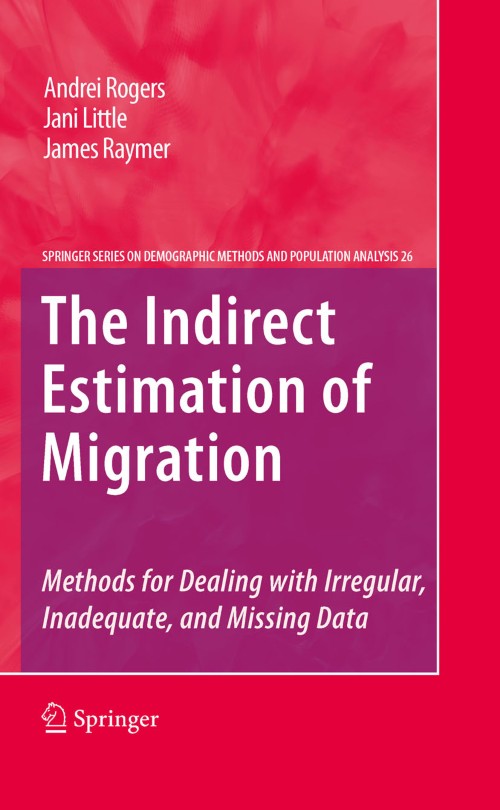
245 14|aThe Indirect Estimation of Migration|h[electronic resource] :|bMethods for Dealing with Irregular, Inadequate, and Missing Data /|cby Andrei Rogers, Jani Little, James Raymer.
250 |a1st ed. 2010.
264 1|aDordrecht :|bSpringer Netherlands :|bImprint: Springer,|c2010.
300 |aXIV, 170 p.|bonline resource.
336 |atext|btxt|2rdacontent
337 |acomputer|bc|2rdamedia
338 |aonline resource|bcr|2rdacarrier
347 |atext file|bPDF|2rda
490 1 |aThe Springer Series on Demographic Methods and Population Analysis,|x2215-1990 ;|v26
505 0 |aDescribing Age Structures of Migration -- Describing Spatial Structures of Migration -- Smoothing Age and Spatial Patterns -- Imposing Age and Spatial Patterns -- Inferring Age and Spatial Patterns -- Conclusion.
520 |aThis unique book introduces an essential element in applied demographic analysis: a tool-kit for describing, smoothing, repairing and - in instances of totally missing data - inferring directional migration flows. Migration rates combine with fertility and mortality rates to shape the evolution of human populations. Demographers have found that all three generally exhibit persistent regularities in their age and spatial patterns, when changing levels are controlled for. Drawing on statistical descriptions of such regularities, it is often possible to improve the quality of the available data by smoothing irregular data, imposing the structures of borrowed and related data on unreliable data, and estimating missing data by indirect methods. Model migration schedules and log-linear models are presented as powerful methods for helping population researchers, historical demographers, geographers, and migration analysts work with the data available to them.
650 0|aEmigration and immigration.
650 0|aGeography.
650 0|aDemography.
650 0|aPopulation.
650 0|aSocial sciences|xStatistical methods.
650 0|aSociology.
650 14|aHuman Migration.
650 24|aGeography.
650 24|aPopulation and Demography.
650 24|aStatistics in Social Sciences, Humanities, Law, Education, Behavorial Sciences, Public Policy.
650 24|aSociology.
700 1 |aLittle, Jani.|eauthor.|4aut|4http://id.loc.gov/vocabulary/relators/aut
700 1 |aRaymer, James.|eauthor.|4aut|4http://id.loc.gov/vocabulary/relators/aut
710 2 |aSpringerLink (Online service)
773 0 |tSpringer Nature eBook
776 08|iPrinted edition:|z9789048189144
776 08|iPrinted edition:|z9789048189168
776 08|iPrinted edition:|z9789400704510
830 0|aThe Springer Series on Demographic Methods and Population Analysis,|x2215-1990 ;|v26
856 40|uhttps://doi.org/10.1007/978-90-481-8915-1
912 |aZDB-2-SHU
912 |aZDB-2-SXS
950 |aHumanities, Social Sciences and Law (SpringerNature-11648)
950 |aSocial Sciences (R0) (SpringerNature-43726)