LEADER 04100nam a22004575i 4500
001 810045
003 TR_AnAIT
005 20260131021458
007 cr nn 008mamaa
008 120118s2011 ne | s |||| 0|eng d
020 |a9789460916427|9978-94-6091-642-7
024 7 |a10.1007/978-94-6091-642-7|2doi
041 |aeng
049 |aTürk Tarih Kurumu Kütüphanesi
050 4|aLB3050-3060.87
072 7|aJNKD|2bicssc
072 7|aEDU030000|2bisacsh
072 7|aJNDH|2thema
082 04|a371.26|223
090 |aDK/11328
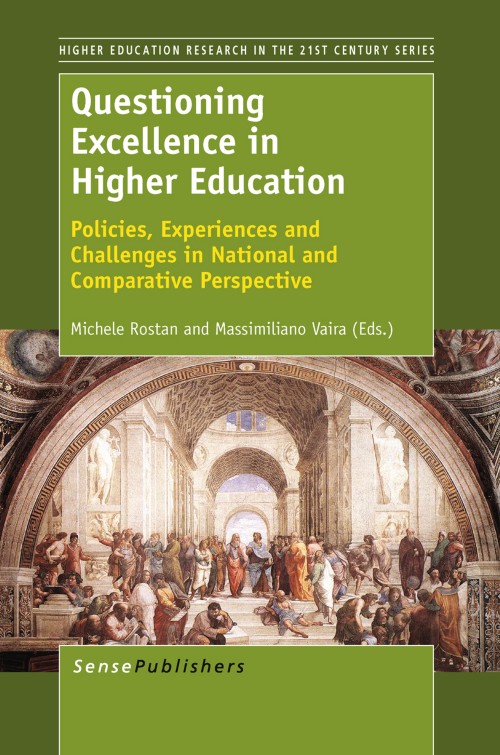
245 10|aQuestioning Excellence in Higher Education|h[electronic resource] /|cedited by Michele Rostan, Massimiliano Vaira.
250 |a1st ed. 2011.
264 1|aRotterdam :|bSensePublishers :|bImprint: SensePublishers,|c2011.
300 |aXVII, 193 p.|bonline resource.
336 |atext|btxt|2rdacontent
337 |acomputer|bc|2rdamedia
338 |aonline resource|bcr|2rdacarrier
347 |atext file|bPDF|2rda
490 1 |aHigher Education Research in the 21st Century, The CHER Series ;|v3
520 |aExcellence in higher education is as old as university, but nowadays the concept is widely emphasized and its meaning has been redefined on the basis of different values and goals, especially those related to market. Excellence has become the meter on which institutions are assessed and public funding allocated, the tool by which worldwide comparisons and rankings of institutions are built, and a marketable brand used by higher education institutions to present themselves. This book offers an international and comparative view on excellence in higher education, ranging from policies to practices, mainly based on research results and empirical evidence, aiming at questioning the concept and its uses which are not only social constructions but also political ones. Far from being a neutral or technical concept, excellence is heavily infused with values which must be traced, analysed and made critical to understand its impacts, backlashes and unintended outcomes on higher education systems, institutions, academics and students. The book is addressed to an international audience and in particular to higher education scholars and professionals. Those who are involved in higher education assessment, members of professional bodies and organizations in the higher education field, students in education, but also policy makers and the public opinion at large will profit from the works of a selected group of scholars coming from a variety of countries. A sense of disquietude seems ever present when discussing new digital practices. The transformations incurred through these can be profound, troublesome in nature and far-reaching. Moral panics remain readily available.
532 8 |aAccessibility summary: This PDF eBook is produced by a third-party. We have requested that the file be made accessible and compliant with the European Accessibility Act (EAA). However, we have not been able to fully verify its compliance with recognized accessibility standards (such as PDF/UA or WCAG). For detailed accessibility information, please refer to the original publisher’s website. If you require an accessible version of this content, please contact accessibilitysupport@springernature.com. We are committed to improving accessibility and will work with the publisher to meet your needs wherever possible.
532 8 |aPublisher contact for further accessibility information: accessibilitysupport@springernature.com
650 0|aEducational tests and measurements.
650 14|aAssessment and Testing.
700 1 |aRostan, Michele.|eeditor.|4edt|4http://id.loc.gov/vocabulary/relators/edt
700 1 |aVaira, Massimiliano.|eeditor.|4edt|4http://id.loc.gov/vocabulary/relators/edt
710 2 |aSpringerLink (Online service)
773 0 |tSpringer Nature eBook
830 0|aHigher Education Research in the 21st Century, The CHER Series ;|v3
856 40|uhttps://doi.org/10.1007/978-94-6091-642-7
912 |aZDB-2-SHU
912 |aZDB-2-SXED
950 |aHumanities, Social Sciences and Law (SpringerNature-11648)
950 |aEducation (R0) (SpringerNature-43721)