

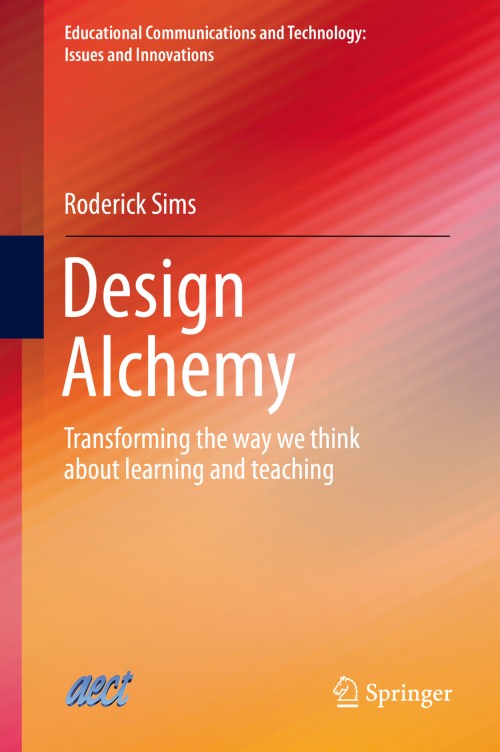
Design Alchemy [electronic resource] : Transforming the way we think about learning and teaching / by Roderick Sims.
Erişim Adresi
ISBN
9783319024233
Dil Kodu
İngilizce
Yer Numarası
DK/11341
Yazar
Basım Bildirimi
1st ed. 2014.
Yayın Bilgisi
Cham : Springer International Publishing : Imprint: Springer, 2014.
Fiziksel Niteleme
XIV, 251 p. 49 illus., 48 illus. in color. online resource.
Dizi
Educational Communications and Technology: Issues and Innovations, 2625-0012
İçindekiler Notu
Foreward -- Preface -- Why Alchemy? -- Why Design Alchemy? -- How did Design Alchemy emerge? -- Which Learning Theories? -- Instructional Design or Design Alchemy? -- Learning Design or Design Alchemy?.- Insight or Distraction? -- What is the Design Alchemy Pedagogy? -- How Does the Design Alchemist Practice? -- What Are the Assets of Design Alchemy? -- Transforming Programs and Courses -- Activities and Assessment -- Understanding Design Alchemy -- Design Alchemy Templates -- Design Alchemy: A Manifesto -- Index.
Özet, vb.
The provision of online learning is increasing almost exponentially, with both established and emerging educational institutions creating new and revised courses to meet the needs of students demanding flexible access and delivery. However, the staff recruited to support this development often does not have the design skills or experience to generate courses that bear the hallmarks of effective online learning experiences. While the principles associated with the practice of instructional design provided pedagogical guidance for these design efforts, it remains commonplace for courses to present as little more than information delivery with no clear strategies for student engagement and interaction. The purpose of this book is to expand on the design concepts documented by the lead author and to present both a design framework and design strategies that will allow organisations to provide courses that embed the affordances of the online, social environment and maximize opportunities for engagement and learning in formal learning contexts. The authors contend that to truly achieve the potential of learning in an online environment, designers need to be alchemists - ensuring the current face-to-face classroom "gold" is not turned to lead and to transform those "leaden" online courses that do not engage or provide interaction into motivating and engaging "golden" learning experiences.
Konu
Educational technology.
Learning, Psychology of.
Digital Education and Educational Technology.
Instructional Psychology.
Learning, Psychology of.
Digital Education and Educational Technology.
Instructional Psychology.
Kurum Adı
