LEADER 03628nam a22005655i 4500
001 810178
003 TR_AnAIT
005 20260131021000
007 cr nn 008mamaa
008 100301s2002 ne | s |||| 0|eng d
020 |a9780306476839|9978-0-306-47683-9
024 7 |a10.1007/0-306-47683-5|2doi
041 |aeng
049 |aTürk Tarih Kurumu Kütüphanesi
050 4|aQA10.92-20
072 7|aJNU|2bicssc
072 7|aPB|2bicssc
072 7|aEDU029010|2bisacsh
072 7|aJNU|2thema
072 7|aPB|2thema
082 04|a510.71|223
090 |aDK/11460
100 1 |aFitzSimons, Gail E.|eauthor.|4aut|4http://id.loc.gov/vocabulary/relators/aut
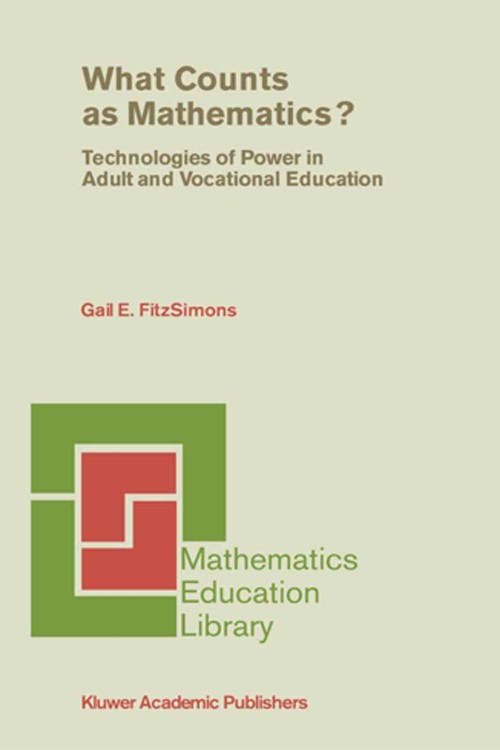
245 10|aWhat Counts as Mathematics?|h[electronic resource] :|bTechnologies of Power in Adult and Vocational Education /|cby Gail E. FitzSimons.
250 |a1st ed. 2002.
264 1|aDordrecht :|bSpringer Netherlands :|bImprint: Springer,|c2002.
300 |aXII, 276 p.|bonline resource.
336 |atext|btxt|2rdacontent
337 |acomputer|bc|2rdamedia
338 |aonline resource|bcr|2rdacarrier
347 |atext file|bPDF|2rda
490 1 |aMathematics Education Library,|x2214-983X ;|v28
505 0 |aPrelude -- What Counts as Mathematics? Institutions and Images -- Technology, Mathematucs, and industry -- Interlude -- Technologies of Power: Recontextualising Texts -- Technologies of Power: The Recontextualising Field -- Technologies of Power: Knowledge Production and Distribution -- Conclusion.
520 |aJÜRGEN MAASS & WOLFGANG SCHLÖGLMANN THEORY AND PRACTICE OF MATHEMATICS EDUCATION FOR ADULTS Our world is dominated by technological developments: The philosopher Heinz Hülsmann wrote that “Atom, Gen and Bit” are the three basic principles now (see Hülsmann, 1985). Each of the so-called new technologies is based upon mathematics: The first computer was built as a part of the Manhattan Project to calculate models of the atomic bomb. The human genome project uses computers very often to find out the structure of the genome. And computers are mathematical machines, materialised mathematics. Social organisations, companies, and not least governments use computers to process information. A precondition for this is to formalise the social or economical structure which “produces” the information. This formalisation is a type of mathematisation, too. The social and economical models of organisations or companies are a part of the process of mathematising the world. Last, but not least, mathematics is a part of everyday life and work. People handle money, buy things, do handywork at home (measure areas to paint, and so on). All together, mathematics is not only the basis for technology, economy, work and everyday life, but a part of our culture. It seems clear that everyone in our society should know more about this.
650 0|aMathematics|xStudy and teaching .
650 0|aProfessional education.
650 0|aVocational education.
650 0|aEducational sociology.
650 14|aMathematics Education.
650 24|aProfessional and Vocational Education.
650 24|aSociology of Education.
710 2 |aSpringerLink (Online service)
773 0 |tSpringer Nature eBook
776 08|iPrinted edition:|z9781402006685
776 08|iPrinted edition:|z9781402006692
776 08|iPrinted edition:|z9789401742771
830 0|aMathematics Education Library,|x2214-983X ;|v28
856 40|uhttps://doi.org/10.1007/0-306-47683-5
912 |aZDB-2-SHU
912 |aZDB-2-SXED
912 |aZDB-2-BAE
950 |aHumanities, Social Sciences and Law (SpringerNature-11648)
950 |aEducation (R0) (SpringerNature-43721)