

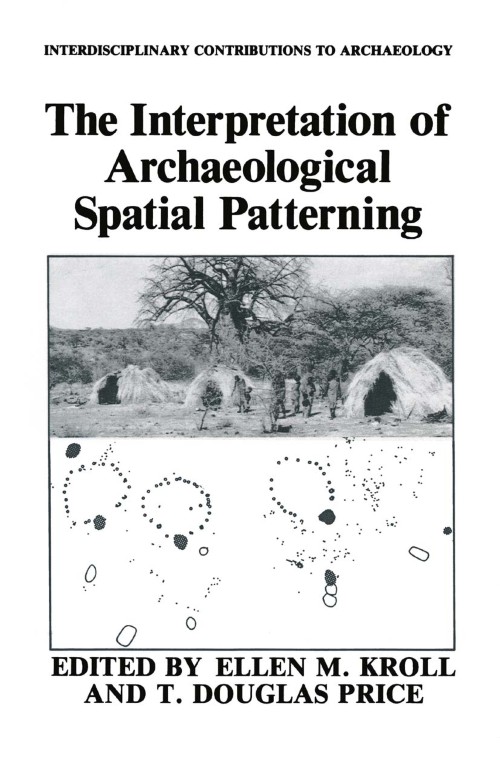
The Interpretation of Archaeological Spatial Patterning [electronic resource] / edited by Ellen M. Kroll, T. Douglas Price.
Erişim Adresi
ISBN
9781489926029
Dil Kodu
İngilizce
Yer Numarası
DK/11465
Basım Bildirimi
1st ed. 1991.
Yayın Bilgisi
New York, NY : Springer US : Imprint: Springer, 1991.
Fiziksel Niteleme
XVI, 316 p. online resource.
Dizi
Interdisciplinary Contributions to Archaeology, 2730-6984
İçindekiler Notu
I. Spatial Analysis of Ethnoarchaeological Sites -- 1 • Site Structure, Kinship, and Sharing in Aboriginal Australia: Implications for Archaeology -- 2 • The Relationship between Nobility Strategies and Site Structure -- 3 • Distribution of Refuse-Producing Activities at Hadza Residential Base Camps: Implications for Analyses of Archaeological Site Structure -- 4 • Variability in Camp Structure and Bone Food Refuse Patterning at Kua San Hunter-Gatherer Camps -- 5 • Linking Ethnoarchaeological Interpretation and Archaeological Data: The Sensitivity of Spatial Analytical Methods to Postdepositional Disturbance -- II. Spatial Analysis of Archaeological Sites -- 6 • Interpreting Spatial Patterns at the Grotte XV: A Multiple-Method Approach -- 7 • Left in the Dust: Contextual Information in Model-Focused Archaeology -- 8 • Tool Use and Spatial Patterning: Complications and Solution -- 9 • Beyond the Formation of Hearth-Associated Artifact Assemblages -- III. Postscript: The End of Spatial Analysis.
Özet, vb.
Investigations of archaeological intrasite spatial patterns have generally taken one of two directions: studies that introduced and explored methods for the analysis of archaeological spatial patterns or those that described and analyzed the for mation of spatial patterns in actuaiistic-ethnographic, experimental, or natu ral-contexts. The archaeological studies were largely quantitative in nature, concerned with the recognition and definition of patterns; the actualistic efforts were often oriented more toward interpretation, dealing with how patterns formed and what they meant. Our research group on archaeological spatial analysis at the University of Wisconsin-Madison has been working for several years on both quantitative and interpretive problems. Both lines of investigation are closely related and are important complements. In order to demonstrate the convergence of archaeological and actualistic studies for the understanding of intrasite spatial patterns, we organized a sympo sium at the 52nd Annual Meeting of the Society of American Archaeology in Toronto, Canada, in May 1987. The symposium, titled "The Interpretation of Stone Age Archaeological Spatial Patterns," was organized into two sessions. The six papers presented in the morning session, five of which comprise Part I of this volume, focused on ethnoarchaeological and experimental research. Michael Schiffer was the discussant for this half of the symposium. Our intention for the ethnoarchaeological contributions to the symposium and volume was the delin eation of some of the significant accomplishments achieved thus far by actualistic studies regarding the formation of spatial patterns.
Konu
Archaeology.
Archaeology.
Archaeology.
Diğer Yazarlar
Kurum Adı
Eseri Alıntıla
Referansları kullanmadan önce gözden geçirmeniz ve varsa gerekli düzeltmeleri yapmanız önerilir.
Dijital Kaynak
MARC Görünümü
LEADER 05265nam a22005415i 4500
001 810183
003 TR_AnAIT
005 20260131020951
007 cr nn 008mamaa
008 130611s1991 xxu| s |||| 0|eng d
020 |a9781489926029|9978-1-4899-2602-9
024 7 |a10.1007/978-1-4899-2602-9|2doi
041 |aeng
049 |aTürk Tarih Kurumu Kütüphanesi
050 4|aCC1-960
072 7|aHD|2bicssc
072 7|aSOC003000|2bisacsh
072 7|aNK|2thema
082 04|a930.1|223
090 |aDK/11465
245 14|aThe Interpretation of Archaeological Spatial Patterning|h[electronic resource] /|cedited by Ellen M. Kroll, T. Douglas Price.
250 |a1st ed. 1991.
264 1|aNew York, NY :|bSpringer US :|bImprint: Springer,|c1991.
300 |aXVI, 316 p.|bonline resource.
336 |atext|btxt|2rdacontent
337 |acomputer|bc|2rdamedia
338 |aonline resource|bcr|2rdacarrier
347 |atext file|bPDF|2rda
490 1 |aInterdisciplinary Contributions to Archaeology,|x2730-6984
505 0 |aI. Spatial Analysis of Ethnoarchaeological Sites -- 1 • Site Structure, Kinship, and Sharing in Aboriginal Australia: Implications for Archaeology -- 2 • The Relationship between Nobility Strategies and Site Structure -- 3 • Distribution of Refuse-Producing Activities at Hadza Residential Base Camps: Implications for Analyses of Archaeological Site Structure -- 4 • Variability in Camp Structure and Bone Food Refuse Patterning at Kua San Hunter-Gatherer Camps -- 5 • Linking Ethnoarchaeological Interpretation and Archaeological Data: The Sensitivity of Spatial Analytical Methods to Postdepositional Disturbance -- II. Spatial Analysis of Archaeological Sites -- 6 • Interpreting Spatial Patterns at the Grotte XV: A Multiple-Method Approach -- 7 • Left in the Dust: Contextual Information in Model-Focused Archaeology -- 8 • Tool Use and Spatial Patterning: Complications and Solution -- 9 • Beyond the Formation of Hearth-Associated Artifact Assemblages -- III. Postscript: The End of Spatial Analysis.
520 |aInvestigations of archaeological intrasite spatial patterns have generally taken one of two directions: studies that introduced and explored methods for the analysis of archaeological spatial patterns or those that described and analyzed the for mation of spatial patterns in actuaiistic-ethnographic, experimental, or natu ral-contexts. The archaeological studies were largely quantitative in nature, concerned with the recognition and definition of patterns; the actualistic efforts were often oriented more toward interpretation, dealing with how patterns formed and what they meant. Our research group on archaeological spatial analysis at the University of Wisconsin-Madison has been working for several years on both quantitative and interpretive problems. Both lines of investigation are closely related and are important complements. In order to demonstrate the convergence of archaeological and actualistic studies for the understanding of intrasite spatial patterns, we organized a sympo sium at the 52nd Annual Meeting of the Society of American Archaeology in Toronto, Canada, in May 1987. The symposium, titled "The Interpretation of Stone Age Archaeological Spatial Patterns," was organized into two sessions. The six papers presented in the morning session, five of which comprise Part I of this volume, focused on ethnoarchaeological and experimental research. Michael Schiffer was the discussant for this half of the symposium. Our intention for the ethnoarchaeological contributions to the symposium and volume was the delin eation of some of the significant accomplishments achieved thus far by actualistic studies regarding the formation of spatial patterns.
532 8 |aAccessibility summary: This PDF is not accessible. It is based on scanned pages and does not support features such as screen reader compatibility or described non-text content (images, graphs etc). However, it likely supports searchable and selectable text based on OCR (Optical Character Recognition). Users with accessibility needs may not be able to use this content effectively. Please contact us at accessibilitysupport@springernature.com if you require assistance or an alternative format.
532 8 |aInaccessible, or known limited accessibility
532 8 |aNo reading system accessibility options actively disabled
532 8 |aPublisher contact for further accessibility information: accessibilitysupport@springernature.com
650 0|aArchaeology.
650 14|aArchaeology.
700 1 |aKroll, Ellen M.|eeditor.|4edt|4http://id.loc.gov/vocabulary/relators/edt
700 1 |aPrice, T. Douglas.|eeditor.|4edt|4http://id.loc.gov/vocabulary/relators/edt
710 2 |aSpringerLink (Online service)
773 0 |tSpringer Nature eBook
776 08|iPrinted edition:|z9780306436451
776 08|iPrinted edition:|z9781489926036
776 08|iPrinted edition:|z9781489926043
830 0|aInterdisciplinary Contributions to Archaeology,|x2730-6984
856 40|uhttps://doi.org/10.1007/978-1-4899-2602-9
912 |aZDB-2-SHU
912 |aZDB-2-SXS
912 |aZDB-2-BAE
950 |aHumanities, Social Sciences and Law (SpringerNature-11648)
950 |aSocial Sciences (R0) (SpringerNature-43726)
001 810183
003 TR_AnAIT
005 20260131020951
007 cr nn 008mamaa
008 130611s1991 xxu| s |||| 0|eng d
020 |a9781489926029|9978-1-4899-2602-9
024 7 |a10.1007/978-1-4899-2602-9|2doi
041 |aeng
049 |aTürk Tarih Kurumu Kütüphanesi
050 4|aCC1-960
072 7|aHD|2bicssc
072 7|aSOC003000|2bisacsh
072 7|aNK|2thema
082 04|a930.1|223
090 |aDK/11465
245 14|aThe Interpretation of Archaeological Spatial Patterning|h[electronic resource] /|cedited by Ellen M. Kroll, T. Douglas Price.
250 |a1st ed. 1991.
264 1|aNew York, NY :|bSpringer US :|bImprint: Springer,|c1991.
300 |aXVI, 316 p.|bonline resource.
336 |atext|btxt|2rdacontent
337 |acomputer|bc|2rdamedia
338 |aonline resource|bcr|2rdacarrier
347 |atext file|bPDF|2rda
490 1 |aInterdisciplinary Contributions to Archaeology,|x2730-6984
505 0 |aI. Spatial Analysis of Ethnoarchaeological Sites -- 1 • Site Structure, Kinship, and Sharing in Aboriginal Australia: Implications for Archaeology -- 2 • The Relationship between Nobility Strategies and Site Structure -- 3 • Distribution of Refuse-Producing Activities at Hadza Residential Base Camps: Implications for Analyses of Archaeological Site Structure -- 4 • Variability in Camp Structure and Bone Food Refuse Patterning at Kua San Hunter-Gatherer Camps -- 5 • Linking Ethnoarchaeological Interpretation and Archaeological Data: The Sensitivity of Spatial Analytical Methods to Postdepositional Disturbance -- II. Spatial Analysis of Archaeological Sites -- 6 • Interpreting Spatial Patterns at the Grotte XV: A Multiple-Method Approach -- 7 • Left in the Dust: Contextual Information in Model-Focused Archaeology -- 8 • Tool Use and Spatial Patterning: Complications and Solution -- 9 • Beyond the Formation of Hearth-Associated Artifact Assemblages -- III. Postscript: The End of Spatial Analysis.
520 |aInvestigations of archaeological intrasite spatial patterns have generally taken one of two directions: studies that introduced and explored methods for the analysis of archaeological spatial patterns or those that described and analyzed the for mation of spatial patterns in actuaiistic-ethnographic, experimental, or natu ral-contexts. The archaeological studies were largely quantitative in nature, concerned with the recognition and definition of patterns; the actualistic efforts were often oriented more toward interpretation, dealing with how patterns formed and what they meant. Our research group on archaeological spatial analysis at the University of Wisconsin-Madison has been working for several years on both quantitative and interpretive problems. Both lines of investigation are closely related and are important complements. In order to demonstrate the convergence of archaeological and actualistic studies for the understanding of intrasite spatial patterns, we organized a sympo sium at the 52nd Annual Meeting of the Society of American Archaeology in Toronto, Canada, in May 1987. The symposium, titled "The Interpretation of Stone Age Archaeological Spatial Patterns," was organized into two sessions. The six papers presented in the morning session, five of which comprise Part I of this volume, focused on ethnoarchaeological and experimental research. Michael Schiffer was the discussant for this half of the symposium. Our intention for the ethnoarchaeological contributions to the symposium and volume was the delin eation of some of the significant accomplishments achieved thus far by actualistic studies regarding the formation of spatial patterns.
532 8 |aAccessibility summary: This PDF is not accessible. It is based on scanned pages and does not support features such as screen reader compatibility or described non-text content (images, graphs etc). However, it likely supports searchable and selectable text based on OCR (Optical Character Recognition). Users with accessibility needs may not be able to use this content effectively. Please contact us at accessibilitysupport@springernature.com if you require assistance or an alternative format.
532 8 |aInaccessible, or known limited accessibility
532 8 |aNo reading system accessibility options actively disabled
532 8 |aPublisher contact for further accessibility information: accessibilitysupport@springernature.com
650 0|aArchaeology.
650 14|aArchaeology.
700 1 |aKroll, Ellen M.|eeditor.|4edt|4http://id.loc.gov/vocabulary/relators/edt
700 1 |aPrice, T. Douglas.|eeditor.|4edt|4http://id.loc.gov/vocabulary/relators/edt
710 2 |aSpringerLink (Online service)
773 0 |tSpringer Nature eBook
776 08|iPrinted edition:|z9780306436451
776 08|iPrinted edition:|z9781489926036
776 08|iPrinted edition:|z9781489926043
830 0|aInterdisciplinary Contributions to Archaeology,|x2730-6984
856 40|uhttps://doi.org/10.1007/978-1-4899-2602-9
912 |aZDB-2-SHU
912 |aZDB-2-SXS
912 |aZDB-2-BAE
950 |aHumanities, Social Sciences and Law (SpringerNature-11648)
950 |aSocial Sciences (R0) (SpringerNature-43726)
Materyaller
Depodan talep edilen materyal sadece kütüphane içerisinde kullanılmaktadır.
Materyal dışarıya ödünç verilmemektedir.
Materyal dışarıya ödünç verilmemektedir.
