LEADER 04214nam a22006375i 4500
001 810191
003 TR_AnAIT
005 20260131020938
007 cr nn 008mamaa
008 130804s1986 xxu| s |||| 0|eng d
020 |a9781489927644|9978-1-4899-2764-4
024 7 |a10.1007/978-1-4899-2764-4|2doi
041 |aeng
049 |aTürk Tarih Kurumu Kütüphanesi
050 4|aT1-995
072 7|aTBC|2bicssc
072 7|aTEC000000|2bisacsh
072 7|aTBC|2thema
082 04|a620|223
090 |aDK/11472
100 1 |aParker, Barry R.|eauthor.|4aut|4http://id.loc.gov/vocabulary/relators/aut
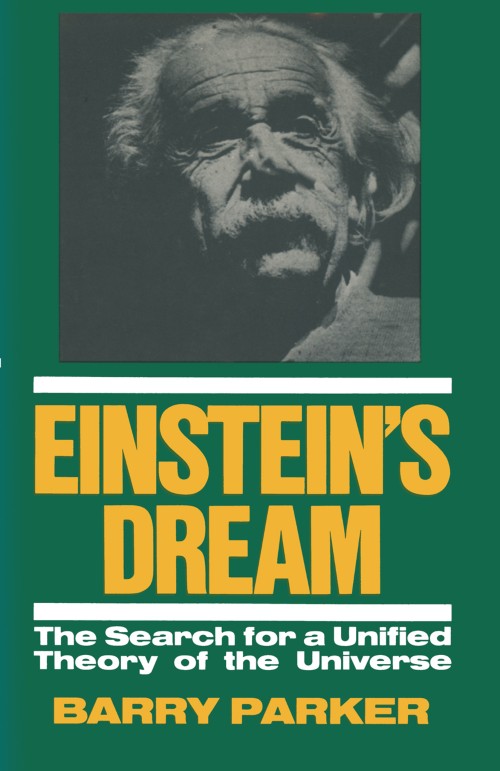
245 10|aEinstein’s Dream|h[electronic resource] :|bThe Search for a Unified Theory of the Universe /|cby Barry R. Parker.
250 |a1st ed. 1986.
264 1|aNew York, NY :|bSpringer US :|bImprint: Springer,|c1986.
300 |aIX, 287 p. 30 illus.|bonline resource.
336 |atext|btxt|2rdacontent
337 |acomputer|bc|2rdamedia
338 |aonline resource|bcr|2rdacarrier
347 |atext file|bPDF|2rda
505 0 |aThe Goal -- Warped Space-Time -- Early Unified Field Theories -- Star Death -- The Ultimate Abyss: The Black Hole -- The Early Universe -- Cosmological Controversy -- The Final Fate of the Universe -- The World of Particles and Fields -- A Unified Theory of the Universe -- Epilogue.
520 |aThirty years ago Albert Einstein died, his dream of a theory that would unify the universe unfulfilled. He spent the last decades of his life searching for such a theory-a theory that would explain everything from elementary particles and their interac tions to the overall structure of the universe. But he failed, not because he didn't try hard enough, but because the attempt was ahead of its time. When Einstein worked on the problem liter ally nothing was known about black holes, white holes, sin gularities, the Big Bang explosion and the early universe, quarks, gauge invariance, and weak and strong nuclear forces. Today we know that all these things are important in relation to a unified theory, and that they must be incorporated in and explained by such a theory. Thus, in a sense, our problem is much more complex today than it was in Einstein's day. But scientists have persevered and as a result we are now tan talizingly close to achieving this long-sought goal. Important breakthroughs have been made. In this book we will look at these breakthroughs and at recent unified theories-theories that go by the names supergravity, superstrings, GUTs, and twistor theory. In order to understand the problem, however, we must begin at the beginning.
532 8 |aAccessibility summary: This PDF is not accessible. It is based on scanned pages and does not support features such as screen reader compatibility or described non-text content (images, graphs etc). However, it likely supports searchable and selectable text based on OCR (Optical Character Recognition). Users with accessibility needs may not be able to use this content effectively. Please contact us at accessibilitysupport@springernature.com if you require assistance or an alternative format.
532 8 |aInaccessible, or known limited accessibility
532 8 |aNo reading system accessibility options actively disabled
532 8 |aPublisher contact for further accessibility information: accessibilitysupport@springernature.com
650 0|aEngineering.
650 0|aLife sciences.
650 0|aSocial sciences.
650 0|aHumanities.
650 0|aScience.
650 0|aMathematics.
650 0|aPhysics.
650 0|aAstronomy.
650 14|aTechnology and Engineering.
650 24|aLife Sciences.
650 24|aHumanities and Social Sciences.
650 24|aPhysical Sciences.
650 24|aMathematics and Computing.
650 24|aPhysics and Astronomy.
710 2 |aSpringerLink (Online service)
773 0 |tSpringer Nature eBook
776 08|iPrinted edition:|z9780306423437
776 08|iPrinted edition:|z9781489927651
856 40|uhttps://doi.org/10.1007/978-1-4899-2764-4
912 |aZDB-2-SHU
912 |aZDB-2-SXH
912 |aZDB-2-BAE
950 |aHumanities, Social Sciences and Law (SpringerNature-11648)
950 |aHistory (R0) (SpringerNature-43722)