

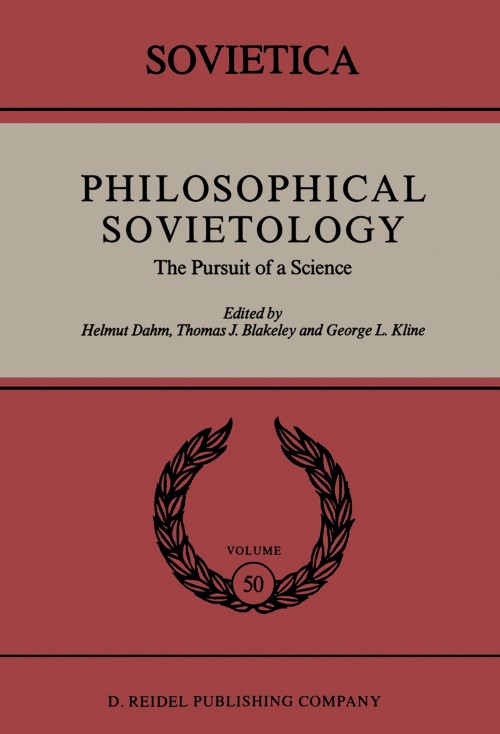
Philosophical Sovietology [electronic resource] : The Pursuit of a Science / by Helmut Dahm, J.E. Blakeley, George L. Kline.
Erişim Adresi
ISBN
9789400940314
Dil Kodu
İngilizce
Yer Numarası
DK/11492
Yazar
Basım Bildirimi
1st ed. 1988.
Yayın Bilgisi
Dordrecht : Springer Netherlands : Imprint: Springer, 1988.
Fiziksel Niteleme
282 p. online resource.
Dizi
Sovietica ; 50
İçindekiler Notu
J.M. Boche?ski’s Accomplishments as Philosophical Sovietologist -- The Philosophical-Sovietological Work of Gustav Andreas Wetter S.J. -- G.A. Wetter: Selected Sovietological Works -- The Myth of Marx’ Materialism -- Appendix I: A Critical Examination of Engels’ Tendentious Editing of the First English Translation of Das Kapital, Volume 1 -- Appendix II: A Comparison of the First French Translation of Das Kapital, Volume 1 (in which Marx was heavily involved) with the Engels Edition -- George L. Kline: Writings on Russian and Soviet Philosophy -- George L. Kline: Writings on Marx, Engels, and Non-Russian Marxism -- Kline on Marx and Marxism -- George L. Kline’s Influence on the Study of Russian and Soviet Philosophy in the United States.
Özet, vb.
On February 24-25, 1956, in a closed session of the 20th Congress of the Communist Party of the Soviet Union, Nikita S. Khrushchev made his now famous speech on the crimes of the Stalin era. That speech marked a break with the past and it marked the end of what J.M. Bochenski dubbed the "dead period" of Soviet philosophy. Soviet philosophy changed abruptly after 1956, especially in the area of dialectical materialism. Yet most philosophers in the West neither noticed nor cared. For them, the resurrection of Soviet philosophy, even if believable, was of little interest. The reasons for the lack of belief and interest were multiple. Soviet philosophy had been dull for so long that subtle differences made little difference. The Cold War was in a frigid period and reinforced the attitude of avoiding anything Soviet. Phenomenology and exis tentialism were booming in Europe and analytic philosophy was king on the Anglo-American philosophical scene. Moreover, not many philosophers in the West knew or could read Russian or were motivated to learn it to be able to read Soviet philosophical works. The launching of Sputnik awakened the West from its self complacent slumbers. Academic interest in the Soviet Union grew.
Konu
Political science __ Philosophy.
Political Philosophy.
Political Philosophy.
Diğer Yazarlar
Kurum Adı
Eseri Alıntıla
Referansları kullanmadan önce gözden geçirmeniz ve varsa gerekli düzeltmeleri yapmanız önerilir.
Dijital Kaynak
MARC Görünümü
LEADER 04575nam a22005535i 4500
001 810212
003 TR_AnAIT
005 20260131020849
007 cr nn 008mamaa
008 121227s1988 ne | s |||| 0|eng d
020 |a9789400940314|9978-94-009-4031-4
024 7 |a10.1007/978-94-009-4031-4|2doi
041 |aeng
049 |aTürk Tarih Kurumu Kütüphanesi
050 4|aB65
072 7|aHPS|2bicssc
072 7|aPHI019000|2bisacsh
072 7|aQDTS|2thema
082 04|a320.01|223
090 |aDK/11492
100 1 |aDahm, Helmut.|eauthor.|4aut|4http://id.loc.gov/vocabulary/relators/aut
245 10|aPhilosophical Sovietology|h[electronic resource] :|bThe Pursuit of a Science /|cby Helmut Dahm, J.E. Blakeley, George L. Kline.
250 |a1st ed. 1988.
264 1|aDordrecht :|bSpringer Netherlands :|bImprint: Springer,|c1988.
300 |a282 p.|bonline resource.
336 |atext|btxt|2rdacontent
337 |acomputer|bc|2rdamedia
338 |aonline resource|bcr|2rdacarrier
347 |atext file|bPDF|2rda
490 1 |aSovietica ;|v50
505 0 |aJ.M. Boche?ski’s Accomplishments as Philosophical Sovietologist -- The Philosophical-Sovietological Work of Gustav Andreas Wetter S.J. -- G.A. Wetter: Selected Sovietological Works -- The Myth of Marx’ Materialism -- Appendix I: A Critical Examination of Engels’ Tendentious Editing of the First English Translation of Das Kapital, Volume 1 -- Appendix II: A Comparison of the First French Translation of Das Kapital, Volume 1 (in which Marx was heavily involved) with the Engels Edition -- George L. Kline: Writings on Russian and Soviet Philosophy -- George L. Kline: Writings on Marx, Engels, and Non-Russian Marxism -- Kline on Marx and Marxism -- George L. Kline’s Influence on the Study of Russian and Soviet Philosophy in the United States.
520 |aOn February 24-25, 1956, in a closed session of the 20th Congress of the Communist Party of the Soviet Union, Nikita S. Khrushchev made his now famous speech on the crimes of the Stalin era. That speech marked a break with the past and it marked the end of what J.M. Bochenski dubbed the "dead period" of Soviet philosophy. Soviet philosophy changed abruptly after 1956, especially in the area of dialectical materialism. Yet most philosophers in the West neither noticed nor cared. For them, the resurrection of Soviet philosophy, even if believable, was of little interest. The reasons for the lack of belief and interest were multiple. Soviet philosophy had been dull for so long that subtle differences made little difference. The Cold War was in a frigid period and reinforced the attitude of avoiding anything Soviet. Phenomenology and exis tentialism were booming in Europe and analytic philosophy was king on the Anglo-American philosophical scene. Moreover, not many philosophers in the West knew or could read Russian or were motivated to learn it to be able to read Soviet philosophical works. The launching of Sputnik awakened the West from its self complacent slumbers. Academic interest in the Soviet Union grew.
532 8 |aAccessibility summary: This PDF is not accessible. It is based on scanned pages and does not support features such as screen reader compatibility or described non-text content (images, graphs etc). However, it likely supports searchable and selectable text based on OCR (Optical Character Recognition). Users with accessibility needs may not be able to use this content effectively. Please contact us at accessibilitysupport@springernature.com if you require assistance or an alternative format.
532 8 |aInaccessible, or known limited accessibility
532 8 |aNo reading system accessibility options actively disabled
532 8 |aPublisher contact for further accessibility information: accessibilitysupport@springernature.com
650 0|aPolitical science|xPhilosophy.
650 14|aPolitical Philosophy.
700 1 |aBlakeley, J.E.|eauthor.|4aut|4http://id.loc.gov/vocabulary/relators/aut
700 1 |aKline, George L.|eauthor.|4aut|4http://id.loc.gov/vocabulary/relators/aut
710 2 |aSpringerLink (Online service)
773 0 |tSpringer Nature eBook
776 08|iPrinted edition:|z9789027726377
776 08|iPrinted edition:|z9789400940321
776 08|iPrinted edition:|z9789401082891
830 0|aSovietica ;|v50
856 40|uhttps://doi.org/10.1007/978-94-009-4031-4
912 |aZDB-2-SHU
912 |aZDB-2-SXPR
912 |aZDB-2-BAE
950 |aHumanities, Social Sciences and Law (SpringerNature-11648)
950 |aPhilosophy and Religion (R0) (SpringerNature-43725)
001 810212
003 TR_AnAIT
005 20260131020849
007 cr nn 008mamaa
008 121227s1988 ne | s |||| 0|eng d
020 |a9789400940314|9978-94-009-4031-4
024 7 |a10.1007/978-94-009-4031-4|2doi
041 |aeng
049 |aTürk Tarih Kurumu Kütüphanesi
050 4|aB65
072 7|aHPS|2bicssc
072 7|aPHI019000|2bisacsh
072 7|aQDTS|2thema
082 04|a320.01|223
090 |aDK/11492
100 1 |aDahm, Helmut.|eauthor.|4aut|4http://id.loc.gov/vocabulary/relators/aut
245 10|aPhilosophical Sovietology|h[electronic resource] :|bThe Pursuit of a Science /|cby Helmut Dahm, J.E. Blakeley, George L. Kline.
250 |a1st ed. 1988.
264 1|aDordrecht :|bSpringer Netherlands :|bImprint: Springer,|c1988.
300 |a282 p.|bonline resource.
336 |atext|btxt|2rdacontent
337 |acomputer|bc|2rdamedia
338 |aonline resource|bcr|2rdacarrier
347 |atext file|bPDF|2rda
490 1 |aSovietica ;|v50
505 0 |aJ.M. Boche?ski’s Accomplishments as Philosophical Sovietologist -- The Philosophical-Sovietological Work of Gustav Andreas Wetter S.J. -- G.A. Wetter: Selected Sovietological Works -- The Myth of Marx’ Materialism -- Appendix I: A Critical Examination of Engels’ Tendentious Editing of the First English Translation of Das Kapital, Volume 1 -- Appendix II: A Comparison of the First French Translation of Das Kapital, Volume 1 (in which Marx was heavily involved) with the Engels Edition -- George L. Kline: Writings on Russian and Soviet Philosophy -- George L. Kline: Writings on Marx, Engels, and Non-Russian Marxism -- Kline on Marx and Marxism -- George L. Kline’s Influence on the Study of Russian and Soviet Philosophy in the United States.
520 |aOn February 24-25, 1956, in a closed session of the 20th Congress of the Communist Party of the Soviet Union, Nikita S. Khrushchev made his now famous speech on the crimes of the Stalin era. That speech marked a break with the past and it marked the end of what J.M. Bochenski dubbed the "dead period" of Soviet philosophy. Soviet philosophy changed abruptly after 1956, especially in the area of dialectical materialism. Yet most philosophers in the West neither noticed nor cared. For them, the resurrection of Soviet philosophy, even if believable, was of little interest. The reasons for the lack of belief and interest were multiple. Soviet philosophy had been dull for so long that subtle differences made little difference. The Cold War was in a frigid period and reinforced the attitude of avoiding anything Soviet. Phenomenology and exis tentialism were booming in Europe and analytic philosophy was king on the Anglo-American philosophical scene. Moreover, not many philosophers in the West knew or could read Russian or were motivated to learn it to be able to read Soviet philosophical works. The launching of Sputnik awakened the West from its self complacent slumbers. Academic interest in the Soviet Union grew.
532 8 |aAccessibility summary: This PDF is not accessible. It is based on scanned pages and does not support features such as screen reader compatibility or described non-text content (images, graphs etc). However, it likely supports searchable and selectable text based on OCR (Optical Character Recognition). Users with accessibility needs may not be able to use this content effectively. Please contact us at accessibilitysupport@springernature.com if you require assistance or an alternative format.
532 8 |aInaccessible, or known limited accessibility
532 8 |aNo reading system accessibility options actively disabled
532 8 |aPublisher contact for further accessibility information: accessibilitysupport@springernature.com
650 0|aPolitical science|xPhilosophy.
650 14|aPolitical Philosophy.
700 1 |aBlakeley, J.E.|eauthor.|4aut|4http://id.loc.gov/vocabulary/relators/aut
700 1 |aKline, George L.|eauthor.|4aut|4http://id.loc.gov/vocabulary/relators/aut
710 2 |aSpringerLink (Online service)
773 0 |tSpringer Nature eBook
776 08|iPrinted edition:|z9789027726377
776 08|iPrinted edition:|z9789400940321
776 08|iPrinted edition:|z9789401082891
830 0|aSovietica ;|v50
856 40|uhttps://doi.org/10.1007/978-94-009-4031-4
912 |aZDB-2-SHU
912 |aZDB-2-SXPR
912 |aZDB-2-BAE
950 |aHumanities, Social Sciences and Law (SpringerNature-11648)
950 |aPhilosophy and Religion (R0) (SpringerNature-43725)
Materyaller
Depodan talep edilen materyal sadece kütüphane içerisinde kullanılmaktadır.
Materyal dışarıya ödünç verilmemektedir.
Materyal dışarıya ödünç verilmemektedir.
