

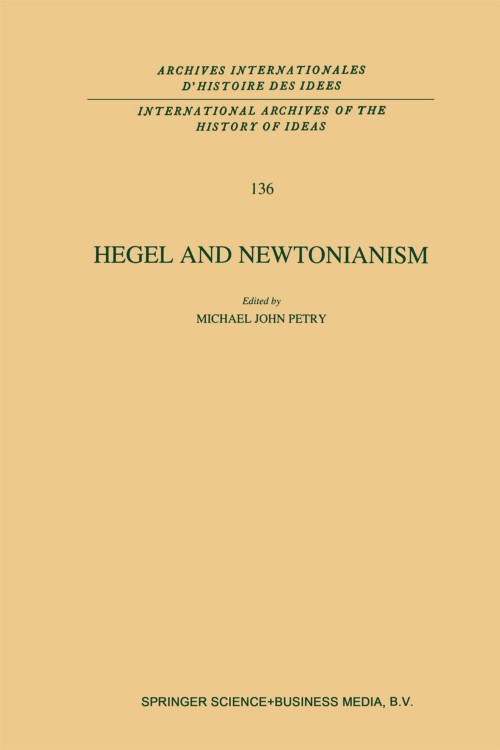
Hegel and Newtonianism [electronic resource] / edited by Michael John Petry.
Erişim Adresi
ISBN
9789401116626
Dil Kodu
İngilizce
Yer Numarası
DK/11495
Basım Bildirimi
1st ed. 1993.
Yayın Bilgisi
Dordrecht : Springer Netherlands : Imprint: Springer, 1993.
Fiziksel Niteleme
XIV, 793 p. online resource.
Dizi
International Archives of the History of Ideas Archives internationales d'histoire des idées, 2215-0307 ; 136
İçindekiler Notu
One: Metaphysics -- 1. Metaphysics and Scientific Proof: Newton and Hegel -- 2. The Conflict between Newton’s Analysis of Configurations and Hegel’s Conceptual Analysis -- 3. Analysis, Synthesis and Dialectic: Hegel’s Answer to Aristotle, Newton and Kant -- 4. Gravity, Polarity and Dialectical Method -- 5. Hegel on the Interaction between Science and Philosophy -- 6. Hegel’s Interpretation of Classical Mechanics -- 7. The Philosophical Background to Hegel’s Criticism of Newton -- 8. The Logic of Hegel’s Philosophy of Nature -- 9. Defending Hegel’s Philosophy of Nature -- 10. Newton and Hegel: Can Science Explain the Scientist? -- 11. Newton’s Pantokrator and Hegel’s Absolute Mind -- Two: Mathematics -- 12. The Method of Exhaustion as a Model for the Calculus -- 13. Hegel on Greek Mathematics and the Modern Calculus -- 14. Newton and British Newtonians on the Foundations of the Calculus -- 15. The Dialectical Structure of Zeno’s Arguments -- 16. Hegel’s Heritage in Applied Mathematics: A Plurality of Traditions -- 17. Hegel on Mathematics and Experimental Science -- Three: Mechanics -- 18. Inertial and Gravitational Mass: Newton, Hegel and Modern Physics -- 19. The Problem of Mass in Hegel -- 20. Pendulums in Newtonian Mechanics -- 21. Classifying the Motion: Hegel on the Pendulum -- 22. The Problem of Falling Bodies — from Galilei to Lagrange -- 23. Hegel on Galilei’s Law of Fall -- Four: Celestial Mechanics -- 24. Eighteenth-Century Conceptions of Gravitation -- 25. Hegel’s Treatment of Universal Gravitation -- 26. The Concept of Force in Eighteenth-Century Mechanics -- 27. Hegel’s Rejection of the Concept of Force -- 28. Universal Gravitation from Elliptical Orbits -- 29. A Worm in Newton’s Apple -- 30. The Significance of Kepler’s Laws -- Five: Optics -- 31. The EarlyDebate Concerning Wave-Theory -- 32. Hegel on Mechanistic Models of Light -- 33. Newton’s Rejection of the Modification Theory of Colour -- 34. Hegel’ s Exposition of Goethe’s Theory of Colour -- 35. Newton’s Colour-Theory and Perception -- 36. Hegel on Shadows and the Blue of the Sky -- Six: Chemistry -- 37. Newtonian Atomism and Eighteenth-Century Chemistry -- 38. Chemistry and Hegel’s Logic -- 39. Newton and Eighteenth-Century Conceptions of Chemical Affinity -- 40. The Significance of Hegel’s Treatment of Chemical Affinity -- 41. Is Nature Conformable to Herself? -- 42. Hegel on Chemistry and the Organic Sciences -- Seven: Bibliographical -- 43. Hegel’s Library: The Works on Mathematics, Mechanics, Optics and Chemistry -- 44. Hegel’s Library: The Newton Editions -- About the Authors -- Abbreviations.
Özet, vb.
It could certainly be argued that the way in which Hegel criticizes Newton in the Dissertation, the Philosophy of Nature and the lectures on the History of Philosophy, has done more than anything else to prejudice his own reputation. At first sight, what we seem to have here is little more than the contrast between the tested accomplishments of the founding father of modern science, and the random remarks of a confused and somewhat disgruntled philosopher; and if we are persuaded to concede that it may perhaps be something more than this - between the work of a clearsighted mathematician and experimentalist, and the blind assertions of some sort of Kantian logician, blundering about among the facts of the real world. By and large, it was this clear-cut simplistic view of the matter which prevailed among Hegel's contemporaries, and which persisted until fairly recently. The modification and eventual transformation of it have come about gradually, over the past twenty or twenty-five years. The first full-scale commentary on the Philosophy of Nature was published in 1970, and gave rise to the realization that to some extent at least, the Hegelian criticism was directed against Newtonianism rather than the work of Newton himself, and that it tended to draw its inspiration from developments within the natural sciences, rather than from the exigencies imposed upon Hegel's thinking by a priori categorial relationships.
Konu
Philosophy.
Philosophy, Modern.
History.
Philosophy.
Early Modern Philosophy.
History.
Philosophy, Modern.
History.
Philosophy.
Early Modern Philosophy.
History.
Diğer Yazarlar
Kurum Adı
Eseri Alıntıla
Referansları kullanmadan önce gözden geçirmeniz ve varsa gerekli düzeltmeleri yapmanız önerilir.
Dijital Kaynak
MARC Görünümü
LEADER 06766nam a22005775i 4500
001 810215
003 TR_AnAIT
005 20260131020832
007 cr nn 008mamaa
008 121227s1993 ne | s |||| 0|eng d
020 |a9789401116626|9978-94-011-1662-6
024 7 |a10.1007/978-94-011-1662-6|2doi
041 |aeng
049 |aTürk Tarih Kurumu Kütüphanesi
050 4|aB1-5802
072 7|aHP|2bicssc
072 7|aPHI000000|2bisacsh
072 7|aQD|2thema
082 04|a100|223
090 |aDK/11495
245 10|aHegel and Newtonianism|h[electronic resource] /|cedited by Michael John Petry.
250 |a1st ed. 1993.
264 1|aDordrecht :|bSpringer Netherlands :|bImprint: Springer,|c1993.
300 |aXIV, 793 p.|bonline resource.
336 |atext|btxt|2rdacontent
337 |acomputer|bc|2rdamedia
338 |aonline resource|bcr|2rdacarrier
347 |atext file|bPDF|2rda
490 1 |aInternational Archives of the History of Ideas Archives internationales d'histoire des idées,|x2215-0307 ;|v136
505 0 |aOne: Metaphysics -- 1. Metaphysics and Scientific Proof: Newton and Hegel -- 2. The Conflict between Newton’s Analysis of Configurations and Hegel’s Conceptual Analysis -- 3. Analysis, Synthesis and Dialectic: Hegel’s Answer to Aristotle, Newton and Kant -- 4. Gravity, Polarity and Dialectical Method -- 5. Hegel on the Interaction between Science and Philosophy -- 6. Hegel’s Interpretation of Classical Mechanics -- 7. The Philosophical Background to Hegel’s Criticism of Newton -- 8. The Logic of Hegel’s Philosophy of Nature -- 9. Defending Hegel’s Philosophy of Nature -- 10. Newton and Hegel: Can Science Explain the Scientist? -- 11. Newton’s Pantokrator and Hegel’s Absolute Mind -- Two: Mathematics -- 12. The Method of Exhaustion as a Model for the Calculus -- 13. Hegel on Greek Mathematics and the Modern Calculus -- 14. Newton and British Newtonians on the Foundations of the Calculus -- 15. The Dialectical Structure of Zeno’s Arguments -- 16. Hegel’s Heritage in Applied Mathematics: A Plurality of Traditions -- 17. Hegel on Mathematics and Experimental Science -- Three: Mechanics -- 18. Inertial and Gravitational Mass: Newton, Hegel and Modern Physics -- 19. The Problem of Mass in Hegel -- 20. Pendulums in Newtonian Mechanics -- 21. Classifying the Motion: Hegel on the Pendulum -- 22. The Problem of Falling Bodies — from Galilei to Lagrange -- 23. Hegel on Galilei’s Law of Fall -- Four: Celestial Mechanics -- 24. Eighteenth-Century Conceptions of Gravitation -- 25. Hegel’s Treatment of Universal Gravitation -- 26. The Concept of Force in Eighteenth-Century Mechanics -- 27. Hegel’s Rejection of the Concept of Force -- 28. Universal Gravitation from Elliptical Orbits -- 29. A Worm in Newton’s Apple -- 30. The Significance of Kepler’s Laws -- Five: Optics -- 31. The EarlyDebate Concerning Wave-Theory -- 32. Hegel on Mechanistic Models of Light -- 33. Newton’s Rejection of the Modification Theory of Colour -- 34. Hegel’ s Exposition of Goethe’s Theory of Colour -- 35. Newton’s Colour-Theory and Perception -- 36. Hegel on Shadows and the Blue of the Sky -- Six: Chemistry -- 37. Newtonian Atomism and Eighteenth-Century Chemistry -- 38. Chemistry and Hegel’s Logic -- 39. Newton and Eighteenth-Century Conceptions of Chemical Affinity -- 40. The Significance of Hegel’s Treatment of Chemical Affinity -- 41. Is Nature Conformable to Herself? -- 42. Hegel on Chemistry and the Organic Sciences -- Seven: Bibliographical -- 43. Hegel’s Library: The Works on Mathematics, Mechanics, Optics and Chemistry -- 44. Hegel’s Library: The Newton Editions -- About the Authors -- Abbreviations.
520 |aIt could certainly be argued that the way in which Hegel criticizes Newton in the Dissertation, the Philosophy of Nature and the lectures on the History of Philosophy, has done more than anything else to prejudice his own reputation. At first sight, what we seem to have here is little more than the contrast between the tested accomplishments of the founding father of modern science, and the random remarks of a confused and somewhat disgruntled philosopher; and if we are persuaded to concede that it may perhaps be something more than this - between the work of a clearsighted mathematician and experimentalist, and the blind assertions of some sort of Kantian logician, blundering about among the facts of the real world. By and large, it was this clear-cut simplistic view of the matter which prevailed among Hegel's contemporaries, and which persisted until fairly recently. The modification and eventual transformation of it have come about gradually, over the past twenty or twenty-five years. The first full-scale commentary on the Philosophy of Nature was published in 1970, and gave rise to the realization that to some extent at least, the Hegelian criticism was directed against Newtonianism rather than the work of Newton himself, and that it tended to draw its inspiration from developments within the natural sciences, rather than from the exigencies imposed upon Hegel's thinking by a priori categorial relationships.
532 8 |aAccessibility summary: This PDF is not accessible. It is based on scanned pages and does not support features such as screen reader compatibility or described non-text content (images, graphs etc). However, it likely supports searchable and selectable text based on OCR (Optical Character Recognition). Users with accessibility needs may not be able to use this content effectively. Please contact us at accessibilitysupport@springernature.com if you require assistance or an alternative format.
532 8 |aInaccessible, or known limited accessibility
532 8 |aNo reading system accessibility options actively disabled
532 8 |aPublisher contact for further accessibility information: accessibilitysupport@springernature.com
650 0|aPhilosophy.
650 0|aPhilosophy, Modern.
650 0|aHistory.
650 14|aPhilosophy.
650 24|aEarly Modern Philosophy.
650 24|aHistory.
700 1 |aPetry, Michael John.|eeditor.|4edt|4http://id.loc.gov/vocabulary/relators/edt
710 2 |aSpringerLink (Online service)
773 0 |tSpringer Nature eBook
776 08|iPrinted edition:|z9780792322023
776 08|iPrinted edition:|z9789401116633
776 08|iPrinted edition:|z9789401047265
830 0|aInternational Archives of the History of Ideas Archives internationales d'histoire des idées,|x2215-0307 ;|v136
856 40|uhttps://doi.org/10.1007/978-94-011-1662-6
912 |aZDB-2-SHU
912 |aZDB-2-SXPR
912 |aZDB-2-BAE
950 |aHumanities, Social Sciences and Law (SpringerNature-11648)
950 |aPhilosophy and Religion (R0) (SpringerNature-43725)
001 810215
003 TR_AnAIT
005 20260131020832
007 cr nn 008mamaa
008 121227s1993 ne | s |||| 0|eng d
020 |a9789401116626|9978-94-011-1662-6
024 7 |a10.1007/978-94-011-1662-6|2doi
041 |aeng
049 |aTürk Tarih Kurumu Kütüphanesi
050 4|aB1-5802
072 7|aHP|2bicssc
072 7|aPHI000000|2bisacsh
072 7|aQD|2thema
082 04|a100|223
090 |aDK/11495
245 10|aHegel and Newtonianism|h[electronic resource] /|cedited by Michael John Petry.
250 |a1st ed. 1993.
264 1|aDordrecht :|bSpringer Netherlands :|bImprint: Springer,|c1993.
300 |aXIV, 793 p.|bonline resource.
336 |atext|btxt|2rdacontent
337 |acomputer|bc|2rdamedia
338 |aonline resource|bcr|2rdacarrier
347 |atext file|bPDF|2rda
490 1 |aInternational Archives of the History of Ideas Archives internationales d'histoire des idées,|x2215-0307 ;|v136
505 0 |aOne: Metaphysics -- 1. Metaphysics and Scientific Proof: Newton and Hegel -- 2. The Conflict between Newton’s Analysis of Configurations and Hegel’s Conceptual Analysis -- 3. Analysis, Synthesis and Dialectic: Hegel’s Answer to Aristotle, Newton and Kant -- 4. Gravity, Polarity and Dialectical Method -- 5. Hegel on the Interaction between Science and Philosophy -- 6. Hegel’s Interpretation of Classical Mechanics -- 7. The Philosophical Background to Hegel’s Criticism of Newton -- 8. The Logic of Hegel’s Philosophy of Nature -- 9. Defending Hegel’s Philosophy of Nature -- 10. Newton and Hegel: Can Science Explain the Scientist? -- 11. Newton’s Pantokrator and Hegel’s Absolute Mind -- Two: Mathematics -- 12. The Method of Exhaustion as a Model for the Calculus -- 13. Hegel on Greek Mathematics and the Modern Calculus -- 14. Newton and British Newtonians on the Foundations of the Calculus -- 15. The Dialectical Structure of Zeno’s Arguments -- 16. Hegel’s Heritage in Applied Mathematics: A Plurality of Traditions -- 17. Hegel on Mathematics and Experimental Science -- Three: Mechanics -- 18. Inertial and Gravitational Mass: Newton, Hegel and Modern Physics -- 19. The Problem of Mass in Hegel -- 20. Pendulums in Newtonian Mechanics -- 21. Classifying the Motion: Hegel on the Pendulum -- 22. The Problem of Falling Bodies — from Galilei to Lagrange -- 23. Hegel on Galilei’s Law of Fall -- Four: Celestial Mechanics -- 24. Eighteenth-Century Conceptions of Gravitation -- 25. Hegel’s Treatment of Universal Gravitation -- 26. The Concept of Force in Eighteenth-Century Mechanics -- 27. Hegel’s Rejection of the Concept of Force -- 28. Universal Gravitation from Elliptical Orbits -- 29. A Worm in Newton’s Apple -- 30. The Significance of Kepler’s Laws -- Five: Optics -- 31. The EarlyDebate Concerning Wave-Theory -- 32. Hegel on Mechanistic Models of Light -- 33. Newton’s Rejection of the Modification Theory of Colour -- 34. Hegel’ s Exposition of Goethe’s Theory of Colour -- 35. Newton’s Colour-Theory and Perception -- 36. Hegel on Shadows and the Blue of the Sky -- Six: Chemistry -- 37. Newtonian Atomism and Eighteenth-Century Chemistry -- 38. Chemistry and Hegel’s Logic -- 39. Newton and Eighteenth-Century Conceptions of Chemical Affinity -- 40. The Significance of Hegel’s Treatment of Chemical Affinity -- 41. Is Nature Conformable to Herself? -- 42. Hegel on Chemistry and the Organic Sciences -- Seven: Bibliographical -- 43. Hegel’s Library: The Works on Mathematics, Mechanics, Optics and Chemistry -- 44. Hegel’s Library: The Newton Editions -- About the Authors -- Abbreviations.
520 |aIt could certainly be argued that the way in which Hegel criticizes Newton in the Dissertation, the Philosophy of Nature and the lectures on the History of Philosophy, has done more than anything else to prejudice his own reputation. At first sight, what we seem to have here is little more than the contrast between the tested accomplishments of the founding father of modern science, and the random remarks of a confused and somewhat disgruntled philosopher; and if we are persuaded to concede that it may perhaps be something more than this - between the work of a clearsighted mathematician and experimentalist, and the blind assertions of some sort of Kantian logician, blundering about among the facts of the real world. By and large, it was this clear-cut simplistic view of the matter which prevailed among Hegel's contemporaries, and which persisted until fairly recently. The modification and eventual transformation of it have come about gradually, over the past twenty or twenty-five years. The first full-scale commentary on the Philosophy of Nature was published in 1970, and gave rise to the realization that to some extent at least, the Hegelian criticism was directed against Newtonianism rather than the work of Newton himself, and that it tended to draw its inspiration from developments within the natural sciences, rather than from the exigencies imposed upon Hegel's thinking by a priori categorial relationships.
532 8 |aAccessibility summary: This PDF is not accessible. It is based on scanned pages and does not support features such as screen reader compatibility or described non-text content (images, graphs etc). However, it likely supports searchable and selectable text based on OCR (Optical Character Recognition). Users with accessibility needs may not be able to use this content effectively. Please contact us at accessibilitysupport@springernature.com if you require assistance or an alternative format.
532 8 |aInaccessible, or known limited accessibility
532 8 |aNo reading system accessibility options actively disabled
532 8 |aPublisher contact for further accessibility information: accessibilitysupport@springernature.com
650 0|aPhilosophy.
650 0|aPhilosophy, Modern.
650 0|aHistory.
650 14|aPhilosophy.
650 24|aEarly Modern Philosophy.
650 24|aHistory.
700 1 |aPetry, Michael John.|eeditor.|4edt|4http://id.loc.gov/vocabulary/relators/edt
710 2 |aSpringerLink (Online service)
773 0 |tSpringer Nature eBook
776 08|iPrinted edition:|z9780792322023
776 08|iPrinted edition:|z9789401116633
776 08|iPrinted edition:|z9789401047265
830 0|aInternational Archives of the History of Ideas Archives internationales d'histoire des idées,|x2215-0307 ;|v136
856 40|uhttps://doi.org/10.1007/978-94-011-1662-6
912 |aZDB-2-SHU
912 |aZDB-2-SXPR
912 |aZDB-2-BAE
950 |aHumanities, Social Sciences and Law (SpringerNature-11648)
950 |aPhilosophy and Religion (R0) (SpringerNature-43725)
Materyaller
Depodan talep edilen materyal sadece kütüphane içerisinde kullanılmaktadır.
Materyal dışarıya ödünç verilmemektedir.
Materyal dışarıya ödünç verilmemektedir.
