

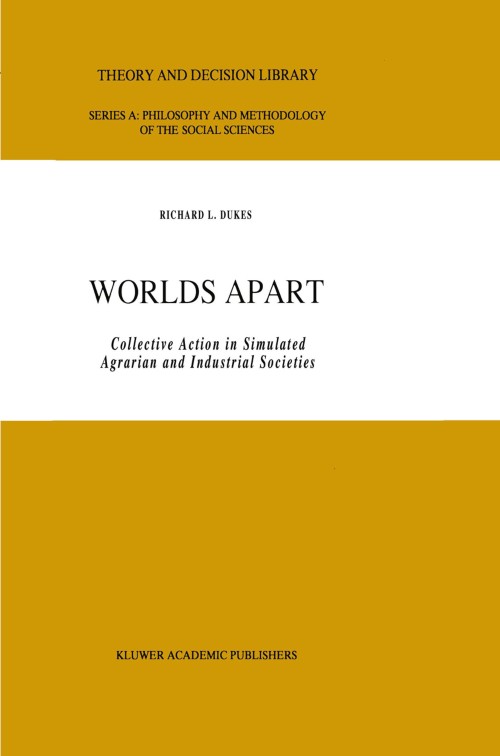
Worlds Apart [electronic resource] : Collective Action in Simulated Agrarian and Industrial Societies / by R.L. Dukes.
Erişim Adresi
ISBN
9789400919624
Dil Kodu
İngilizce
Yer Numarası
DK/11497
Yazar
Basım Bildirimi
1st ed. 1990.
Yayın Bilgisi
Dordrecht : Springer Netherlands : Imprint: Springer, 1990.
Fiziksel Niteleme
XIV, 194 p. online resource.
Dizi
Theory and Decision Library A:, Rational Choice in Practical Philosophy and Philosophy of Science, 2352-2119 ; 14
İçindekiler Notu
One — Gamed Simulations for Social Scientists -- Gaming in the College Classroom -- Scientific Gaming -- Gamed Simulation -- Social Science Research with Gamed Simulations -- Games Versus Real Life -- The Industrial Revolution -- Starpower -- Research Design -- Stratification in Agrarian and Industrial Society Contrasted -- Findings About Conflict and Change -- What is a Gamed Simulation? -- Simulation -- Gamed Simulations -- two — History of Gamed Simulation in Social Science Research -- Inter-Nation Simulation (INS) -- Simsoc (Simulated Society) -- Starpower -- High School -- Generation Gap -- The Commons Game -- Conclusion -- three — Theory -- Social Structure -- Open and Closed Social Systems -- Implications of Social Structure for Empirical Predictions Concerning Play of Starpower -- Status Characteristics -- The Intergroup Association Block -- The Formation of Interests and Perceptions -- Group Size and the Organization of Interest Groups -- The Second Round -- Rule Change Portion of the Game and Class Conflict -- Mobilization -- Group Interaction -- Rule Changes -- Elite Theory -- Law -- Repression -- Collective Action -- The Results of Repression and Collective Action -- Four — History and Rules of Starpower -- History -- How Starpower is Played -- Transcript of a Play of Starpower -- Five — Operationalization of Concepts of the Theory Model -- The Social Structural Block: Manipulated Variables -- Variables of the Status Characteristics Block -- Round 2 -- The Rule Change Portion of the Game -- Round 3 -- Six — Hypotheses to be Tested in the Starpower Simulation -- Components of the Theoretical Model -- Round 2 -- The End of Round 2 -- The Rule Change Portion of the Game -- Round 3 -- Summary of the Hypotheses -- Seven — Research Procedures -- The Classroom Groups -- Player Characteristics -- Size ofSocieties -- Size of Social Classes -- Late Arriving Players -- Starpower and the Sociology and Social Anthropology Curriculum -- Game Administration -- Identification Tags -- Player’s Logs -- Timing of Rounds -- Standardized Bonus Rounds -- Round 3 -- Rule Changes -- Collective Action -- Debriefing -- Summary -- Eight — Qualitative Analysis of Starpower -- The Day We Played Starpower: Observations by a Fictitious Player -- Group Bonus -- Motility -- Rule Changes -- Collective Action -- Comments by Players -- Summary of the Observations -- Nine — Findings from the Quantitative Analysis of Collective Action in Starpower -- Round 1 -- Round 2 -- Transition Period at the end of Round 2 -- Rule Changes -- Verbal Interactions -- Collective Action -- Round 3 -- Summary of Data Analysis -- Afterword -- Appendix a — Sample Scoresheet -- References.
Konu
Sociology.
Political science.
Sociology.
Political Science.
Political science.
Sociology.
Political Science.
Kurum Adı
Eseri Alıntıla
Referansları kullanmadan önce gözden geçirmeniz ve varsa gerekli düzeltmeleri yapmanız önerilir.
Dijital Kaynak
MARC Görünümü
LEADER 05385nam a22005655i 4500
001 810217
003 TR_AnAIT
005 20260131020822
007 cr nn 008mamaa
008 121227s1990 ne | s |||| 0|eng d
020 |a9789400919624|9978-94-009-1962-4
024 7 |a10.1007/978-94-009-1962-4|2doi
041 |aeng
049 |aTürk Tarih Kurumu Kütüphanesi
050 4|aHM
072 7|aJHB|2bicssc
072 7|aJHB|2bicssc
072 7|aSOC026000|2bisacsh
072 7|aJHB|2thema
072 7|aJHB|2thema
082 04|a301|223
090 |aDK/11497
100 1 |aDukes, R.L.|eauthor.|4aut|4http://id.loc.gov/vocabulary/relators/aut
245 10|aWorlds Apart|h[electronic resource] :|bCollective Action in Simulated Agrarian and Industrial Societies /|cby R.L. Dukes.
250 |a1st ed. 1990.
264 1|aDordrecht :|bSpringer Netherlands :|bImprint: Springer,|c1990.
300 |aXIV, 194 p.|bonline resource.
336 |atext|btxt|2rdacontent
337 |acomputer|bc|2rdamedia
338 |aonline resource|bcr|2rdacarrier
347 |atext file|bPDF|2rda
490 1 |aTheory and Decision Library A:, Rational Choice in Practical Philosophy and Philosophy of Science,|x2352-2119 ;|v14
505 0 |aOne — Gamed Simulations for Social Scientists -- Gaming in the College Classroom -- Scientific Gaming -- Gamed Simulation -- Social Science Research with Gamed Simulations -- Games Versus Real Life -- The Industrial Revolution -- Starpower -- Research Design -- Stratification in Agrarian and Industrial Society Contrasted -- Findings About Conflict and Change -- What is a Gamed Simulation? -- Simulation -- Gamed Simulations -- two — History of Gamed Simulation in Social Science Research -- Inter-Nation Simulation (INS) -- Simsoc (Simulated Society) -- Starpower -- High School -- Generation Gap -- The Commons Game -- Conclusion -- three — Theory -- Social Structure -- Open and Closed Social Systems -- Implications of Social Structure for Empirical Predictions Concerning Play of Starpower -- Status Characteristics -- The Intergroup Association Block -- The Formation of Interests and Perceptions -- Group Size and the Organization of Interest Groups -- The Second Round -- Rule Change Portion of the Game and Class Conflict -- Mobilization -- Group Interaction -- Rule Changes -- Elite Theory -- Law -- Repression -- Collective Action -- The Results of Repression and Collective Action -- Four — History and Rules of Starpower -- History -- How Starpower is Played -- Transcript of a Play of Starpower -- Five — Operationalization of Concepts of the Theory Model -- The Social Structural Block: Manipulated Variables -- Variables of the Status Characteristics Block -- Round 2 -- The Rule Change Portion of the Game -- Round 3 -- Six — Hypotheses to be Tested in the Starpower Simulation -- Components of the Theoretical Model -- Round 2 -- The End of Round 2 -- The Rule Change Portion of the Game -- Round 3 -- Summary of the Hypotheses -- Seven — Research Procedures -- The Classroom Groups -- Player Characteristics -- Size ofSocieties -- Size of Social Classes -- Late Arriving Players -- Starpower and the Sociology and Social Anthropology Curriculum -- Game Administration -- Identification Tags -- Player’s Logs -- Timing of Rounds -- Standardized Bonus Rounds -- Round 3 -- Rule Changes -- Collective Action -- Debriefing -- Summary -- Eight — Qualitative Analysis of Starpower -- The Day We Played Starpower: Observations by a Fictitious Player -- Group Bonus -- Motility -- Rule Changes -- Collective Action -- Comments by Players -- Summary of the Observations -- Nine — Findings from the Quantitative Analysis of Collective Action in Starpower -- Round 1 -- Round 2 -- Transition Period at the end of Round 2 -- Rule Changes -- Verbal Interactions -- Collective Action -- Round 3 -- Summary of Data Analysis -- Afterword -- Appendix a — Sample Scoresheet -- References.
532 8 |aAccessibility summary: This PDF is not accessible. It is based on scanned pages and does not support features such as screen reader compatibility or described non-text content (images, graphs etc). However, it likely supports searchable and selectable text based on OCR (Optical Character Recognition). Users with accessibility needs may not be able to use this content effectively. Please contact us at accessibilitysupport@springernature.com if you require assistance or an alternative format.
532 8 |aInaccessible, or known limited accessibility
532 8 |aNo reading system accessibility options actively disabled
532 8 |aPublisher contact for further accessibility information: accessibilitysupport@springernature.com
650 0|aSociology.
650 0|aPolitical science.
650 14|aSociology.
650 24|aPolitical Science.
710 2 |aSpringerLink (Online service)
773 0 |tSpringer Nature eBook
776 08|iPrinted edition:|z9780792306207
776 08|iPrinted edition:|z9789400919631
776 08|iPrinted edition:|z9789401073776
830 0|aTheory and Decision Library A:, Rational Choice in Practical Philosophy and Philosophy of Science,|x2352-2119 ;|v14
856 40|uhttps://doi.org/10.1007/978-94-009-1962-4
912 |aZDB-2-SHU
912 |aZDB-2-SXS
912 |aZDB-2-BAE
950 |aHumanities, Social Sciences and Law (SpringerNature-11648)
950 |aSocial Sciences (R0) (SpringerNature-43726)
001 810217
003 TR_AnAIT
005 20260131020822
007 cr nn 008mamaa
008 121227s1990 ne | s |||| 0|eng d
020 |a9789400919624|9978-94-009-1962-4
024 7 |a10.1007/978-94-009-1962-4|2doi
041 |aeng
049 |aTürk Tarih Kurumu Kütüphanesi
050 4|aHM
072 7|aJHB|2bicssc
072 7|aJHB|2bicssc
072 7|aSOC026000|2bisacsh
072 7|aJHB|2thema
072 7|aJHB|2thema
082 04|a301|223
090 |aDK/11497
100 1 |aDukes, R.L.|eauthor.|4aut|4http://id.loc.gov/vocabulary/relators/aut
245 10|aWorlds Apart|h[electronic resource] :|bCollective Action in Simulated Agrarian and Industrial Societies /|cby R.L. Dukes.
250 |a1st ed. 1990.
264 1|aDordrecht :|bSpringer Netherlands :|bImprint: Springer,|c1990.
300 |aXIV, 194 p.|bonline resource.
336 |atext|btxt|2rdacontent
337 |acomputer|bc|2rdamedia
338 |aonline resource|bcr|2rdacarrier
347 |atext file|bPDF|2rda
490 1 |aTheory and Decision Library A:, Rational Choice in Practical Philosophy and Philosophy of Science,|x2352-2119 ;|v14
505 0 |aOne — Gamed Simulations for Social Scientists -- Gaming in the College Classroom -- Scientific Gaming -- Gamed Simulation -- Social Science Research with Gamed Simulations -- Games Versus Real Life -- The Industrial Revolution -- Starpower -- Research Design -- Stratification in Agrarian and Industrial Society Contrasted -- Findings About Conflict and Change -- What is a Gamed Simulation? -- Simulation -- Gamed Simulations -- two — History of Gamed Simulation in Social Science Research -- Inter-Nation Simulation (INS) -- Simsoc (Simulated Society) -- Starpower -- High School -- Generation Gap -- The Commons Game -- Conclusion -- three — Theory -- Social Structure -- Open and Closed Social Systems -- Implications of Social Structure for Empirical Predictions Concerning Play of Starpower -- Status Characteristics -- The Intergroup Association Block -- The Formation of Interests and Perceptions -- Group Size and the Organization of Interest Groups -- The Second Round -- Rule Change Portion of the Game and Class Conflict -- Mobilization -- Group Interaction -- Rule Changes -- Elite Theory -- Law -- Repression -- Collective Action -- The Results of Repression and Collective Action -- Four — History and Rules of Starpower -- History -- How Starpower is Played -- Transcript of a Play of Starpower -- Five — Operationalization of Concepts of the Theory Model -- The Social Structural Block: Manipulated Variables -- Variables of the Status Characteristics Block -- Round 2 -- The Rule Change Portion of the Game -- Round 3 -- Six — Hypotheses to be Tested in the Starpower Simulation -- Components of the Theoretical Model -- Round 2 -- The End of Round 2 -- The Rule Change Portion of the Game -- Round 3 -- Summary of the Hypotheses -- Seven — Research Procedures -- The Classroom Groups -- Player Characteristics -- Size ofSocieties -- Size of Social Classes -- Late Arriving Players -- Starpower and the Sociology and Social Anthropology Curriculum -- Game Administration -- Identification Tags -- Player’s Logs -- Timing of Rounds -- Standardized Bonus Rounds -- Round 3 -- Rule Changes -- Collective Action -- Debriefing -- Summary -- Eight — Qualitative Analysis of Starpower -- The Day We Played Starpower: Observations by a Fictitious Player -- Group Bonus -- Motility -- Rule Changes -- Collective Action -- Comments by Players -- Summary of the Observations -- Nine — Findings from the Quantitative Analysis of Collective Action in Starpower -- Round 1 -- Round 2 -- Transition Period at the end of Round 2 -- Rule Changes -- Verbal Interactions -- Collective Action -- Round 3 -- Summary of Data Analysis -- Afterword -- Appendix a — Sample Scoresheet -- References.
532 8 |aAccessibility summary: This PDF is not accessible. It is based on scanned pages and does not support features such as screen reader compatibility or described non-text content (images, graphs etc). However, it likely supports searchable and selectable text based on OCR (Optical Character Recognition). Users with accessibility needs may not be able to use this content effectively. Please contact us at accessibilitysupport@springernature.com if you require assistance or an alternative format.
532 8 |aInaccessible, or known limited accessibility
532 8 |aNo reading system accessibility options actively disabled
532 8 |aPublisher contact for further accessibility information: accessibilitysupport@springernature.com
650 0|aSociology.
650 0|aPolitical science.
650 14|aSociology.
650 24|aPolitical Science.
710 2 |aSpringerLink (Online service)
773 0 |tSpringer Nature eBook
776 08|iPrinted edition:|z9780792306207
776 08|iPrinted edition:|z9789400919631
776 08|iPrinted edition:|z9789401073776
830 0|aTheory and Decision Library A:, Rational Choice in Practical Philosophy and Philosophy of Science,|x2352-2119 ;|v14
856 40|uhttps://doi.org/10.1007/978-94-009-1962-4
912 |aZDB-2-SHU
912 |aZDB-2-SXS
912 |aZDB-2-BAE
950 |aHumanities, Social Sciences and Law (SpringerNature-11648)
950 |aSocial Sciences (R0) (SpringerNature-43726)
Materyaller
Depodan talep edilen materyal sadece kütüphane içerisinde kullanılmaktadır.
Materyal dışarıya ödünç verilmemektedir.
Materyal dışarıya ödünç verilmemektedir.
