

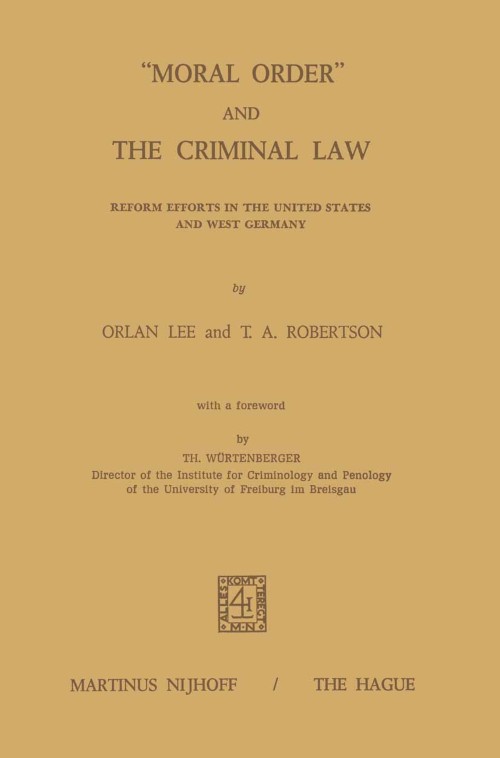
“Moral Order” and The Criminal Law [electronic resource] : Reform Efforts in the United States and West Germany / by O. Lee, T.A. Robertson.
Erişim Adresi
ISBN
9789401024389
Dil Kodu
İngilizce
Yer Numarası
DK/11509
Yazar
Basım Bildirimi
1st ed. 1973.
Yayın Bilgisi
Dordrecht : Springer Netherlands : Imprint: Springer, 1973.
Fiziksel Niteleme
290 p. online resource.
İçindekiler Notu
I: Crime, the Criminal law, and the Ethics of Criminalization -- A. The Extent of the Problem of Crime and Making the Criminal Law -- B. Individual Freedom and Social Order -- C. “The Right-Minded” and “The Reasonable Man” -- D. “The Community” and “The People” -- E. Legal Obligation and Moral Obligation -- Criminal Law and Reform in the United States -- II: Historical and Theoretical Problems -- III: Current issues and Selected Substantive Reforms -- Criminal Law and Reform in West Germany -- IV: Historical and Theoretical Problems: issues in the “General Part” of the Code -- V: Current issues and the Reform of the “Special Part” of the Code -- VI: Conclusions on the Role of Function and Ideal in Making the Law -- A Brief Bibliography of Sources on the German Criminal Law in English -- A Note on the U.S. Supreme Court’s Decisions on Abortion -- Index of Persons.
Özet, vb.
XIV Seen as a whole, however, I regard the work before us to be especially noteworthy precisely because of its illumination of both the social contexts surrounding the law and the ideas which underlie the efforts towards criminal law reform. An analysis of this kind has not appeared until now, to my knowledge, even in the German literature on the subject, so that this book is of great value to ·the German reader as well as the American. B. Particulars In Chapter IV: A the authors give a general introduction into the development of the German criminal law reform. In that connection they recognize the special role of the Christian Democratic (CDU), Socialist (SPD) coalition in the political situation [leading to passage of the reform law]. The authors emphasize the importance of the introduction of a uniform prison sentence [that is to say ·the termination of the distinction between kinds of prison sentences] and the elimination of short term prison sentences, as the main points of the reform in the "general part" of the code. They remark (pages 170; 192) that a uniform concept of the goal of punishment is still lacking, although, when all is said, there is a general agreement on the principle of resocialization.
Konu
Criminal law.
Criminal Law and Criminal Procedure Law.
Criminal Law and Criminal Procedure Law.
Diğer Yazarlar
Kurum Adı
Eseri Alıntıla
Referansları kullanmadan önce gözden geçirmeniz ve varsa gerekli düzeltmeleri yapmanız önerilir.
Dijital Kaynak
MARC Görünümü
LEADER 04537nam a22005055i 4500
001 810229
003 TR_AnAIT
005 20260131020805
007 cr nn 008mamaa
008 121227s1973 ne | s |||| 0|eng d
020 |a9789401024389|9978-94-010-2438-9
024 7 |a10.1007/978-94-010-2438-9|2doi
041 |aeng
049 |aTürk Tarih Kurumu Kütüphanesi
050 4|aK5000-5582
072 7|aLNF|2bicssc
072 7|aLAW026000|2bisacsh
072 7|aLNF|2thema
082 04|a345|223
090 |aDK/11509
100 1 |aLee, O.|eauthor.|4aut|4http://id.loc.gov/vocabulary/relators/aut
245 10|a“Moral Order” and The Criminal Law|h[electronic resource] :|bReform Efforts in the United States and West Germany /|cby O. Lee, T.A. Robertson.
250 |a1st ed. 1973.
264 1|aDordrecht :|bSpringer Netherlands :|bImprint: Springer,|c1973.
300 |a290 p.|bonline resource.
336 |atext|btxt|2rdacontent
337 |acomputer|bc|2rdamedia
338 |aonline resource|bcr|2rdacarrier
347 |atext file|bPDF|2rda
505 0 |aI: Crime, the Criminal law, and the Ethics of Criminalization -- A. The Extent of the Problem of Crime and Making the Criminal Law -- B. Individual Freedom and Social Order -- C. “The Right-Minded” and “The Reasonable Man” -- D. “The Community” and “The People” -- E. Legal Obligation and Moral Obligation -- Criminal Law and Reform in the United States -- II: Historical and Theoretical Problems -- III: Current issues and Selected Substantive Reforms -- Criminal Law and Reform in West Germany -- IV: Historical and Theoretical Problems: issues in the “General Part” of the Code -- V: Current issues and the Reform of the “Special Part” of the Code -- VI: Conclusions on the Role of Function and Ideal in Making the Law -- A Brief Bibliography of Sources on the German Criminal Law in English -- A Note on the U.S. Supreme Court’s Decisions on Abortion -- Index of Persons.
520 |aXIV Seen as a whole, however, I regard the work before us to be especially noteworthy precisely because of its illumination of both the social contexts surrounding the law and the ideas which underlie the efforts towards criminal law reform. An analysis of this kind has not appeared until now, to my knowledge, even in the German literature on the subject, so that this book is of great value to ·the German reader as well as the American. B. Particulars In Chapter IV: A the authors give a general introduction into the development of the German criminal law reform. In that connection they recognize the special role of the Christian Democratic (CDU), Socialist (SPD) coalition in the political situation [leading to passage of the reform law]. The authors emphasize the importance of the introduction of a uniform prison sentence [that is to say ·the termination of the distinction between kinds of prison sentences] and the elimination of short term prison sentences, as the main points of the reform in the "general part" of the code. They remark (pages 170; 192) that a uniform concept of the goal of punishment is still lacking, although, when all is said, there is a general agreement on the principle of resocialization.
532 8 |aAccessibility summary: This PDF is not accessible. It is based on scanned pages and does not support features such as screen reader compatibility or described non-text content (images, graphs etc). However, it likely supports searchable and selectable text based on OCR (Optical Character Recognition). Users with accessibility needs may not be able to use this content effectively. Please contact us at accessibilitysupport@springernature.com if you require assistance or an alternative format.
532 8 |aInaccessible, or known limited accessibility
532 8 |aNo reading system accessibility options actively disabled
532 8 |aPublisher contact for further accessibility information: accessibilitysupport@springernature.com
650 0|aCriminal law.
650 14|aCriminal Law and Criminal Procedure Law.
700 1 |aRobertson, T.A.|eauthor.|4aut|4http://id.loc.gov/vocabulary/relators/aut
710 2 |aSpringerLink (Online service)
773 0 |tSpringer Nature eBook
776 08|iPrinted edition:|z9789024715329
776 08|iPrinted edition:|z9789401024396
856 40|uhttps://doi.org/10.1007/978-94-010-2438-9
912 |aZDB-2-SHU
912 |aZDB-2-SXLC
912 |aZDB-2-BAE
950 |aHumanities, Social Sciences and Law (SpringerNature-11648)
950 |aLaw and Criminology (R0) (SpringerNature-43727)
001 810229
003 TR_AnAIT
005 20260131020805
007 cr nn 008mamaa
008 121227s1973 ne | s |||| 0|eng d
020 |a9789401024389|9978-94-010-2438-9
024 7 |a10.1007/978-94-010-2438-9|2doi
041 |aeng
049 |aTürk Tarih Kurumu Kütüphanesi
050 4|aK5000-5582
072 7|aLNF|2bicssc
072 7|aLAW026000|2bisacsh
072 7|aLNF|2thema
082 04|a345|223
090 |aDK/11509
100 1 |aLee, O.|eauthor.|4aut|4http://id.loc.gov/vocabulary/relators/aut
245 10|a“Moral Order” and The Criminal Law|h[electronic resource] :|bReform Efforts in the United States and West Germany /|cby O. Lee, T.A. Robertson.
250 |a1st ed. 1973.
264 1|aDordrecht :|bSpringer Netherlands :|bImprint: Springer,|c1973.
300 |a290 p.|bonline resource.
336 |atext|btxt|2rdacontent
337 |acomputer|bc|2rdamedia
338 |aonline resource|bcr|2rdacarrier
347 |atext file|bPDF|2rda
505 0 |aI: Crime, the Criminal law, and the Ethics of Criminalization -- A. The Extent of the Problem of Crime and Making the Criminal Law -- B. Individual Freedom and Social Order -- C. “The Right-Minded” and “The Reasonable Man” -- D. “The Community” and “The People” -- E. Legal Obligation and Moral Obligation -- Criminal Law and Reform in the United States -- II: Historical and Theoretical Problems -- III: Current issues and Selected Substantive Reforms -- Criminal Law and Reform in West Germany -- IV: Historical and Theoretical Problems: issues in the “General Part” of the Code -- V: Current issues and the Reform of the “Special Part” of the Code -- VI: Conclusions on the Role of Function and Ideal in Making the Law -- A Brief Bibliography of Sources on the German Criminal Law in English -- A Note on the U.S. Supreme Court’s Decisions on Abortion -- Index of Persons.
520 |aXIV Seen as a whole, however, I regard the work before us to be especially noteworthy precisely because of its illumination of both the social contexts surrounding the law and the ideas which underlie the efforts towards criminal law reform. An analysis of this kind has not appeared until now, to my knowledge, even in the German literature on the subject, so that this book is of great value to ·the German reader as well as the American. B. Particulars In Chapter IV: A the authors give a general introduction into the development of the German criminal law reform. In that connection they recognize the special role of the Christian Democratic (CDU), Socialist (SPD) coalition in the political situation [leading to passage of the reform law]. The authors emphasize the importance of the introduction of a uniform prison sentence [that is to say ·the termination of the distinction between kinds of prison sentences] and the elimination of short term prison sentences, as the main points of the reform in the "general part" of the code. They remark (pages 170; 192) that a uniform concept of the goal of punishment is still lacking, although, when all is said, there is a general agreement on the principle of resocialization.
532 8 |aAccessibility summary: This PDF is not accessible. It is based on scanned pages and does not support features such as screen reader compatibility or described non-text content (images, graphs etc). However, it likely supports searchable and selectable text based on OCR (Optical Character Recognition). Users with accessibility needs may not be able to use this content effectively. Please contact us at accessibilitysupport@springernature.com if you require assistance or an alternative format.
532 8 |aInaccessible, or known limited accessibility
532 8 |aNo reading system accessibility options actively disabled
532 8 |aPublisher contact for further accessibility information: accessibilitysupport@springernature.com
650 0|aCriminal law.
650 14|aCriminal Law and Criminal Procedure Law.
700 1 |aRobertson, T.A.|eauthor.|4aut|4http://id.loc.gov/vocabulary/relators/aut
710 2 |aSpringerLink (Online service)
773 0 |tSpringer Nature eBook
776 08|iPrinted edition:|z9789024715329
776 08|iPrinted edition:|z9789401024396
856 40|uhttps://doi.org/10.1007/978-94-010-2438-9
912 |aZDB-2-SHU
912 |aZDB-2-SXLC
912 |aZDB-2-BAE
950 |aHumanities, Social Sciences and Law (SpringerNature-11648)
950 |aLaw and Criminology (R0) (SpringerNature-43727)
Materyaller
Depodan talep edilen materyal sadece kütüphane içerisinde kullanılmaktadır.
Materyal dışarıya ödünç verilmemektedir.
Materyal dışarıya ödünç verilmemektedir.
