

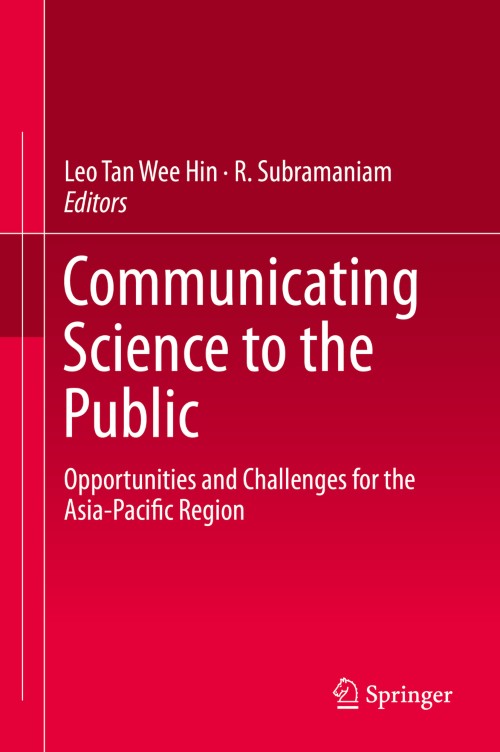
Communicating Science to the Public [electronic resource] : Opportunities and Challenges for the Asia-Pacific Region / edited by Leo Tan Wee Hin, R. Subramaniam.
Erişim Adresi
ISBN
9789401790970
Dil Kodu
İngilizce
Yer Numarası
DK/11522
Basım Bildirimi
1st ed. 2014.
Yayın Bilgisi
Dordrecht : Springer Netherlands : Imprint: Springer, 2014.
Fiziksel Niteleme
X, 298 p. 32 illus. online resource.
İçindekiler Notu
Schools -- Promoting science literacy via science journalism: Issues and challenges, Billy McClune, and Ruth Jarman -- Science clubs: An under-utilized tool for promoting science communication activities in schools, M. Shaheed Hartley -- Developing scientific literacy from engaging in science in everyday life: Ideas for science educators, Teo Tang Wee and Lim Kim Yong -- The nature of science kits in affecting change in public attitude towards and understanding of science, Daniel Dickerson and Craig Stewart -- Field trips to industrial establishments: Infinite opportunities for popularizing science, Irene Tan and Charles Chew -- Science centers -- A role for science centers in communicating science – A personal view, Graham Durant -- Science communicators as commercial and social entrepreneurs, Graham Walker -- Assessing science communication effectiveness: Issues in evacuation and measurement, Rod Lamberts and Catherine Rayner -- Universities -- Graduate degree programs in science communication: Educating and training science communicators to work with communities, Nancy Longnecker and Mzamose Gondwe -- Outreach activities by universities as a channel for science communication, Lloyd Spencer Davis -- Role of learned societies in science communication, Leo Tan Wee Hin and R. Subramaniam -- Science Olympiads as vehicles for identifying talent in the sciences: The Singapore experience, Shirley S. L. Lim, Horn-Mun Cheah and Tzi-Sum Andy Hor -- Challenges facing developing countries in the promotion of science communication, Leo Tan Wee Hin and R. Subramaniam -- General communication initiatives -- Web-based channels for science communication, Karen Bultitude -- Science communication through mobile devices, Oum Prakash Sharma -- Café scientfiques, Duncan Dallas -- Television as a medium of science, M. Shamsher Ali.
Özet, vb.
This book explores effective approaches for communicating science to the public in developing countries. Offering multiple perspectives on this important topic, it features 17 chapters that represent the efforts of 23 authors from eight countries: Australia, Bangladesh, India, Ireland, New Zealand, USA, Singapore and South Africa. Inside, readers will find a diversity of approaches to communicate science to the public. The book also highlights some of the challenges that science communicators, science policy makers, science teachers, university academics in the sciences and even entrepreneurs may face in their attempts to boost science literacy levels in their countries. In addition, it shares several best practices from the developed world that may help readers create communication initiatives that can lead to increased engagement with science in communities in the Asia Pacific region and beyond. Given the pervasive influence of science and technology in today’s society, their impact will only increase in the years to come as the world becomes more globalized and the economies of countries become more inter-linked. This book will be a useful source of reference for developing countries looking to tap into the potential of science for nation building and effectively engage their communities to better understand science and technology. Supported by the Pacific Science Association, Hawaii.
Konu
Science __ Study and teaching.
Science Education.
Science Education.
Diğer Yazarlar
Kurum Adı
Eseri Alıntıla
Referansları kullanmadan önce gözden geçirmeniz ve varsa gerekli düzeltmeleri yapmanız önerilir.
Dijital Kaynak
MARC Görünümü
LEADER 05005nam a22004815i 4500
001 810243
003 TR_AnAIT
005 20260131020738
007 cr nn 008mamaa
008 140724s2014 ne | s |||| 0|eng d
020 |a9789401790970|9978-94-017-9097-0
024 7 |a10.1007/978-94-017-9097-0|2doi
041 |aeng
049 |aTürk Tarih Kurumu Kütüphanesi
050 4|aQ181-183.4
072 7|aJNU|2bicssc
072 7|aPD|2bicssc
072 7|aSCI063000|2bisacsh
072 7|aJNU|2thema
072 7|aPD|2thema
082 04|a507.1|223
090 |aDK/11522
245 10|aCommunicating Science to the Public|h[electronic resource] :|bOpportunities and Challenges for the Asia-Pacific Region /|cedited by Leo Tan Wee Hin, R. Subramaniam.
250 |a1st ed. 2014.
264 1|aDordrecht :|bSpringer Netherlands :|bImprint: Springer,|c2014.
300 |aX, 298 p. 32 illus.|bonline resource.
336 |atext|btxt|2rdacontent
337 |acomputer|bc|2rdamedia
338 |aonline resource|bcr|2rdacarrier
347 |atext file|bPDF|2rda
505 0 |aSchools -- Promoting science literacy via science journalism: Issues and challenges, Billy McClune, and Ruth Jarman -- Science clubs: An under-utilized tool for promoting science communication activities in schools, M. Shaheed Hartley -- Developing scientific literacy from engaging in science in everyday life: Ideas for science educators, Teo Tang Wee and Lim Kim Yong -- The nature of science kits in affecting change in public attitude towards and understanding of science, Daniel Dickerson and Craig Stewart -- Field trips to industrial establishments: Infinite opportunities for popularizing science, Irene Tan and Charles Chew -- Science centers -- A role for science centers in communicating science – A personal view, Graham Durant -- Science communicators as commercial and social entrepreneurs, Graham Walker -- Assessing science communication effectiveness: Issues in evacuation and measurement, Rod Lamberts and Catherine Rayner -- Universities -- Graduate degree programs in science communication: Educating and training science communicators to work with communities, Nancy Longnecker and Mzamose Gondwe -- Outreach activities by universities as a channel for science communication, Lloyd Spencer Davis -- Role of learned societies in science communication, Leo Tan Wee Hin and R. Subramaniam -- Science Olympiads as vehicles for identifying talent in the sciences: The Singapore experience, Shirley S. L. Lim, Horn-Mun Cheah and Tzi-Sum Andy Hor -- Challenges facing developing countries in the promotion of science communication, Leo Tan Wee Hin and R. Subramaniam -- General communication initiatives -- Web-based channels for science communication, Karen Bultitude -- Science communication through mobile devices, Oum Prakash Sharma -- Café scientfiques, Duncan Dallas -- Television as a medium of science, M. Shamsher Ali.
520 |aThis book explores effective approaches for communicating science to the public in developing countries. Offering multiple perspectives on this important topic, it features 17 chapters that represent the efforts of 23 authors from eight countries: Australia, Bangladesh, India, Ireland, New Zealand, USA, Singapore and South Africa. Inside, readers will find a diversity of approaches to communicate science to the public. The book also highlights some of the challenges that science communicators, science policy makers, science teachers, university academics in the sciences and even entrepreneurs may face in their attempts to boost science literacy levels in their countries. In addition, it shares several best practices from the developed world that may help readers create communication initiatives that can lead to increased engagement with science in communities in the Asia Pacific region and beyond. Given the pervasive influence of science and technology in today’s society, their impact will only increase in the years to come as the world becomes more globalized and the economies of countries become more inter-linked. This book will be a useful source of reference for developing countries looking to tap into the potential of science for nation building and effectively engage their communities to better understand science and technology. Supported by the Pacific Science Association, Hawaii.
650 0|aScience|xStudy and teaching.
650 14|aScience Education.
700 1 |aTan Wee Hin, Leo.|eeditor.|4edt|4http://id.loc.gov/vocabulary/relators/edt
700 1 |aSubramaniam, R.|eeditor.|4edt|4http://id.loc.gov/vocabulary/relators/edt
710 2 |aSpringerLink (Online service)
773 0 |tSpringer Nature eBook
776 08|iPrinted edition:|z9789401790963
776 08|iPrinted edition:|z9789401790987
776 08|iPrinted edition:|z9789402405675
856 40|uhttps://doi.org/10.1007/978-94-017-9097-0
912 |aZDB-2-SHU
912 |aZDB-2-SXED
950 |aHumanities, Social Sciences and Law (SpringerNature-11648)
950 |aEducation (R0) (SpringerNature-43721)
001 810243
003 TR_AnAIT
005 20260131020738
007 cr nn 008mamaa
008 140724s2014 ne | s |||| 0|eng d
020 |a9789401790970|9978-94-017-9097-0
024 7 |a10.1007/978-94-017-9097-0|2doi
041 |aeng
049 |aTürk Tarih Kurumu Kütüphanesi
050 4|aQ181-183.4
072 7|aJNU|2bicssc
072 7|aPD|2bicssc
072 7|aSCI063000|2bisacsh
072 7|aJNU|2thema
072 7|aPD|2thema
082 04|a507.1|223
090 |aDK/11522
245 10|aCommunicating Science to the Public|h[electronic resource] :|bOpportunities and Challenges for the Asia-Pacific Region /|cedited by Leo Tan Wee Hin, R. Subramaniam.
250 |a1st ed. 2014.
264 1|aDordrecht :|bSpringer Netherlands :|bImprint: Springer,|c2014.
300 |aX, 298 p. 32 illus.|bonline resource.
336 |atext|btxt|2rdacontent
337 |acomputer|bc|2rdamedia
338 |aonline resource|bcr|2rdacarrier
347 |atext file|bPDF|2rda
505 0 |aSchools -- Promoting science literacy via science journalism: Issues and challenges, Billy McClune, and Ruth Jarman -- Science clubs: An under-utilized tool for promoting science communication activities in schools, M. Shaheed Hartley -- Developing scientific literacy from engaging in science in everyday life: Ideas for science educators, Teo Tang Wee and Lim Kim Yong -- The nature of science kits in affecting change in public attitude towards and understanding of science, Daniel Dickerson and Craig Stewart -- Field trips to industrial establishments: Infinite opportunities for popularizing science, Irene Tan and Charles Chew -- Science centers -- A role for science centers in communicating science – A personal view, Graham Durant -- Science communicators as commercial and social entrepreneurs, Graham Walker -- Assessing science communication effectiveness: Issues in evacuation and measurement, Rod Lamberts and Catherine Rayner -- Universities -- Graduate degree programs in science communication: Educating and training science communicators to work with communities, Nancy Longnecker and Mzamose Gondwe -- Outreach activities by universities as a channel for science communication, Lloyd Spencer Davis -- Role of learned societies in science communication, Leo Tan Wee Hin and R. Subramaniam -- Science Olympiads as vehicles for identifying talent in the sciences: The Singapore experience, Shirley S. L. Lim, Horn-Mun Cheah and Tzi-Sum Andy Hor -- Challenges facing developing countries in the promotion of science communication, Leo Tan Wee Hin and R. Subramaniam -- General communication initiatives -- Web-based channels for science communication, Karen Bultitude -- Science communication through mobile devices, Oum Prakash Sharma -- Café scientfiques, Duncan Dallas -- Television as a medium of science, M. Shamsher Ali.
520 |aThis book explores effective approaches for communicating science to the public in developing countries. Offering multiple perspectives on this important topic, it features 17 chapters that represent the efforts of 23 authors from eight countries: Australia, Bangladesh, India, Ireland, New Zealand, USA, Singapore and South Africa. Inside, readers will find a diversity of approaches to communicate science to the public. The book also highlights some of the challenges that science communicators, science policy makers, science teachers, university academics in the sciences and even entrepreneurs may face in their attempts to boost science literacy levels in their countries. In addition, it shares several best practices from the developed world that may help readers create communication initiatives that can lead to increased engagement with science in communities in the Asia Pacific region and beyond. Given the pervasive influence of science and technology in today’s society, their impact will only increase in the years to come as the world becomes more globalized and the economies of countries become more inter-linked. This book will be a useful source of reference for developing countries looking to tap into the potential of science for nation building and effectively engage their communities to better understand science and technology. Supported by the Pacific Science Association, Hawaii.
650 0|aScience|xStudy and teaching.
650 14|aScience Education.
700 1 |aTan Wee Hin, Leo.|eeditor.|4edt|4http://id.loc.gov/vocabulary/relators/edt
700 1 |aSubramaniam, R.|eeditor.|4edt|4http://id.loc.gov/vocabulary/relators/edt
710 2 |aSpringerLink (Online service)
773 0 |tSpringer Nature eBook
776 08|iPrinted edition:|z9789401790963
776 08|iPrinted edition:|z9789401790987
776 08|iPrinted edition:|z9789402405675
856 40|uhttps://doi.org/10.1007/978-94-017-9097-0
912 |aZDB-2-SHU
912 |aZDB-2-SXED
950 |aHumanities, Social Sciences and Law (SpringerNature-11648)
950 |aEducation (R0) (SpringerNature-43721)
Materyaller
Depodan talep edilen materyal sadece kütüphane içerisinde kullanılmaktadır.
Materyal dışarıya ödünç verilmemektedir.
Materyal dışarıya ödünç verilmemektedir.
