

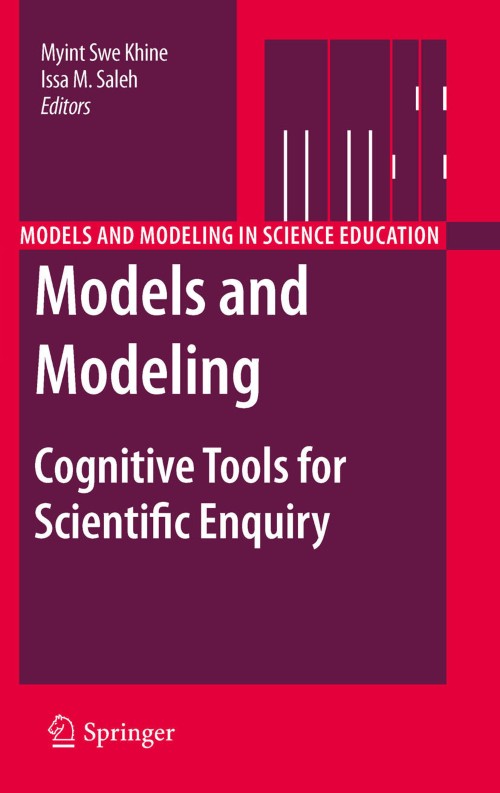
Models and Modeling [electronic resource] : Cognitive Tools for Scientific Enquiry / edited by Myint Swe Khine, Issa M. Saleh.
Erişim Adresi
ISBN
9789400704497
Dil Kodu
İngilizce
Yer Numarası
DK/11553
Basım Bildirimi
1st ed. 2011.
Yayın Bilgisi
Dordrecht : Springer Netherlands : Imprint: Springer, 2011.
Fiziksel Niteleme
VIII, 292 p. online resource.
Dizi
Models and Modeling in Science Education, 2213-2260 ; 6
İçindekiler Notu
PART I - Theory Formation and Modeling in Science Education -- Chapter 1. Modeling and the Future of Science Learning, Richard K. Coll, Denis Laijum -- Chapter 2. A Study of Expert Theory Formation: The Role of Different Model Types and Domain Frameworks, Allan Collins.-Chapter 3. The Nature of Scientific Meta-Knowledge, Barbara Y. White, Allan Collins, John R. Frederiksen -- Chapter 4. From Modeling Schemata to the Profiling Schema: Modeling across the Curricula for Profile Shaping Education, Ibrahim A. Halloun. - PART II – Modeling and Student Learning in Science Education -- Chapter 5. Helping Students Construct Robust Conceptual Models, Colleen Megowan-Romanowicz -- Chapter 6. The Molecular Workbench Software: An Innovative Dynamic Modeling Tool for Nanoscience Education, Charles Xie, Amy Pallant -- Chapter 7. Lowering the Learning Threshold: Multi-Agent-Based Models and Learning Electricity, Pratim Sengupta, Uri Wilensky -- Chapter 8. Engineering-based Modeling Experiences in the Elementary and Middle Classroom, Lyn D. English, Nicholas G. Mousoulides -- Chapter 9. Engaging Elementary Students in Scientific Modeling: The MoDeLS 5th Grade Approach and Findings, Hamin Baek, Christina Schwarz, Jing Chen, Hayat Hokayem, Li Zhan -- PART III – Modeling and Teachers’ Knowledge -- Chapter 10. Relationships between Elementary Teachers’ Conceptions of Scientific Modeling and the Nature of Science, Valarie L. Akerson, Orvil White, Huseyin Colak,Khemmawaddee Pongsanon -- Chapter 11. Science teachers’ knowledge about learning and teaching models and modeling in Public Understanding of Science, Ineke Henze, Jan H. van Driel -- Chapter 12. Teaching Pre-serviceElementary Teachers to Teach Science with Computer Models, Nicos Valanides, Charoula Angeli -- Subject Index.
Özet, vb.
The process of developing models, known as modeling, allows scientists to visualize difficult concepts, explain complex phenomena and clarify intricate theories. In recent years, science educators have greatly increased their use of modeling in teaching, especially real-time dynamic modeling, which is central to a scientific investigation. Modeling in science teaching is being used in an array of fields, everything from primary sciences to tertiary chemistry to college physics, and it is sure to play an increasing role in the future of education. Models and Modeling: Cognitive Tools for Scientific Enquiry is a comprehensive introduction to the use of models and modeling in science education. It identifies and describes many different modeling tools and presents recent applications of modeling as a cognitive tool for scientific enquiry. The processes of modelling and the use of the resulting models to inform predictions play key roles in the nature of science and hence in science education, especially in inquiry-based approaches. Against a background of the philosophical basis for modelling and models, the implications for science education are explored. Well-designed and thoroughly classroom-tested schemes to support students in learning how to model are reviewed. Research into teachers’ understanding of models and their place in the nature of science are reviewed as are successful strategies for the further development of that knowledge. This book has a major contribution to make to the pre- and in-service education of elementary (primary) and high (secondary) school science teachers. John K. Gilbert Professor Emeritus, The University of Reading Visiting Professor, King's College London Editor-in-Chief, International Journal of ScienceEducation.
Konu
Science __ Study and teaching.
Learning, Psychology of.
Science Education.
Instructional Psychology.
Learning, Psychology of.
Science Education.
Instructional Psychology.
Diğer Yazarlar
Kurum Adı
Eseri Alıntıla
Referansları kullanmadan önce gözden geçirmeniz ve varsa gerekli düzeltmeleri yapmanız önerilir.
Dijital Kaynak
MARC Görünümü
LEADER 05512nam a22005295i 4500
001 810274
003 TR_AnAIT
005 20260131020555
007 cr nn 008mamaa
008 110228s2011 ne | s |||| 0|eng d
020 |a9789400704497|9978-94-007-0449-7
024 7 |a10.1007/978-94-007-0449-7|2doi
041 |aeng
049 |aTürk Tarih Kurumu Kütüphanesi
050 4|aQ181-183.4
072 7|aJNU|2bicssc
072 7|aPD|2bicssc
072 7|aSCI063000|2bisacsh
072 7|aJNU|2thema
072 7|aPD|2thema
082 04|a507.1|223
090 |aDK/11553
245 10|aModels and Modeling|h[electronic resource] :|bCognitive Tools for Scientific Enquiry /|cedited by Myint Swe Khine, Issa M. Saleh.
250 |a1st ed. 2011.
264 1|aDordrecht :|bSpringer Netherlands :|bImprint: Springer,|c2011.
300 |aVIII, 292 p.|bonline resource.
336 |atext|btxt|2rdacontent
337 |acomputer|bc|2rdamedia
338 |aonline resource|bcr|2rdacarrier
347 |atext file|bPDF|2rda
490 1 |aModels and Modeling in Science Education,|x2213-2260 ;|v6
505 0 |aPART I - Theory Formation and Modeling in Science Education -- Chapter 1. Modeling and the Future of Science Learning, Richard K. Coll, Denis Laijum -- Chapter 2. A Study of Expert Theory Formation: The Role of Different Model Types and Domain Frameworks, Allan Collins.-Chapter 3. The Nature of Scientific Meta-Knowledge, Barbara Y. White, Allan Collins, John R. Frederiksen -- Chapter 4. From Modeling Schemata to the Profiling Schema: Modeling across the Curricula for Profile Shaping Education, Ibrahim A. Halloun. - PART II – Modeling and Student Learning in Science Education -- Chapter 5. Helping Students Construct Robust Conceptual Models, Colleen Megowan-Romanowicz -- Chapter 6. The Molecular Workbench Software: An Innovative Dynamic Modeling Tool for Nanoscience Education, Charles Xie, Amy Pallant -- Chapter 7. Lowering the Learning Threshold: Multi-Agent-Based Models and Learning Electricity, Pratim Sengupta, Uri Wilensky -- Chapter 8. Engineering-based Modeling Experiences in the Elementary and Middle Classroom, Lyn D. English, Nicholas G. Mousoulides -- Chapter 9. Engaging Elementary Students in Scientific Modeling: The MoDeLS 5th Grade Approach and Findings, Hamin Baek, Christina Schwarz, Jing Chen, Hayat Hokayem, Li Zhan -- PART III – Modeling and Teachers’ Knowledge -- Chapter 10. Relationships between Elementary Teachers’ Conceptions of Scientific Modeling and the Nature of Science, Valarie L. Akerson, Orvil White, Huseyin Colak,Khemmawaddee Pongsanon -- Chapter 11. Science teachers’ knowledge about learning and teaching models and modeling in Public Understanding of Science, Ineke Henze, Jan H. van Driel -- Chapter 12. Teaching Pre-serviceElementary Teachers to Teach Science with Computer Models, Nicos Valanides, Charoula Angeli -- Subject Index.
520 |a The process of developing models, known as modeling, allows scientists to visualize difficult concepts, explain complex phenomena and clarify intricate theories. In recent years, science educators have greatly increased their use of modeling in teaching, especially real-time dynamic modeling, which is central to a scientific investigation. Modeling in science teaching is being used in an array of fields, everything from primary sciences to tertiary chemistry to college physics, and it is sure to play an increasing role in the future of education. Models and Modeling: Cognitive Tools for Scientific Enquiry is a comprehensive introduction to the use of models and modeling in science education. It identifies and describes many different modeling tools and presents recent applications of modeling as a cognitive tool for scientific enquiry. The processes of modelling and the use of the resulting models to inform predictions play key roles in the nature of science and hence in science education, especially in inquiry-based approaches. Against a background of the philosophical basis for modelling and models, the implications for science education are explored. Well-designed and thoroughly classroom-tested schemes to support students in learning how to model are reviewed. Research into teachers’ understanding of models and their place in the nature of science are reviewed as are successful strategies for the further development of that knowledge. This book has a major contribution to make to the pre- and in-service education of elementary (primary) and high (secondary) school science teachers. John K. Gilbert Professor Emeritus, The University of Reading Visiting Professor, King's College London Editor-in-Chief, International Journal of ScienceEducation.
650 0|aScience|xStudy and teaching.
650 0|aLearning, Psychology of.
650 14|aScience Education.
650 24|aInstructional Psychology.
700 1 |aKhine, Myint Swe.|eeditor.|4edt|4http://id.loc.gov/vocabulary/relators/edt
700 1 |aSaleh, Issa M.|eeditor.|4edt|4http://id.loc.gov/vocabulary/relators/edt
710 2 |aSpringerLink (Online service)
773 0 |tSpringer Nature eBook
776 08|iPrinted edition:|z9789400704480
776 08|iPrinted edition:|z9789400704503
776 08|iPrinted edition:|z9789400735484
830 0|aModels and Modeling in Science Education,|x2213-2260 ;|v6
856 40|uhttps://doi.org/10.1007/978-94-007-0449-7
912 |aZDB-2-SHU
912 |aZDB-2-SXED
950 |aHumanities, Social Sciences and Law (SpringerNature-11648)
950 |aEducation (R0) (SpringerNature-43721)
001 810274
003 TR_AnAIT
005 20260131020555
007 cr nn 008mamaa
008 110228s2011 ne | s |||| 0|eng d
020 |a9789400704497|9978-94-007-0449-7
024 7 |a10.1007/978-94-007-0449-7|2doi
041 |aeng
049 |aTürk Tarih Kurumu Kütüphanesi
050 4|aQ181-183.4
072 7|aJNU|2bicssc
072 7|aPD|2bicssc
072 7|aSCI063000|2bisacsh
072 7|aJNU|2thema
072 7|aPD|2thema
082 04|a507.1|223
090 |aDK/11553
245 10|aModels and Modeling|h[electronic resource] :|bCognitive Tools for Scientific Enquiry /|cedited by Myint Swe Khine, Issa M. Saleh.
250 |a1st ed. 2011.
264 1|aDordrecht :|bSpringer Netherlands :|bImprint: Springer,|c2011.
300 |aVIII, 292 p.|bonline resource.
336 |atext|btxt|2rdacontent
337 |acomputer|bc|2rdamedia
338 |aonline resource|bcr|2rdacarrier
347 |atext file|bPDF|2rda
490 1 |aModels and Modeling in Science Education,|x2213-2260 ;|v6
505 0 |aPART I - Theory Formation and Modeling in Science Education -- Chapter 1. Modeling and the Future of Science Learning, Richard K. Coll, Denis Laijum -- Chapter 2. A Study of Expert Theory Formation: The Role of Different Model Types and Domain Frameworks, Allan Collins.-Chapter 3. The Nature of Scientific Meta-Knowledge, Barbara Y. White, Allan Collins, John R. Frederiksen -- Chapter 4. From Modeling Schemata to the Profiling Schema: Modeling across the Curricula for Profile Shaping Education, Ibrahim A. Halloun. - PART II – Modeling and Student Learning in Science Education -- Chapter 5. Helping Students Construct Robust Conceptual Models, Colleen Megowan-Romanowicz -- Chapter 6. The Molecular Workbench Software: An Innovative Dynamic Modeling Tool for Nanoscience Education, Charles Xie, Amy Pallant -- Chapter 7. Lowering the Learning Threshold: Multi-Agent-Based Models and Learning Electricity, Pratim Sengupta, Uri Wilensky -- Chapter 8. Engineering-based Modeling Experiences in the Elementary and Middle Classroom, Lyn D. English, Nicholas G. Mousoulides -- Chapter 9. Engaging Elementary Students in Scientific Modeling: The MoDeLS 5th Grade Approach and Findings, Hamin Baek, Christina Schwarz, Jing Chen, Hayat Hokayem, Li Zhan -- PART III – Modeling and Teachers’ Knowledge -- Chapter 10. Relationships between Elementary Teachers’ Conceptions of Scientific Modeling and the Nature of Science, Valarie L. Akerson, Orvil White, Huseyin Colak,Khemmawaddee Pongsanon -- Chapter 11. Science teachers’ knowledge about learning and teaching models and modeling in Public Understanding of Science, Ineke Henze, Jan H. van Driel -- Chapter 12. Teaching Pre-serviceElementary Teachers to Teach Science with Computer Models, Nicos Valanides, Charoula Angeli -- Subject Index.
520 |a The process of developing models, known as modeling, allows scientists to visualize difficult concepts, explain complex phenomena and clarify intricate theories. In recent years, science educators have greatly increased their use of modeling in teaching, especially real-time dynamic modeling, which is central to a scientific investigation. Modeling in science teaching is being used in an array of fields, everything from primary sciences to tertiary chemistry to college physics, and it is sure to play an increasing role in the future of education. Models and Modeling: Cognitive Tools for Scientific Enquiry is a comprehensive introduction to the use of models and modeling in science education. It identifies and describes many different modeling tools and presents recent applications of modeling as a cognitive tool for scientific enquiry. The processes of modelling and the use of the resulting models to inform predictions play key roles in the nature of science and hence in science education, especially in inquiry-based approaches. Against a background of the philosophical basis for modelling and models, the implications for science education are explored. Well-designed and thoroughly classroom-tested schemes to support students in learning how to model are reviewed. Research into teachers’ understanding of models and their place in the nature of science are reviewed as are successful strategies for the further development of that knowledge. This book has a major contribution to make to the pre- and in-service education of elementary (primary) and high (secondary) school science teachers. John K. Gilbert Professor Emeritus, The University of Reading Visiting Professor, King's College London Editor-in-Chief, International Journal of ScienceEducation.
650 0|aScience|xStudy and teaching.
650 0|aLearning, Psychology of.
650 14|aScience Education.
650 24|aInstructional Psychology.
700 1 |aKhine, Myint Swe.|eeditor.|4edt|4http://id.loc.gov/vocabulary/relators/edt
700 1 |aSaleh, Issa M.|eeditor.|4edt|4http://id.loc.gov/vocabulary/relators/edt
710 2 |aSpringerLink (Online service)
773 0 |tSpringer Nature eBook
776 08|iPrinted edition:|z9789400704480
776 08|iPrinted edition:|z9789400704503
776 08|iPrinted edition:|z9789400735484
830 0|aModels and Modeling in Science Education,|x2213-2260 ;|v6
856 40|uhttps://doi.org/10.1007/978-94-007-0449-7
912 |aZDB-2-SHU
912 |aZDB-2-SXED
950 |aHumanities, Social Sciences and Law (SpringerNature-11648)
950 |aEducation (R0) (SpringerNature-43721)
Materyaller
Depodan talep edilen materyal sadece kütüphane içerisinde kullanılmaktadır.
Materyal dışarıya ödünç verilmemektedir.
Materyal dışarıya ödünç verilmemektedir.
