LEADER 04412nam a22005535i 4500
001 810293
003 TR_AnAIT
005 20260131020454
007 cr nn 008mamaa
008 101014s2010 ne | s |||| 0|eng d
020 |a9789048132157|9978-90-481-3215-7
024 7 |a10.1007/978-90-481-3215-7|2doi
041 |aeng
049 |aTürk Tarih Kurumu Kütüphanesi
050 4|aLB1050.9-1091
072 7|aJNC|2bicssc
072 7|aEDU009000|2bisacsh
072 7|aJNC|2thema
082 04|a370.15|223
090 |aDK/11572
100 1 |aShell, Duane F.|eauthor.|4aut|4http://id.loc.gov/vocabulary/relators/aut
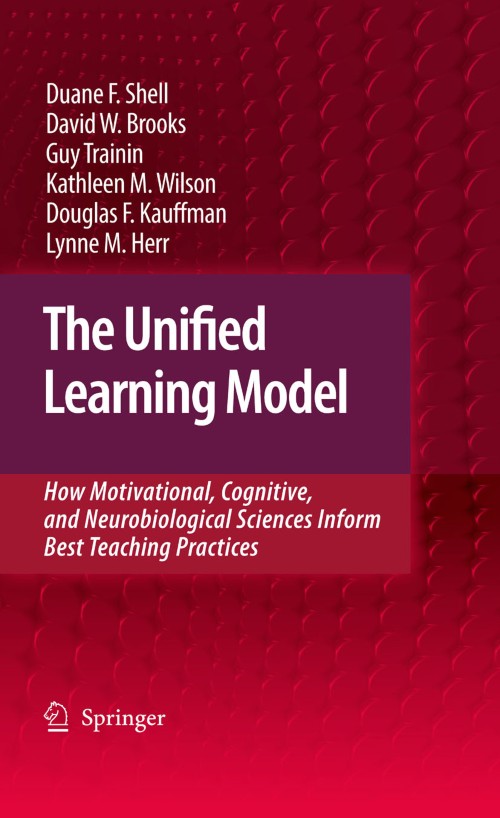
245 14|aThe Unified Learning Model|h[electronic resource] :|bHow Motivational, Cognitive, and Neurobiological Sciences Inform Best Teaching Practices /|cby Duane F. Shell, David W. Brooks, Guy Trainin, Kathleen M. Wilson, Douglas F. Kauffman, Lynne M. Herr.
250 |a1st ed. 2010.
264 1|aDordrecht :|bSpringer Netherlands :|bImprint: Springer,|c2010.
300 |aXI, 212 p.|bonline resource.
336 |atext|btxt|2rdacontent
337 |acomputer|bc|2rdamedia
338 |aonline resource|bcr|2rdacarrier
347 |atext file|bPDF|2rda
505 0 |aDeveloping the Unified Learning Model -- The Unified Learning Model -- Learning -- Working Memory -- Knowledge -- Motivation -- How the ULM Fits In -- Applying the Unified Learning Model -- Classroom Applications Overview -- Supporting Motivation -- Efficient Instruction -- Feedback and Assessment -- A Focus on Thinking -- Encouraging Self-regulation -- Managing the Classroom Environment -- Improving as a Teacher -- Policy -- Frontiers -- Epilogue.
520 |aThis cutting-edge synthesis of ideas and concepts from the cognitive, motivation, and neurobiological sciences sets out a unique theory of learning that should be of interest to everyone from education practitioners to neuroscientists. The authors base their Unified Learning Model, or ULM, on three core principles. Firstly, that learning requires working memory allocation (attention). Second, that working memory’s capacity for allocation is affected by prior knowledge. And finally, that working memory allocation is directed by motivation. These three principles guide a complete model of learning that synthesizes what is known from research in brain function, cognition, and motivation. This, then, is a book about how humans learn. Its focus is on classroom learning although the principles are, as the name of the book suggests, universal. The text’s scope covers learning from pre-school to post-graduate, as well as training in business, industrial and the military. It addresses all learning described by the word "thought", as well as anything we might try to teach, or instruct in formal educational settings. The book presents a model of learning that the authors offer as scientists rather than educators. They assert that more than enough is known to sustain a "scientific" model of learning. Rather than being a mere review of the literature, this work is a synthesis. Many scholars and teachers will have heard much if not most or even all of the information used to develop the model. What they will not have come across is a model – designed to be both accessible and usable – that puts together the information in just this way.
650 0|aEducational psychology.
650 0|aLearning, Psychology of.
650 0|aTeachers|xTraining of.
650 14|aEducational Psychology.
650 24|aInstructional Psychology.
650 24|aTeaching and Teacher Education.
700 1 |aBrooks, David W.|eauthor.|4aut|4http://id.loc.gov/vocabulary/relators/aut
700 1 |aTrainin, Guy.|eauthor.|4aut|4http://id.loc.gov/vocabulary/relators/aut
700 1 |aWilson, Kathleen M.|eauthor.|4aut|4http://id.loc.gov/vocabulary/relators/aut
700 1 |aKauffman, Douglas F.|eauthor.|4aut|4http://id.loc.gov/vocabulary/relators/aut
700 1 |aHerr, Lynne M.|eauthor.|4aut|4http://id.loc.gov/vocabulary/relators/aut
710 2 |aSpringerLink (Online service)
773 0 |tSpringer Nature eBook
776 08|iPrinted edition:|z9789048132140
776 08|iPrinted edition:|z9789048132164
776 08|iPrinted edition:|z9789400791381
856 40|uhttps://doi.org/10.1007/978-90-481-3215-7
912 |aZDB-2-SHU
912 |aZDB-2-SXED
950 |aHumanities, Social Sciences and Law (SpringerNature-11648)
950 |aEducation (R0) (SpringerNature-43721)