LEADER 03834nam a22006015i 4500
001 810318
003 TR_AnAIT
005 20260131020319
007 cr nn 008mamaa
008 110831s2011 gw | s |||| 0|eng d
020 |a9783642215728|9978-3-642-21572-8
024 7 |a10.1007/978-3-642-21572-8|2doi
041 |aeng
049 |aTürk Tarih Kurumu Kütüphanesi
050 4|aK7000-7720.22
072 7|aLB|2bicssc
072 7|aLAM|2bicssc
072 7|aLAW051000|2bisacsh
072 7|aLB|2thema
072 7|aLAM|2thema
082 04|a340.9|223
090 |aDK/11596
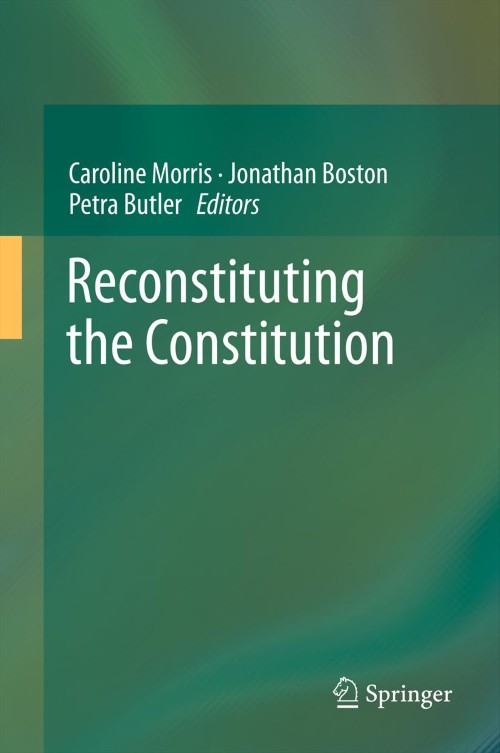
245 10|aReconstituting the Constitution|h[electronic resource] /|cedited by Caroline Morris, Jonathan Boston, Petra Butler.
250 |a1st ed. 2011.
264 1|aBerlin, Heidelberg :|bSpringer Berlin Heidelberg :|bImprint: Springer,|c2011.
300 |aXII, 519 p.|bonline resource.
336 |atext|btxt|2rdacontent
337 |acomputer|bc|2rdamedia
338 |aonline resource|bcr|2rdacarrier
347 |atext file|bPDF|2rda
505 0 |aPart 1: Reconstituting the Constitution: An Overview -- Part 2: Reforming Constitutions: Lessons from Abroad -- Part 3: The Republican Question -- Part 4: The Need for a Written Constitution? Strengthening the Bill of Rights Act and the Place of the Treaty of Waitangi -- Part 5: The Future of Electoral Law -- Part 6: Australia: Involving Civil Society in Constitutional Reform -- Part 7: Influence of International Treaties -- Part 8: The Trans-Tasman Relationship -- Part 9: The Role and Governance of Sub-National Government -- Part 10: Protecting Future Generations -- Appendix.
520 |aAll nation states, whether ancient or newly created, must examine their constitutional fundamentals to keep their constitutions relevant and dynamic. Constitutional change has greater legitimacy when the questions are debated before the people and accepted by them. Who are the peoples in this state? What role should they have in relation to the government? What rights should they have? Who should be Head of State? What is our constitutional relationship with other nation states? What is the influence of international law on our domestic system? What process should constitutional change follow? In this volume, scholars, practitioners, politicians, public officials, and young people explore these questions and others in relation to the New Zealand constitution and provide some thought-provoking answers. This book is recommended for anyone seeking insight into how a former British colony with bicultural foundations is making the transition to a multicultural society in an increasingly complex and globalised world.
650 0|aPrivate international law.
650 0|aConflict of laws.
650 0|aInternational law.
650 0|aComparative law.
650 0|aConstitutional law.
650 0|aPolitical science.
650 14|aPrivate International Law, International and Foreign Law, Comparative Law.
650 24|aConstitutional Law.
650 24|aPolitical Science.
700 1 |aMorris, Caroline.|eeditor.|4edt|4http://id.loc.gov/vocabulary/relators/edt
700 1 |aBoston, Jonathan.|eeditor.|4edt|4http://id.loc.gov/vocabulary/relators/edt
700 1 |aButler, Petra.|eeditor.|4edt|4http://id.loc.gov/vocabulary/relators/edt
710 2 |aSpringerLink (Online service)
773 0 |tSpringer Nature eBook
776 08|iPrinted edition:|z9783642215711
776 08|iPrinted edition:|z9783642215735
776 08|iPrinted edition:|z9783642426780
856 40|uhttps://doi.org/10.1007/978-3-642-21572-8
912 |aZDB-2-SHU
912 |aZDB-2-SXLC
912 |aZDB-2-SXPE
950 |aHumanities, Social Sciences and Law (SpringerNature-11648)
950 |aLaw and Criminology (R0) (SpringerNature-43727)
950 |aSpringer Nature Proceedings excluding Computer Science (SpringerNature-85345)