

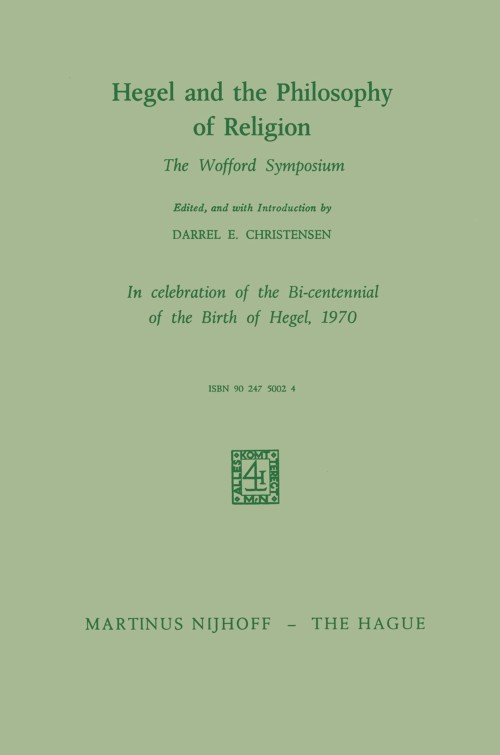
Hegel and the Philosophy of Religion [electronic resource] : The Wofford Symposium / by Darrel E. Christensen ; edited by Darrel E. Christensen, G.W.F. Hegel.
Erişim Adresi
ISBN
9789401191524
Dil Kodu
İngilizce
Yer Numarası
DK/11599
Yazar
Basım Bildirimi
1st ed. 1970.
Yayın Bilgisi
Dordrecht : Springer Netherlands : Imprint: Springer, 1970.
Fiziksel Niteleme
300 p. online resource.
İçindekiler Notu
Section I Some Historical Presuppositions of Hegel’s System -- Comment by Charles E. Scott (Vanderbilt University) -- Comment by Eugene Thomas Long (Randolph-Macon College) -- Henrich: Reply to Commentators -- Section II The Young Hegel and the Postulates of Practical Reason -- Comment by W. E. Steinkraus (State University of N.Y., Oswego) -- Comment by Thomas N. Munson (DePaul University) -- Discussion -- Section III Hegel’s Phenomenology of Mind as a Development of Kant’s Basic Ontology -- Comment by Murray Greene (New School of Social Research) -- Comment by George Schrader (Yale University) -- Werkmeister: Reply to Commentators -- Section IV Hegel’s “Unhappy Consciousness” and Nietzsche’s “Slave Morality,” -- Comment by Joseph C. Flay (Pennsylvnia State University) -- Comment by Thomas J. J. Altizer (State University of N.Y., Stony Brook) -- Greene: Reply to Commentators -- Section V Hegel’s Reinterpretation of the Doctrine of Spirit and the Religious Community -- Comment by P. Christopher Smith (Lowell State College) -- John E. Smith: Reply to P. Christopher Smith -- Section VI Hegel and the Marxist-Leninist Critique of Religion -- Comment by W. Winslow Shea (University of North Carolina, Chapel Hill) -- Comment by Ignas K. Skrupskelis (University of South Carolina) -- Kline: Reply to Commentators -- Discussion -- Section VII “Authenticity” and “Warranted Belief” in Hegel’s Dialectic of Religion -- Comment by J. N. Findlay (Yale University) -- Christensen: Reply to J. N. Findlay -- Discussion -- Section VIII Hegel on the Identity of Content in Religion and Philosophy -- Comment by James Doull (Dalhousie University) -- Comment by Charles D. Darrett (Wofford College) -- Lauer: Reply to Commentators -- Discussion.
Özet, vb.
THE WOFFORD SYMPOSIUM: ITs PURPOSE, GENESIS, AND THEME The purpose of The Wofford Symposium was to stimulate original scholarship on the theme of the meeting, to provide a forum in philosophy of high quality in the area which Wofford College principally serves, and to make available for publication this collection of papers, which it was felt would meet a peculiar need in the contemporary literature of philosophy. In April, 1967, I attended the annual meeting of the Metaphysical Society of America at Purdue University. Noting the frequency with which Hegel was brought into the discussions at that meeting, I was led on two occasions to inject the question into informal group discussions in the halls, "Isn't it time some sort of symposium on Hegel was held?" On the last occasion Professor Frederick Weiss replied, "Why don't you start it?" I'm not yet certain how serious the remark was intended to be, but after waiting two months, half expecting to hear of a plan under way, it occurred to me that perhaps what was wanting was a concrete proposal.
Konu
Religion __ Philosophy.
Philosophy, Modern.
Philosophy of Religion.
Early Modern Philosophy.
Philosophy, Modern.
Philosophy of Religion.
Early Modern Philosophy.
Diğer Yazarlar
Kurum Adı
Eseri Alıntıla
Referansları kullanmadan önce gözden geçirmeniz ve varsa gerekli düzeltmeleri yapmanız önerilir.
Dijital Kaynak
MARC Görünümü
LEADER 05428nam a22005415i 4500
001 810321
003 TR_AnAIT
005 20260131020308
007 cr nn 008mamaa
008 121227s1970 ne | s |||| 0|eng d
020 |a9789401191524|9978-94-011-9152-4
024 7 |a10.1007/978-94-011-9152-4|2doi
041 |aeng
049 |aTürk Tarih Kurumu Kütüphanesi
050 4|aBL51
072 7|aHRAB|2bicssc
072 7|aPHI022000|2bisacsh
072 7|aQRAB|2thema
082 04|a210|223
090 |aDK/11599
100 1 |aChristensen, Darrel E.|eauthor.|4aut|4http://id.loc.gov/vocabulary/relators/aut
245 10|aHegel and the Philosophy of Religion|h[electronic resource] :|bThe Wofford Symposium /|cby Darrel E. Christensen ; edited by Darrel E. Christensen, G.W.F. Hegel.
250 |a1st ed. 1970.
264 1|aDordrecht :|bSpringer Netherlands :|bImprint: Springer,|c1970.
300 |a300 p.|bonline resource.
336 |atext|btxt|2rdacontent
337 |acomputer|bc|2rdamedia
338 |aonline resource|bcr|2rdacarrier
347 |atext file|bPDF|2rda
505 0 |aSection I Some Historical Presuppositions of Hegel’s System -- Comment by Charles E. Scott (Vanderbilt University) -- Comment by Eugene Thomas Long (Randolph-Macon College) -- Henrich: Reply to Commentators -- Section II The Young Hegel and the Postulates of Practical Reason -- Comment by W. E. Steinkraus (State University of N.Y., Oswego) -- Comment by Thomas N. Munson (DePaul University) -- Discussion -- Section III Hegel’s Phenomenology of Mind as a Development of Kant’s Basic Ontology -- Comment by Murray Greene (New School of Social Research) -- Comment by George Schrader (Yale University) -- Werkmeister: Reply to Commentators -- Section IV Hegel’s “Unhappy Consciousness” and Nietzsche’s “Slave Morality,” -- Comment by Joseph C. Flay (Pennsylvnia State University) -- Comment by Thomas J. J. Altizer (State University of N.Y., Stony Brook) -- Greene: Reply to Commentators -- Section V Hegel’s Reinterpretation of the Doctrine of Spirit and the Religious Community -- Comment by P. Christopher Smith (Lowell State College) -- John E. Smith: Reply to P. Christopher Smith -- Section VI Hegel and the Marxist-Leninist Critique of Religion -- Comment by W. Winslow Shea (University of North Carolina, Chapel Hill) -- Comment by Ignas K. Skrupskelis (University of South Carolina) -- Kline: Reply to Commentators -- Discussion -- Section VII “Authenticity” and “Warranted Belief” in Hegel’s Dialectic of Religion -- Comment by J. N. Findlay (Yale University) -- Christensen: Reply to J. N. Findlay -- Discussion -- Section VIII Hegel on the Identity of Content in Religion and Philosophy -- Comment by James Doull (Dalhousie University) -- Comment by Charles D. Darrett (Wofford College) -- Lauer: Reply to Commentators -- Discussion.
520 |aTHE WOFFORD SYMPOSIUM: ITs PURPOSE, GENESIS, AND THEME The purpose of The Wofford Symposium was to stimulate original scholarship on the theme of the meeting, to provide a forum in philosophy of high quality in the area which Wofford College principally serves, and to make available for publication this collection of papers, which it was felt would meet a peculiar need in the contemporary literature of philosophy. In April, 1967, I attended the annual meeting of the Metaphysical Society of America at Purdue University. Noting the frequency with which Hegel was brought into the discussions at that meeting, I was led on two occasions to inject the question into informal group discussions in the halls, "Isn't it time some sort of symposium on Hegel was held?" On the last occasion Professor Frederick Weiss replied, "Why don't you start it?" I'm not yet certain how serious the remark was intended to be, but after waiting two months, half expecting to hear of a plan under way, it occurred to me that perhaps what was wanting was a concrete proposal.
532 8 |aAccessibility summary: This PDF is not accessible. It is based on scanned pages and does not support features such as screen reader compatibility or described non-text content (images, graphs etc). However, it likely supports searchable and selectable text based on OCR (Optical Character Recognition). Users with accessibility needs may not be able to use this content effectively. Please contact us at accessibilitysupport@springernature.com if you require assistance or an alternative format.
532 8 |aInaccessible, or known limited accessibility
532 8 |aNo reading system accessibility options actively disabled
532 8 |aPublisher contact for further accessibility information: accessibilitysupport@springernature.com
650 0|aReligion|xPhilosophy.
650 0|aPhilosophy, Modern.
650 14|aPhilosophy of Religion.
650 24|aEarly Modern Philosophy.
700 1 |aChristensen, Darrel E.|eeditor.|4edt|4http://id.loc.gov/vocabulary/relators/edt
700 1 |aHegel, G.W.F.|eeditor.|4edt|4http://id.loc.gov/vocabulary/relators/edt
710 2 |aSpringerLink (Online service)
773 0 |tSpringer Nature eBook
776 08|iPrinted edition:|z9789401184397
776 08|iPrinted edition:|z9789401191531
856 40|uhttps://doi.org/10.1007/978-94-011-9152-4
912 |aZDB-2-SHU
912 |aZDB-2-SXPR
912 |aZDB-2-BAE
950 |aHumanities, Social Sciences and Law (SpringerNature-11648)
950 |aPhilosophy and Religion (R0) (SpringerNature-43725)
001 810321
003 TR_AnAIT
005 20260131020308
007 cr nn 008mamaa
008 121227s1970 ne | s |||| 0|eng d
020 |a9789401191524|9978-94-011-9152-4
024 7 |a10.1007/978-94-011-9152-4|2doi
041 |aeng
049 |aTürk Tarih Kurumu Kütüphanesi
050 4|aBL51
072 7|aHRAB|2bicssc
072 7|aPHI022000|2bisacsh
072 7|aQRAB|2thema
082 04|a210|223
090 |aDK/11599
100 1 |aChristensen, Darrel E.|eauthor.|4aut|4http://id.loc.gov/vocabulary/relators/aut
245 10|aHegel and the Philosophy of Religion|h[electronic resource] :|bThe Wofford Symposium /|cby Darrel E. Christensen ; edited by Darrel E. Christensen, G.W.F. Hegel.
250 |a1st ed. 1970.
264 1|aDordrecht :|bSpringer Netherlands :|bImprint: Springer,|c1970.
300 |a300 p.|bonline resource.
336 |atext|btxt|2rdacontent
337 |acomputer|bc|2rdamedia
338 |aonline resource|bcr|2rdacarrier
347 |atext file|bPDF|2rda
505 0 |aSection I Some Historical Presuppositions of Hegel’s System -- Comment by Charles E. Scott (Vanderbilt University) -- Comment by Eugene Thomas Long (Randolph-Macon College) -- Henrich: Reply to Commentators -- Section II The Young Hegel and the Postulates of Practical Reason -- Comment by W. E. Steinkraus (State University of N.Y., Oswego) -- Comment by Thomas N. Munson (DePaul University) -- Discussion -- Section III Hegel’s Phenomenology of Mind as a Development of Kant’s Basic Ontology -- Comment by Murray Greene (New School of Social Research) -- Comment by George Schrader (Yale University) -- Werkmeister: Reply to Commentators -- Section IV Hegel’s “Unhappy Consciousness” and Nietzsche’s “Slave Morality,” -- Comment by Joseph C. Flay (Pennsylvnia State University) -- Comment by Thomas J. J. Altizer (State University of N.Y., Stony Brook) -- Greene: Reply to Commentators -- Section V Hegel’s Reinterpretation of the Doctrine of Spirit and the Religious Community -- Comment by P. Christopher Smith (Lowell State College) -- John E. Smith: Reply to P. Christopher Smith -- Section VI Hegel and the Marxist-Leninist Critique of Religion -- Comment by W. Winslow Shea (University of North Carolina, Chapel Hill) -- Comment by Ignas K. Skrupskelis (University of South Carolina) -- Kline: Reply to Commentators -- Discussion -- Section VII “Authenticity” and “Warranted Belief” in Hegel’s Dialectic of Religion -- Comment by J. N. Findlay (Yale University) -- Christensen: Reply to J. N. Findlay -- Discussion -- Section VIII Hegel on the Identity of Content in Religion and Philosophy -- Comment by James Doull (Dalhousie University) -- Comment by Charles D. Darrett (Wofford College) -- Lauer: Reply to Commentators -- Discussion.
520 |aTHE WOFFORD SYMPOSIUM: ITs PURPOSE, GENESIS, AND THEME The purpose of The Wofford Symposium was to stimulate original scholarship on the theme of the meeting, to provide a forum in philosophy of high quality in the area which Wofford College principally serves, and to make available for publication this collection of papers, which it was felt would meet a peculiar need in the contemporary literature of philosophy. In April, 1967, I attended the annual meeting of the Metaphysical Society of America at Purdue University. Noting the frequency with which Hegel was brought into the discussions at that meeting, I was led on two occasions to inject the question into informal group discussions in the halls, "Isn't it time some sort of symposium on Hegel was held?" On the last occasion Professor Frederick Weiss replied, "Why don't you start it?" I'm not yet certain how serious the remark was intended to be, but after waiting two months, half expecting to hear of a plan under way, it occurred to me that perhaps what was wanting was a concrete proposal.
532 8 |aAccessibility summary: This PDF is not accessible. It is based on scanned pages and does not support features such as screen reader compatibility or described non-text content (images, graphs etc). However, it likely supports searchable and selectable text based on OCR (Optical Character Recognition). Users with accessibility needs may not be able to use this content effectively. Please contact us at accessibilitysupport@springernature.com if you require assistance or an alternative format.
532 8 |aInaccessible, or known limited accessibility
532 8 |aNo reading system accessibility options actively disabled
532 8 |aPublisher contact for further accessibility information: accessibilitysupport@springernature.com
650 0|aReligion|xPhilosophy.
650 0|aPhilosophy, Modern.
650 14|aPhilosophy of Religion.
650 24|aEarly Modern Philosophy.
700 1 |aChristensen, Darrel E.|eeditor.|4edt|4http://id.loc.gov/vocabulary/relators/edt
700 1 |aHegel, G.W.F.|eeditor.|4edt|4http://id.loc.gov/vocabulary/relators/edt
710 2 |aSpringerLink (Online service)
773 0 |tSpringer Nature eBook
776 08|iPrinted edition:|z9789401184397
776 08|iPrinted edition:|z9789401191531
856 40|uhttps://doi.org/10.1007/978-94-011-9152-4
912 |aZDB-2-SHU
912 |aZDB-2-SXPR
912 |aZDB-2-BAE
950 |aHumanities, Social Sciences and Law (SpringerNature-11648)
950 |aPhilosophy and Religion (R0) (SpringerNature-43725)
Materyaller
Depodan talep edilen materyal sadece kütüphane içerisinde kullanılmaktadır.
Materyal dışarıya ödünç verilmemektedir.
Materyal dışarıya ödünç verilmemektedir.
