

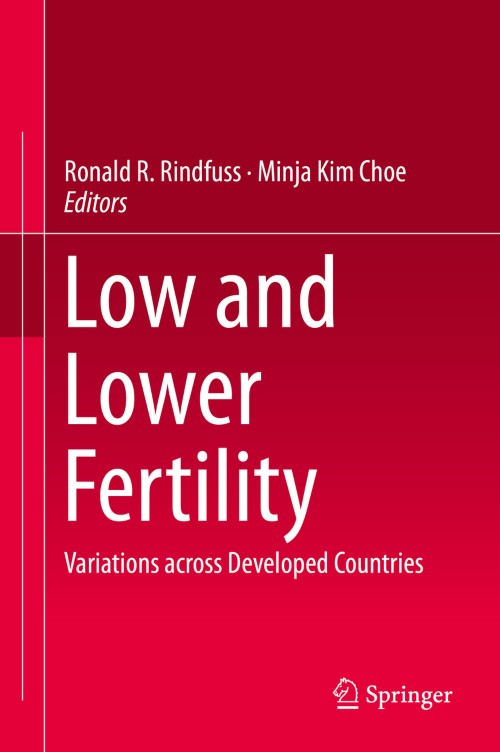
Low and Lower Fertility [electronic resource] : Variations across Developed Countries / edited by Ronald R. Rindfuss, Minja Kim Choe.
Erişim Adresi
ISBN
9783319214825
Dil Kodu
İngilizce
Yer Numarası
DK/11657
Basım Bildirimi
1st ed. 2015.
Yayın Bilgisi
Cham : Springer International Publishing : Imprint: Springer, 2015.
Fiziksel Niteleme
VII, 188 p. 32 illus., 31 illus. in color. online resource.
İçindekiler Notu
1. Introduction and overview. Minja Kim Choe and Ronald R Rindfuss -- 2. The Surprise that Ought Not To Be: Sustained Low Fertility and Slow Policy Response in China. Wang Feng (University of California – Irvine and Fudan University, Shanghai) -- 3. Singapore’s Pro-Natalist Policies: To What Extent Have They Worked? Gavin Jones (Nationa University of Singapore) -- 4. Policy Responses to a Rapidly Ageing Population: Hong Kong, SAR. Stuart Basten (University of Oxford) -- 5. Below-Replacement Fertility in Japan: Patterns, Factors and Policy Implications. Noriko O. Tsuya (Keio University) -- 6. Low Fertility, Population Ageing, and Policy Response in South Korea. So-Young Lee (KIHASA) -- 7. Variation in U.S. Fertility: Lowest-low and the Not-so-low. S. Philip Morgan (University of North Carolina) -- 8. The Evolution of Population and Family Policy in Australia. Peter McDonald (The Australian National University) -- 9. Policy Responses to Low Fertility and Population Ageing: The Case of the Netherlands. Melinda C. Mills (University of Groningen, moving June 2014 to Oxford University).
Özet, vb.
This volume examines two distinct low fertility scenarios that have emerged in economically advanced countries since the turn of the 20th century: one in which fertility is at or near replacement-level and the other where fertility is well below replacement. It explores the way various institutions, histories and cultures influence fertility in a diverse range of countries in Asia, Europe, North America and Australia. The book features invited papers from the Conference on Low Fertility, Population Aging and Population Policy, held December 2013 and co-sponsored by the East-West Center and the Korea Institute for Health and Social Affairs (KIHASA). It first presents an overview of the demographic and policy implications of the two low fertility scenarios. Next, the book explores five countries currently experiencing low fertility rates: China, Hong Kong, Japan, Singapore and South Korea. It then examines three countries that have close to replacement-level fertility: Australia, the Netherlands and the United States. Each country is featured in a separate chapter written by a demographer with expert knowledge in the area. Very low fertility is linked to a number of conditions countries face, including a declining population size. At the same time, low fertility, and its effect on the age structure, threatens social welfare policies. This book goes beyond the technical to examine the core institutional, policy and cultural factors behind this increasingly important issue.It helps readers to make cross-country comparisons and gain insight into how diverse institutions, policies and culture shape fertility levels and patterns.
Konu
Demography.
Population.
Population __ Economic aspects.
Public health.
Sociology.
Social groups.
Social policy.
Population and Demography.
Population Economics.
Public Health.
Sociology of Family, Youth and Aging.
Social Policy.
Population.
Population __ Economic aspects.
Public health.
Sociology.
Social groups.
Social policy.
Population and Demography.
Population Economics.
Public Health.
Sociology of Family, Youth and Aging.
Social Policy.
Diğer Yazarlar
Kurum Adı
Eseri Alıntıla
Referansları kullanmadan önce gözden geçirmeniz ve varsa gerekli düzeltmeleri yapmanız önerilir.
Dijital Kaynak
MARC Görünümü
LEADER 04797nam a22005775i 4500
001 810379
003 TR_AnAIT
005 20260131020006
007 cr nn 008mamaa
008 151012s2015 sz | s |||| 0|eng d
020 |a9783319214825|9978-3-319-21482-5
024 7 |a10.1007/978-3-319-21482-5|2doi
041 |aeng
049 |aTürk Tarih Kurumu Kütüphanesi
050 4|aHB848-3697
072 7|aJHBD|2bicssc
072 7|aSOC006000|2bisacsh
072 7|aJHBD|2thema
082 04|a304.6|223
090 |aDK/11657
245 10|aLow and Lower Fertility|h[electronic resource] :|bVariations across Developed Countries /|cedited by Ronald R. Rindfuss, Minja Kim Choe.
250 |a1st ed. 2015.
264 1|aCham :|bSpringer International Publishing :|bImprint: Springer,|c2015.
300 |aVII, 188 p. 32 illus., 31 illus. in color.|bonline resource.
336 |atext|btxt|2rdacontent
337 |acomputer|bc|2rdamedia
338 |aonline resource|bcr|2rdacarrier
347 |atext file|bPDF|2rda
505 0 |a1. Introduction and overview. Minja Kim Choe and Ronald R Rindfuss -- 2. The Surprise that Ought Not To Be: Sustained Low Fertility and Slow Policy Response in China. Wang Feng (University of California – Irvine and Fudan University, Shanghai) -- 3. Singapore’s Pro-Natalist Policies: To What Extent Have They Worked? Gavin Jones (Nationa University of Singapore) -- 4. Policy Responses to a Rapidly Ageing Population: Hong Kong, SAR. Stuart Basten (University of Oxford) -- 5. Below-Replacement Fertility in Japan: Patterns, Factors and Policy Implications. Noriko O. Tsuya (Keio University) -- 6. Low Fertility, Population Ageing, and Policy Response in South Korea. So-Young Lee (KIHASA) -- 7. Variation in U.S. Fertility: Lowest-low and the Not-so-low. S. Philip Morgan (University of North Carolina) -- 8. The Evolution of Population and Family Policy in Australia. Peter McDonald (The Australian National University) -- 9. Policy Responses to Low Fertility and Population Ageing: The Case of the Netherlands. Melinda C. Mills (University of Groningen, moving June 2014 to Oxford University).
520 |aThis volume examines two distinct low fertility scenarios that have emerged in economically advanced countries since the turn of the 20th century: one in which fertility is at or near replacement-level and the other where fertility is well below replacement. It explores the way various institutions, histories and cultures influence fertility in a diverse range of countries in Asia, Europe, North America and Australia. The book features invited papers from the Conference on Low Fertility, Population Aging and Population Policy, held December 2013 and co-sponsored by the East-West Center and the Korea Institute for Health and Social Affairs (KIHASA). It first presents an overview of the demographic and policy implications of the two low fertility scenarios. Next, the book explores five countries currently experiencing low fertility rates: China, Hong Kong, Japan, Singapore and South Korea. It then examines three countries that have close to replacement-level fertility: Australia, the Netherlands and the United States. Each country is featured in a separate chapter written by a demographer with expert knowledge in the area. Very low fertility is linked to a number of conditions countries face, including a declining population size. At the same time, low fertility, and its effect on the age structure, threatens social welfare policies. This book goes beyond the technical to examine the core institutional, policy and cultural factors behind this increasingly important issue.It helps readers to make cross-country comparisons and gain insight into how diverse institutions, policies and culture shape fertility levels and patterns.
650 0|aDemography.
650 0|aPopulation.
650 0|aPopulation|xEconomic aspects.
650 0|aPublic health.
650 0|aSociology.
650 0|aSocial groups.
650 0|aSocial policy.
650 14|aPopulation and Demography.
650 24|aPopulation Economics.
650 24|aPublic Health.
650 24|aSociology of Family, Youth and Aging.
650 24|aSocial Policy.
700 1 |aRindfuss, Ronald R.|eeditor.|4edt|4http://id.loc.gov/vocabulary/relators/edt
700 1 |aChoe, Minja Kim.|eeditor.|4edt|4http://id.loc.gov/vocabulary/relators/edt
710 2 |aSpringerLink (Online service)
773 0 |tSpringer Nature eBook
776 08|iPrinted edition:|z9783319214818
776 08|iPrinted edition:|z9783319214832
776 08|iPrinted edition:|z9783319360577
856 40|uhttps://doi.org/10.1007/978-3-319-21482-5
912 |aZDB-2-SHU
912 |aZDB-2-SXS
950 |aHumanities, Social Sciences and Law (SpringerNature-11648)
950 |aSocial Sciences (R0) (SpringerNature-43726)
001 810379
003 TR_AnAIT
005 20260131020006
007 cr nn 008mamaa
008 151012s2015 sz | s |||| 0|eng d
020 |a9783319214825|9978-3-319-21482-5
024 7 |a10.1007/978-3-319-21482-5|2doi
041 |aeng
049 |aTürk Tarih Kurumu Kütüphanesi
050 4|aHB848-3697
072 7|aJHBD|2bicssc
072 7|aSOC006000|2bisacsh
072 7|aJHBD|2thema
082 04|a304.6|223
090 |aDK/11657
245 10|aLow and Lower Fertility|h[electronic resource] :|bVariations across Developed Countries /|cedited by Ronald R. Rindfuss, Minja Kim Choe.
250 |a1st ed. 2015.
264 1|aCham :|bSpringer International Publishing :|bImprint: Springer,|c2015.
300 |aVII, 188 p. 32 illus., 31 illus. in color.|bonline resource.
336 |atext|btxt|2rdacontent
337 |acomputer|bc|2rdamedia
338 |aonline resource|bcr|2rdacarrier
347 |atext file|bPDF|2rda
505 0 |a1. Introduction and overview. Minja Kim Choe and Ronald R Rindfuss -- 2. The Surprise that Ought Not To Be: Sustained Low Fertility and Slow Policy Response in China. Wang Feng (University of California – Irvine and Fudan University, Shanghai) -- 3. Singapore’s Pro-Natalist Policies: To What Extent Have They Worked? Gavin Jones (Nationa University of Singapore) -- 4. Policy Responses to a Rapidly Ageing Population: Hong Kong, SAR. Stuart Basten (University of Oxford) -- 5. Below-Replacement Fertility in Japan: Patterns, Factors and Policy Implications. Noriko O. Tsuya (Keio University) -- 6. Low Fertility, Population Ageing, and Policy Response in South Korea. So-Young Lee (KIHASA) -- 7. Variation in U.S. Fertility: Lowest-low and the Not-so-low. S. Philip Morgan (University of North Carolina) -- 8. The Evolution of Population and Family Policy in Australia. Peter McDonald (The Australian National University) -- 9. Policy Responses to Low Fertility and Population Ageing: The Case of the Netherlands. Melinda C. Mills (University of Groningen, moving June 2014 to Oxford University).
520 |aThis volume examines two distinct low fertility scenarios that have emerged in economically advanced countries since the turn of the 20th century: one in which fertility is at or near replacement-level and the other where fertility is well below replacement. It explores the way various institutions, histories and cultures influence fertility in a diverse range of countries in Asia, Europe, North America and Australia. The book features invited papers from the Conference on Low Fertility, Population Aging and Population Policy, held December 2013 and co-sponsored by the East-West Center and the Korea Institute for Health and Social Affairs (KIHASA). It first presents an overview of the demographic and policy implications of the two low fertility scenarios. Next, the book explores five countries currently experiencing low fertility rates: China, Hong Kong, Japan, Singapore and South Korea. It then examines three countries that have close to replacement-level fertility: Australia, the Netherlands and the United States. Each country is featured in a separate chapter written by a demographer with expert knowledge in the area. Very low fertility is linked to a number of conditions countries face, including a declining population size. At the same time, low fertility, and its effect on the age structure, threatens social welfare policies. This book goes beyond the technical to examine the core institutional, policy and cultural factors behind this increasingly important issue.It helps readers to make cross-country comparisons and gain insight into how diverse institutions, policies and culture shape fertility levels and patterns.
650 0|aDemography.
650 0|aPopulation.
650 0|aPopulation|xEconomic aspects.
650 0|aPublic health.
650 0|aSociology.
650 0|aSocial groups.
650 0|aSocial policy.
650 14|aPopulation and Demography.
650 24|aPopulation Economics.
650 24|aPublic Health.
650 24|aSociology of Family, Youth and Aging.
650 24|aSocial Policy.
700 1 |aRindfuss, Ronald R.|eeditor.|4edt|4http://id.loc.gov/vocabulary/relators/edt
700 1 |aChoe, Minja Kim.|eeditor.|4edt|4http://id.loc.gov/vocabulary/relators/edt
710 2 |aSpringerLink (Online service)
773 0 |tSpringer Nature eBook
776 08|iPrinted edition:|z9783319214818
776 08|iPrinted edition:|z9783319214832
776 08|iPrinted edition:|z9783319360577
856 40|uhttps://doi.org/10.1007/978-3-319-21482-5
912 |aZDB-2-SHU
912 |aZDB-2-SXS
950 |aHumanities, Social Sciences and Law (SpringerNature-11648)
950 |aSocial Sciences (R0) (SpringerNature-43726)
Materyaller
Depodan talep edilen materyal sadece kütüphane içerisinde kullanılmaktadır.
Materyal dışarıya ödünç verilmemektedir.
Materyal dışarıya ödünç verilmemektedir.
