LEADER 04089nam a22005175i 4500
001 810401
003 TR_AnAIT
005 20260131015901
007 cr nn 008mamaa
008 121227s1965 ne | s |||| 0|eng d
020 |a9789401194471|9978-94-011-9447-1
024 7 |a10.1007/978-94-011-9447-1|2doi
041 |aeng
049 |aTürk Tarih Kurumu Kütüphanesi
050 4|aB1-5802
072 7|aHPC|2bicssc
072 7|aPHI009000|2bisacsh
072 7|aQDH|2thema
082 04|a109|223
090 |aDK/11679
100 1 |aAnderson, James F.|eauthor.|4aut|4http://id.loc.gov/vocabulary/relators/aut
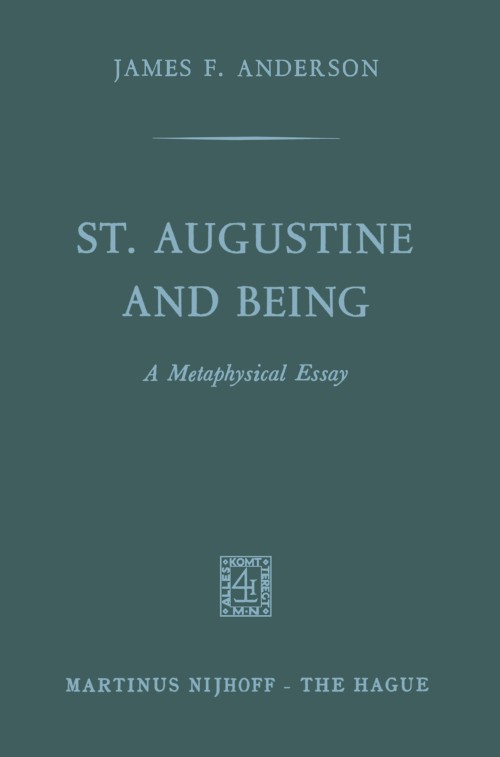
245 10|aSt. Augustine and being|h[electronic resource] :|bA Metaphysical Essay /|cby James F. Anderson.
250 |a1st ed. 1965.
264 1|aDordrecht :|bSpringer Netherlands :|bImprint: Springer,|c1965.
300 |a76 p. 2 illus.|bonline resource.
336 |atext|btxt|2rdacontent
337 |acomputer|bc|2rdamedia
338 |aonline resource|bcr|2rdacarrier
347 |atext file|bPDF|2rda
505 0 |aThe Existence of Augustinian “Metaphysics” -- Mutability and Immutability -- Being and Non-Being -- Self-Identity -- Creation and Formation -- Truth -- Participation -- Analogy -- “Essence” and Creatures -- “ Essence” and God.
520 |aThe properly metaphysical dimension of Augustine's thought has received little special attention among scholars - even "Scholastics. " The Thomist metaphysicians - especially we "Anglo-Saxon" ones - receive first honors for being the most neglectful of all. Why? I t is a puzzling phenomenon particularly in the light of the fact (recognized by almost every Thomist) that the very existence of Thomas the theologian is inconceivable apart from his pre-eminent Christian mentor in the intellectual life, the Bishop of Hippo. It is a puzzling phenomenon because, although the Christian metaphysics of Thomas Aquinas is not the Christian metaphysics of Augustine, these metaphysics could not be simply opposed to one another, else the theologies wherein they exercise the indispensable function of vital rational organs would themselves be discordant. But what respectable "Scholas tic" would deny that, in their essential teaching about God and the things of God, the thought of these two masters is remarkably congruent? May I suggest that one of the major reasons for this paradoxical neglect of Augustinian metaphysics on the part of Thomists (above all, in the English-speaking world) is their simplistic assumption that whereas Aquinas was an Aristotelian in phi losophy, Augustine was a Platonist, despite the fact that in theology they were substantially at one - as if there could be theological agreement, formally speaking, even where there is metaphysical disagreement, formally speaking.
532 8 |aAccessibility summary: This PDF is not accessible. It is based on scanned pages and does not support features such as screen reader compatibility or described non-text content (images, graphs etc). However, it likely supports searchable and selectable text based on OCR (Optical Character Recognition). Users with accessibility needs may not be able to use this content effectively. Please contact us at accessibilitysupport@springernature.com if you require assistance or an alternative format.
532 8 |aInaccessible, or known limited accessibility
532 8 |aNo reading system accessibility options actively disabled
532 8 |aPublisher contact for further accessibility information: accessibilitysupport@springernature.com
650 0|aPhilosophy|xHistory.
650 0|aReligion|xPhilosophy.
650 14|aHistory of Philosophy.
650 24|aPhilosophy of Religion.
710 2 |aSpringerLink (Online service)
773 0 |tSpringer Nature eBook
776 08|iPrinted edition:|z9789401186551
776 08|iPrinted edition:|z9789401194488
856 40|uhttps://doi.org/10.1007/978-94-011-9447-1
912 |aZDB-2-SHU
912 |aZDB-2-SXPR
912 |aZDB-2-BAE
950 |aHumanities, Social Sciences and Law (SpringerNature-11648)
950 |aPhilosophy and Religion (R0) (SpringerNature-43725)