LEADER 03394nam a22005175i 4500
001 810423
003 TR_AnAIT
005 20260131015801
007 cr nn 008mamaa
008 101125s2011 xxu| s |||| 0|eng d
020 |a9781441911025|9978-1-4419-1102-5
024 7 |a10.1007/978-1-4419-1102-5|2doi
041 |aeng
049 |aTürk Tarih Kurumu Kütüphanesi
050 4|aHV6001-7220.5
072 7|aJKV|2bicssc
072 7|aSOC004000|2bisacsh
072 7|aJKV|2thema
082 04|a364|223
090 |aDK/11701
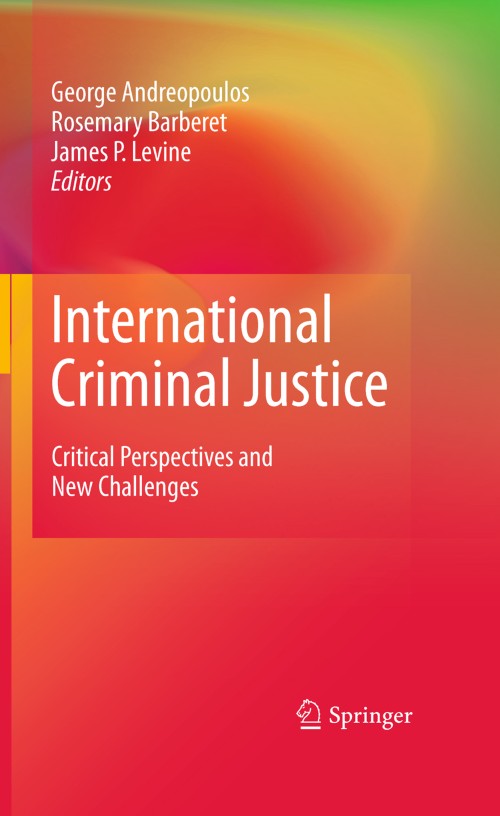
245 10|aInternational Criminal Justice|h[electronic resource] :|bCritical Perspectives and New Challenges /|cedited by George Andreopoulos, Rosemary Barberet, James P. Levine.
250 |a1st ed. 2011.
264 1|aNew York, NY :|bSpringer New York :|bImprint: Springer,|c2011.
300 |aXVIII, 198 p.|bonline resource.
336 |atext|btxt|2rdacontent
337 |acomputer|bc|2rdamedia
338 |aonline resource|bcr|2rdacarrier
347 |atext file|bPDF|2rda
520 |aIn recent years, justice-related issues have figured prominently on the international agenda. This expansion of the justice space is a product of a growing demand for accountability in world politics. Whether the issue is addressing heinous crimes such as genocide, war crimes and crimes against humanity in situations of armed conflict, confronting the inability or reluctance of governments to protect their own populations, or responding to the challenges posed by transnational terrorism, the international community has witnessed the proliferation of institutions and mechanisms, as well as the dynamic interplay between domestic and international processes, in the pursuit of justice-sensitive outcomes. International and hybrid tribunals, UN-led and domestic counter-terrorist initiatives, and the use of force for human protection purposes have demarcated the space within which ethical, political, and legal debates have unfolded in the quest for a more humane world order. In International Criminal Justice: Legal and Theoretical Perspectives, the authors address some of the most important debates surrounding key mechanisms and processes involved in this quest, and assess the merits of contending approaches to the promotion of international justice norms. This volume will contribute to the ongoing debate on the challenges, as well as opportunities, facing the justice agenda in its effort to shape developments in an increasingly interdependent world. .
650 0|aCriminology.
650 0|aLaw|xPhilosophy.
650 0|aLaw|xHistory.
650 0|aLaw.
650 14|aCriminology.
650 24|aTheories of Law, Philosophy of Law, Legal History.
650 24|aLaw.
700 1 |aAndreopoulos, George.|eeditor.|4edt|4http://id.loc.gov/vocabulary/relators/edt
700 1 |aBarberet, Rosemary.|eeditor.|4edt|4http://id.loc.gov/vocabulary/relators/edt
700 1 |aLevine, James P.|eeditor.|4edt|4http://id.loc.gov/vocabulary/relators/edt
710 2 |aSpringerLink (Online service)
773 0 |tSpringer Nature eBook
776 08|iPrinted edition:|z9781441911018
776 08|iPrinted edition:|z9781441911032
776 08|iPrinted edition:|z9781489981837
856 40|uhttps://doi.org/10.1007/978-1-4419-1102-5
912 |aZDB-2-SHU
912 |aZDB-2-SXS
950 |aHumanities, Social Sciences and Law (SpringerNature-11648)
950 |aSocial Sciences (R0) (SpringerNature-43726)