LEADER 04305nam a22005775i 4500
001 810496
003 TR_AnAIT
005 20260131015355
007 cr nn 008mamaa
008 121227s1964 ne | s |||| 0|eng d
020 |a9789401188364|9978-94-011-8836-4
024 7 |a10.1007/978-94-011-8836-4|2doi
041 |aeng
049 |aTürk Tarih Kurumu Kütüphanesi
050 4|aK1700-1973
072 7|aLNH|2bicssc
072 7|aLNT|2bicssc
072 7|aLAW054000|2bisacsh
072 7|aLNH|2thema
072 7|aLNT|2thema
082 04|a344.01|223
090 |aDK/11772
100 1 |aHashem, Hisham Rif'at.|eauthor.|4aut|4http://id.loc.gov/vocabulary/relators/aut
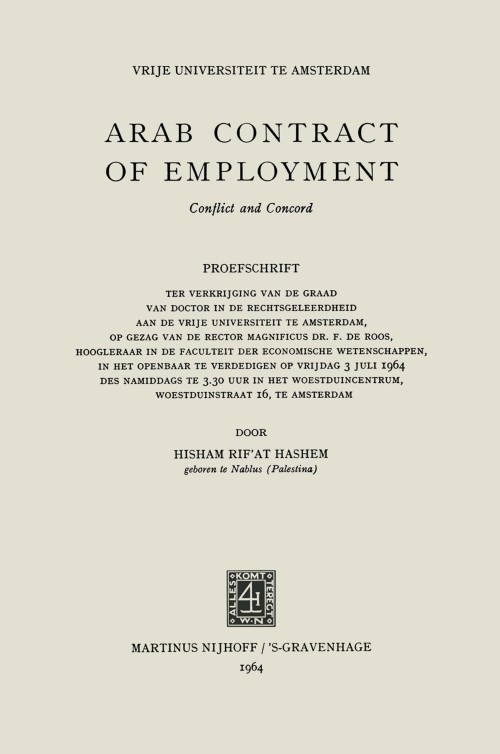
245 10|aArab Contract of Employment|h[electronic resource] /|cby Hisham Rif'at Hashem.
250 |a1st ed. 1964.
264 1|aDordrecht :|bSpringer Netherlands :|bImprint: Springer,|c1964.
300 |a297 p.|bonline resource.
336 |atext|btxt|2rdacontent
337 |acomputer|bc|2rdamedia
338 |aonline resource|bcr|2rdacarrier
347 |atext file|bPDF|2rda
505 0 |aI. Introduction -- II. the Contract of Employment -- I. Definitions -- II. Formation of the Contract of Employment -- III. Rights and Obligations of the Parties -- IV. Wages -- V. Lea on es and Holidays -- VI. Suspension, Frustration and Termination of the Contract of Employment -- VII. the Termination Gratuity -- Selected Bibliography.
520 |aThe contract of employment is the legal instrument which regulates the conditions of employment of the vast majority of the working 1 people of the world. More than any other civil contract based on mutual rights and obligations, this contract is characterised by the importance of its human elements. Sir William Blackstone once under lined the human and legal significance ofthe relationship, by classifying it immediately after the two great human relationships of husband and 2 wife and of parent and child. The contract is thus nationally and internationally important. In 1927 the International Labour Conference adopted a resolution "requesting the governing body of the Office to consider the possibility of placing the question of the general principles of contracts of employment on the agenda of a future session of the Conference. "3 This question was regrettably not followed up. The reason though not the justification, lies in the difficult task of limiting the bounds of the contract and of reconciling the different legal systems in the various countries. The effort spent by the LL. O. during the last few years towards the adoption of an international recommendation on the termination of the contract, which is yet to bear fruit, illustrates the difficulties involved. In the Arab countries the importance of the contract of employment was more felt since the introduction of industry thirty years ago.
532 8 |aAccessibility summary: This PDF is not accessible. It is based on scanned pages and does not support features such as screen reader compatibility or described non-text content (images, graphs etc). However, it likely supports searchable and selectable text based on OCR (Optical Character Recognition). Users with accessibility needs may not be able to use this content effectively. Please contact us at accessibilitysupport@springernature.com if you require assistance or an alternative format.
532 8 |aInaccessible, or known limited accessibility
532 8 |aNo reading system accessibility options actively disabled
532 8 |aPublisher contact for further accessibility information: accessibilitysupport@springernature.com
650 0|aSocial legislation.
650 0|aPrivate international law.
650 0|aConflict of laws.
650 0|aInternational law.
650 0|aComparative law.
650 14|aLabour Law/Social Law.
650 24|aPrivate International Law, International and Foreign Law, Comparative Law.
710 2 |aSpringerLink (Online service)
773 0 |tSpringer Nature eBook
776 08|iPrinted edition:|z9789401181884
776 08|iPrinted edition:|z9789401188371
856 40|uhttps://doi.org/10.1007/978-94-011-8836-4
912 |aZDB-2-SHU
912 |aZDB-2-SXLC
912 |aZDB-2-BAE
950 |aHumanities, Social Sciences and Law (SpringerNature-11648)
950 |aLaw and Criminology (R0) (SpringerNature-43727)