

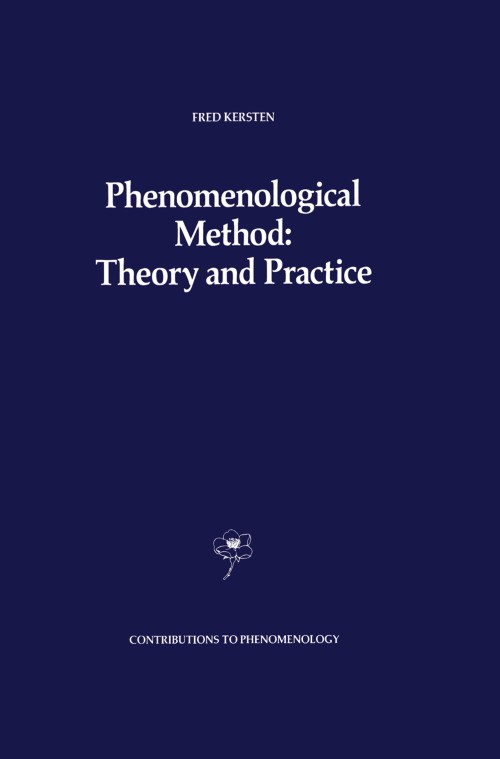
Phenomenological Method: Theory and Practice [electronic resource] / by F. Kersten.
Erişim Adresi
ISBN
9789400922655
Dil Kodu
İngilizce
Yer Numarası
DK/11786
Yazar
Basım Bildirimi
1st ed. 1989.
Yayın Bilgisi
Dordrecht : Springer Netherlands : Imprint: Springer, 1989.
Fiziksel Niteleme
X, 434 p. online resource.
Dizi
Contributions to Phenomenology, In Cooperation with The Center for Advanced Research in Phenomenology, 2215-1915 ; 1
İçindekiler Notu
One The Method of Phenomenological Reductions -- “Wir wollen auf den ‘Sachen selbst’ zurückgehen” -- 1. The Transcendental Phenomenological Reductions -- 2. Specific Transcendental Phenomenological Procedures -- 3. Further Transcendental Procedures -- 4. The Order of Transcendental Phenomenological inquiry That Wills to Return to the “Things Themselves” -- Two Transcendental Phenomenology of Space, Time, Other -- The Problem, Plan and Historical Setting of the Constitution of Space and Time -- 5. Transcendental Phenomenological Unbuilding to the Tactually, Visually, and Auditorily Presented in Prespace -- 6. Transcendental Phenomenological Building-up of Quasi-Objective Space In Primary Passivity -- 7. The Transcendental Phenomenological Building-up of Phantom Quasi-objective Space. The Transcendental Phenomenological ‘Deduction’ of Space -- 8. The Transcendental Phenomenological Building-up of primordial Quasi-objective Space. The Transcendental Phenomenological “Deduction” of Time -- 9. Time, Space, Other -- Notes -- List of Works Cited.
Özet, vb.
This book has two parts. The first part is chiefly concerned with critically establishing the universally necessary order of the various steps of transcendental phenomenological method; the second part provides specific cases of phenomenological analysis that illustrate and test the method established in the first part. More than this, and perhaps even more important in the long run, the phenomeno logical analyses reported in the second part purport a foundation for drawing phenomenological-philosophical conclusions about prob lems of space perception, "other minds," and time perception. The non-analytical, that is, the literary, sources of this book are many. Principal among them are the writings of Husserl (which will be accorded a special methodological function) as well as the writings of his students of the Gottingen and Freiburg years. Of the latter especially important are the writings and, when memory serves, the lectures of Dorion Cairns and Aron Gurwitsch. Of the former especially significant are the writings of Heinrich Hofmann, Wilhelm Schapp, and Hedwig COlilrad-Martius.
Konu
Phenomenology .
Pragmatism.
Philosophy of mind.
Phenomenology.
Pragmatism.
Philosophy of Mind.
Pragmatism.
Philosophy of mind.
Phenomenology.
Pragmatism.
Philosophy of Mind.
Kurum Adı
Eseri Alıntıla
Referansları kullanmadan önce gözden geçirmeniz ve varsa gerekli düzeltmeleri yapmanız önerilir.
Dijital Kaynak
MARC Görünümü
LEADER 04873nam a22005775i 4500
001 810510
003 TR_AnAIT
005 20260131015248
007 cr nn 008mamaa
008 121227s1989 ne | s |||| 0|eng d
020 |a9789400922655|9978-94-009-2265-5
024 7 |a10.1007/978-94-009-2265-5|2doi
041 |aeng
049 |aTürk Tarih Kurumu Kütüphanesi
050 4|aB829.5.A-Z
072 7|aHPCF3|2bicssc
072 7|aPHI018000|2bisacsh
072 7|aQDHR5|2thema
082 04|a142.7|223
090 |aDK/11786
100 1 |aKersten, F.|eauthor.|4aut|4http://id.loc.gov/vocabulary/relators/aut
245 10|aPhenomenological Method: Theory and Practice|h[electronic resource] /|cby F. Kersten.
250 |a1st ed. 1989.
264 1|aDordrecht :|bSpringer Netherlands :|bImprint: Springer,|c1989.
300 |aX, 434 p.|bonline resource.
336 |atext|btxt|2rdacontent
337 |acomputer|bc|2rdamedia
338 |aonline resource|bcr|2rdacarrier
347 |atext file|bPDF|2rda
490 1 |aContributions to Phenomenology, In Cooperation with The Center for Advanced Research in Phenomenology,|x2215-1915 ;|v1
505 0 |aOne The Method of Phenomenological Reductions -- “Wir wollen auf den ‘Sachen selbst’ zurückgehen” -- 1. The Transcendental Phenomenological Reductions -- 2. Specific Transcendental Phenomenological Procedures -- 3. Further Transcendental Procedures -- 4. The Order of Transcendental Phenomenological inquiry That Wills to Return to the “Things Themselves” -- Two Transcendental Phenomenology of Space, Time, Other -- The Problem, Plan and Historical Setting of the Constitution of Space and Time -- 5. Transcendental Phenomenological Unbuilding to the Tactually, Visually, and Auditorily Presented in Prespace -- 6. Transcendental Phenomenological Building-up of Quasi-Objective Space In Primary Passivity -- 7. The Transcendental Phenomenological Building-up of Phantom Quasi-objective Space. The Transcendental Phenomenological ‘Deduction’ of Space -- 8. The Transcendental Phenomenological Building-up of primordial Quasi-objective Space. The Transcendental Phenomenological “Deduction” of Time -- 9. Time, Space, Other -- Notes -- List of Works Cited.
520 |aThis book has two parts. The first part is chiefly concerned with critically establishing the universally necessary order of the various steps of transcendental phenomenological method; the second part provides specific cases of phenomenological analysis that illustrate and test the method established in the first part. More than this, and perhaps even more important in the long run, the phenomeno logical analyses reported in the second part purport a foundation for drawing phenomenological-philosophical conclusions about prob lems of space perception, "other minds," and time perception. The non-analytical, that is, the literary, sources of this book are many. Principal among them are the writings of Husserl (which will be accorded a special methodological function) as well as the writings of his students of the Gottingen and Freiburg years. Of the latter especially important are the writings and, when memory serves, the lectures of Dorion Cairns and Aron Gurwitsch. Of the former especially significant are the writings of Heinrich Hofmann, Wilhelm Schapp, and Hedwig COlilrad-Martius.
532 8 |aAccessibility summary: This PDF is not accessible. It is based on scanned pages and does not support features such as screen reader compatibility or described non-text content (images, graphs etc). However, it likely supports searchable and selectable text based on OCR (Optical Character Recognition). Users with accessibility needs may not be able to use this content effectively. Please contact us at accessibilitysupport@springernature.com if you require assistance or an alternative format.
532 8 |aInaccessible, or known limited accessibility
532 8 |aNo reading system accessibility options actively disabled
532 8 |aPublisher contact for further accessibility information: accessibilitysupport@springernature.com
650 0|aPhenomenology .
650 0|aPragmatism.
650 0|aPhilosophy of mind.
650 14|aPhenomenology.
650 24|aPragmatism.
650 24|aPhilosophy of Mind.
710 2 |aSpringerLink (Online service)
773 0 |tSpringer Nature eBook
776 08|iPrinted edition:|z9780792300946
776 08|iPrinted edition:|z9789400922662
776 08|iPrinted edition:|z9789401075152
830 0|aContributions to Phenomenology, In Cooperation with The Center for Advanced Research in Phenomenology,|x2215-1915 ;|v1
856 40|uhttps://doi.org/10.1007/978-94-009-2265-5
912 |aZDB-2-SHU
912 |aZDB-2-SXPR
912 |aZDB-2-BAE
950 |aHumanities, Social Sciences and Law (SpringerNature-11648)
950 |aPhilosophy and Religion (R0) (SpringerNature-43725)
001 810510
003 TR_AnAIT
005 20260131015248
007 cr nn 008mamaa
008 121227s1989 ne | s |||| 0|eng d
020 |a9789400922655|9978-94-009-2265-5
024 7 |a10.1007/978-94-009-2265-5|2doi
041 |aeng
049 |aTürk Tarih Kurumu Kütüphanesi
050 4|aB829.5.A-Z
072 7|aHPCF3|2bicssc
072 7|aPHI018000|2bisacsh
072 7|aQDHR5|2thema
082 04|a142.7|223
090 |aDK/11786
100 1 |aKersten, F.|eauthor.|4aut|4http://id.loc.gov/vocabulary/relators/aut
245 10|aPhenomenological Method: Theory and Practice|h[electronic resource] /|cby F. Kersten.
250 |a1st ed. 1989.
264 1|aDordrecht :|bSpringer Netherlands :|bImprint: Springer,|c1989.
300 |aX, 434 p.|bonline resource.
336 |atext|btxt|2rdacontent
337 |acomputer|bc|2rdamedia
338 |aonline resource|bcr|2rdacarrier
347 |atext file|bPDF|2rda
490 1 |aContributions to Phenomenology, In Cooperation with The Center for Advanced Research in Phenomenology,|x2215-1915 ;|v1
505 0 |aOne The Method of Phenomenological Reductions -- “Wir wollen auf den ‘Sachen selbst’ zurückgehen” -- 1. The Transcendental Phenomenological Reductions -- 2. Specific Transcendental Phenomenological Procedures -- 3. Further Transcendental Procedures -- 4. The Order of Transcendental Phenomenological inquiry That Wills to Return to the “Things Themselves” -- Two Transcendental Phenomenology of Space, Time, Other -- The Problem, Plan and Historical Setting of the Constitution of Space and Time -- 5. Transcendental Phenomenological Unbuilding to the Tactually, Visually, and Auditorily Presented in Prespace -- 6. Transcendental Phenomenological Building-up of Quasi-Objective Space In Primary Passivity -- 7. The Transcendental Phenomenological Building-up of Phantom Quasi-objective Space. The Transcendental Phenomenological ‘Deduction’ of Space -- 8. The Transcendental Phenomenological Building-up of primordial Quasi-objective Space. The Transcendental Phenomenological “Deduction” of Time -- 9. Time, Space, Other -- Notes -- List of Works Cited.
520 |aThis book has two parts. The first part is chiefly concerned with critically establishing the universally necessary order of the various steps of transcendental phenomenological method; the second part provides specific cases of phenomenological analysis that illustrate and test the method established in the first part. More than this, and perhaps even more important in the long run, the phenomeno logical analyses reported in the second part purport a foundation for drawing phenomenological-philosophical conclusions about prob lems of space perception, "other minds," and time perception. The non-analytical, that is, the literary, sources of this book are many. Principal among them are the writings of Husserl (which will be accorded a special methodological function) as well as the writings of his students of the Gottingen and Freiburg years. Of the latter especially important are the writings and, when memory serves, the lectures of Dorion Cairns and Aron Gurwitsch. Of the former especially significant are the writings of Heinrich Hofmann, Wilhelm Schapp, and Hedwig COlilrad-Martius.
532 8 |aAccessibility summary: This PDF is not accessible. It is based on scanned pages and does not support features such as screen reader compatibility or described non-text content (images, graphs etc). However, it likely supports searchable and selectable text based on OCR (Optical Character Recognition). Users with accessibility needs may not be able to use this content effectively. Please contact us at accessibilitysupport@springernature.com if you require assistance or an alternative format.
532 8 |aInaccessible, or known limited accessibility
532 8 |aNo reading system accessibility options actively disabled
532 8 |aPublisher contact for further accessibility information: accessibilitysupport@springernature.com
650 0|aPhenomenology .
650 0|aPragmatism.
650 0|aPhilosophy of mind.
650 14|aPhenomenology.
650 24|aPragmatism.
650 24|aPhilosophy of Mind.
710 2 |aSpringerLink (Online service)
773 0 |tSpringer Nature eBook
776 08|iPrinted edition:|z9780792300946
776 08|iPrinted edition:|z9789400922662
776 08|iPrinted edition:|z9789401075152
830 0|aContributions to Phenomenology, In Cooperation with The Center for Advanced Research in Phenomenology,|x2215-1915 ;|v1
856 40|uhttps://doi.org/10.1007/978-94-009-2265-5
912 |aZDB-2-SHU
912 |aZDB-2-SXPR
912 |aZDB-2-BAE
950 |aHumanities, Social Sciences and Law (SpringerNature-11648)
950 |aPhilosophy and Religion (R0) (SpringerNature-43725)
Materyaller
Depodan talep edilen materyal sadece kütüphane içerisinde kullanılmaktadır.
Materyal dışarıya ödünç verilmemektedir.
Materyal dışarıya ödünç verilmemektedir.
