

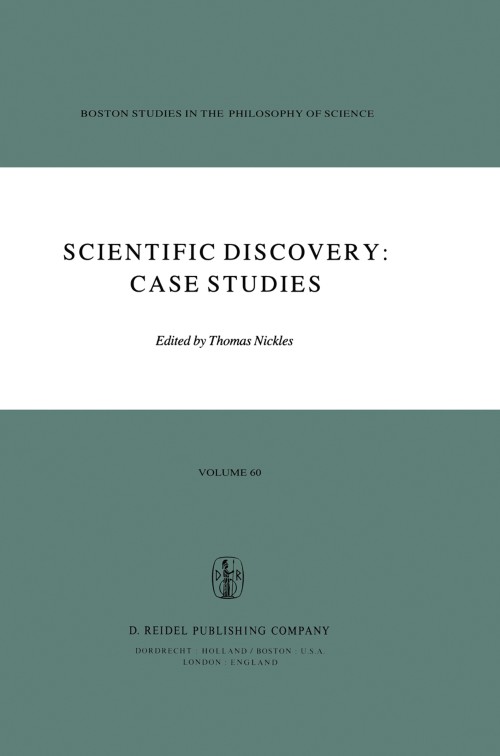
Scientific Discovery: Case Studies [electronic resource] / edited by Thomas Nickles.
Erişim Adresi
ISBN
9789400990159
Dil Kodu
İngilizce
Yer Numarası
DK/11789
Basım Bildirimi
1st ed. 1980.
Yayın Bilgisi
Dordrecht : Springer Netherlands : Imprint: Springer, 1980.
Fiziksel Niteleme
XXVI, 382 p. 1 illus. online resource.
Dizi
Boston Studies in the Philosophy and History of Science, 2214-7942 ; 60
İçindekiler Notu
Understanding Scientific Discovery -- Scientific Judgment: Creativity and Discovery in Scientific Thought -- Discussion of Wartofsky’s Paper -- The Rational Explanation of Historical Discoveries -- Theoretical and Methodological Innovation in the Copernican Era and Beyond: Social Factors -- The Legitimation of Scientific Belief: Theory Justification by Copernicus -- Wilhelm IV of Hesse-Kassel: Informal Commun-ication and the Aristocratic Context of Discovery -- The Clock Metaphor in the History of Psychology -- Biological Sciences From Darwin To Computer Diagnosis -- The Evolving Systems Approach to Creative Scientific Work: Charles Darwin’s Early Thought -- Ought Philosophers Consider Scientific Discovery? A Darwinian Case-Study -- Theory Construction in Genetics -- Discovery in the Biomedical Sciences: Logic or Irrational Intuition? -- Comment on Schaffner -- Reply -- Reductionistic Research Strategies and their Biases in the Units of Selection Controversy -- Physics and Chemistry in the Twentieth Century -- The Discovery of a New Quantum Theory -- The Personal Character of the Discovery of Mechanisms in Cloud Physics -- The Structure of Discovery: Evolution of Structural Accounts of Chemical Bonding -- The Revolution in Geology: Continental Drift -- The Method of Multiple Working Hypotheses and the Development of Plate Tectonic Theory -- Hess’s Development of his Seafloor Spreading Hypothesis -- Index of Names -- Index of Subjects.
Özet, vb.
The history of science is articulated by moments of discovery. Yet, these 'moments' are not simple or isolated events in science. Just as a scientific discovery illuminates our understanding of nature or of society, and reveals new connections among phenomena, so too does the history of scientific activity and the analysis of scientific reasoning illuminate the processes which give rise to moments of discovery and the complex network of consequences which follow upon such moments. Understanding discovery has not been, until recently, a major concern of modem philosophy of science. Whether the act of discoyery was regarded as mysterious and inexplicable, or obvious and in no need of explanation, modem philosophy of science in effect bracketed the question. It concentrated instead on the logic of scientific explanation or on the issues of validation or justification of scientific theories or laws. The recent revival of interest in the context of discovery, indeed in the acts of discovery, on the part of philosophers and historians of science, represents no one particular method'ological or philosophical orientation. It proceeds as much from an empiricist and analytical approach as from a sociological or historical one; from considerations of the logic of science as much as from the alogical or extralogical contexts of scientific tho'¢tt and practice. But, in general, this new interest focuses sharply on the actual historical and contem porary cases of scientific discovery, and on an examination of the act or moment of discovery in situ.
Konu
Science __ Philosophy.
History.
Philosophy and social sciences.
Philosophy of Science.
History.
Philosophy of the Social Sciences.
History.
Philosophy and social sciences.
Philosophy of Science.
History.
Philosophy of the Social Sciences.
Diğer Yazarlar
Kurum Adı
Eseri Alıntıla
Referansları kullanmadan önce gözden geçirmeniz ve varsa gerekli düzeltmeleri yapmanız önerilir.
Dijital Kaynak
MARC Görünümü
LEADER 05695nam a22005895i 4500
001 810513
003 TR_AnAIT
005 20260131015238
007 cr nn 008mamaa
008 121227s1980 ne | s |||| 0|eng d
020 |a9789400990159|9978-94-009-9015-9
024 7 |a10.1007/978-94-009-9015-9|2doi
041 |aeng
049 |aTürk Tarih Kurumu Kütüphanesi
050 4|aQ174-175.3
050 4|aB67
072 7|aPDA|2bicssc
072 7|aSCI075000|2bisacsh
072 7|aPDA|2thema
082 04|a501|223
090 |aDK/11789
245 10|aScientific Discovery: Case Studies|h[electronic resource] /|cedited by Thomas Nickles.
250 |a1st ed. 1980.
264 1|aDordrecht :|bSpringer Netherlands :|bImprint: Springer,|c1980.
300 |aXXVI, 382 p. 1 illus.|bonline resource.
336 |atext|btxt|2rdacontent
337 |acomputer|bc|2rdamedia
338 |aonline resource|bcr|2rdacarrier
347 |atext file|bPDF|2rda
490 1 |aBoston Studies in the Philosophy and History of Science,|x2214-7942 ;|v60
505 0 |aUnderstanding Scientific Discovery -- Scientific Judgment: Creativity and Discovery in Scientific Thought -- Discussion of Wartofsky’s Paper -- The Rational Explanation of Historical Discoveries -- Theoretical and Methodological Innovation in the Copernican Era and Beyond: Social Factors -- The Legitimation of Scientific Belief: Theory Justification by Copernicus -- Wilhelm IV of Hesse-Kassel: Informal Commun-ication and the Aristocratic Context of Discovery -- The Clock Metaphor in the History of Psychology -- Biological Sciences From Darwin To Computer Diagnosis -- The Evolving Systems Approach to Creative Scientific Work: Charles Darwin’s Early Thought -- Ought Philosophers Consider Scientific Discovery? A Darwinian Case-Study -- Theory Construction in Genetics -- Discovery in the Biomedical Sciences: Logic or Irrational Intuition? -- Comment on Schaffner -- Reply -- Reductionistic Research Strategies and their Biases in the Units of Selection Controversy -- Physics and Chemistry in the Twentieth Century -- The Discovery of a New Quantum Theory -- The Personal Character of the Discovery of Mechanisms in Cloud Physics -- The Structure of Discovery: Evolution of Structural Accounts of Chemical Bonding -- The Revolution in Geology: Continental Drift -- The Method of Multiple Working Hypotheses and the Development of Plate Tectonic Theory -- Hess’s Development of his Seafloor Spreading Hypothesis -- Index of Names -- Index of Subjects.
520 |aThe history of science is articulated by moments of discovery. Yet, these 'moments' are not simple or isolated events in science. Just as a scientific discovery illuminates our understanding of nature or of society, and reveals new connections among phenomena, so too does the history of scientific activity and the analysis of scientific reasoning illuminate the processes which give rise to moments of discovery and the complex network of consequences which follow upon such moments. Understanding discovery has not been, until recently, a major concern of modem philosophy of science. Whether the act of discoyery was regarded as mysterious and inexplicable, or obvious and in no need of explanation, modem philosophy of science in effect bracketed the question. It concentrated instead on the logic of scientific explanation or on the issues of validation or justification of scientific theories or laws. The recent revival of interest in the context of discovery, indeed in the acts of discovery, on the part of philosophers and historians of science, represents no one particular method'ological or philosophical orientation. It proceeds as much from an empiricist and analytical approach as from a sociological or historical one; from considerations of the logic of science as much as from the alogical or extralogical contexts of scientific tho'¢tt and practice. But, in general, this new interest focuses sharply on the actual historical and contem porary cases of scientific discovery, and on an examination of the act or moment of discovery in situ.
532 8 |aAccessibility summary: This PDF is not accessible. It is based on scanned pages and does not support features such as screen reader compatibility or described non-text content (images, graphs etc). However, it likely supports searchable and selectable text based on OCR (Optical Character Recognition). Users with accessibility needs may not be able to use this content effectively. Please contact us at accessibilitysupport@springernature.com if you require assistance or an alternative format.
532 8 |aInaccessible, or known limited accessibility
532 8 |aNo reading system accessibility options actively disabled
532 8 |aPublisher contact for further accessibility information: accessibilitysupport@springernature.com
650 0|aScience|xPhilosophy.
650 0|aHistory.
650 0|aPhilosophy and social sciences.
650 14|aPhilosophy of Science.
650 24|aHistory.
650 24|aPhilosophy of the Social Sciences.
700 1 |aNickles, Thomas.|eeditor.|4edt|4http://id.loc.gov/vocabulary/relators/edt
710 2 |aSpringerLink (Online service)
773 0 |tSpringer Nature eBook
776 08|iPrinted edition:|z9789027710925
776 08|iPrinted edition:|z9789027710932
776 08|iPrinted edition:|z9789400990166
830 0|aBoston Studies in the Philosophy and History of Science,|x2214-7942 ;|v60
856 40|uhttps://doi.org/10.1007/978-94-009-9015-9
912 |aZDB-2-SHU
912 |aZDB-2-SXPR
912 |aZDB-2-BAE
950 |aHumanities, Social Sciences and Law (SpringerNature-11648)
950 |aPhilosophy and Religion (R0) (SpringerNature-43725)
001 810513
003 TR_AnAIT
005 20260131015238
007 cr nn 008mamaa
008 121227s1980 ne | s |||| 0|eng d
020 |a9789400990159|9978-94-009-9015-9
024 7 |a10.1007/978-94-009-9015-9|2doi
041 |aeng
049 |aTürk Tarih Kurumu Kütüphanesi
050 4|aQ174-175.3
050 4|aB67
072 7|aPDA|2bicssc
072 7|aSCI075000|2bisacsh
072 7|aPDA|2thema
082 04|a501|223
090 |aDK/11789
245 10|aScientific Discovery: Case Studies|h[electronic resource] /|cedited by Thomas Nickles.
250 |a1st ed. 1980.
264 1|aDordrecht :|bSpringer Netherlands :|bImprint: Springer,|c1980.
300 |aXXVI, 382 p. 1 illus.|bonline resource.
336 |atext|btxt|2rdacontent
337 |acomputer|bc|2rdamedia
338 |aonline resource|bcr|2rdacarrier
347 |atext file|bPDF|2rda
490 1 |aBoston Studies in the Philosophy and History of Science,|x2214-7942 ;|v60
505 0 |aUnderstanding Scientific Discovery -- Scientific Judgment: Creativity and Discovery in Scientific Thought -- Discussion of Wartofsky’s Paper -- The Rational Explanation of Historical Discoveries -- Theoretical and Methodological Innovation in the Copernican Era and Beyond: Social Factors -- The Legitimation of Scientific Belief: Theory Justification by Copernicus -- Wilhelm IV of Hesse-Kassel: Informal Commun-ication and the Aristocratic Context of Discovery -- The Clock Metaphor in the History of Psychology -- Biological Sciences From Darwin To Computer Diagnosis -- The Evolving Systems Approach to Creative Scientific Work: Charles Darwin’s Early Thought -- Ought Philosophers Consider Scientific Discovery? A Darwinian Case-Study -- Theory Construction in Genetics -- Discovery in the Biomedical Sciences: Logic or Irrational Intuition? -- Comment on Schaffner -- Reply -- Reductionistic Research Strategies and their Biases in the Units of Selection Controversy -- Physics and Chemistry in the Twentieth Century -- The Discovery of a New Quantum Theory -- The Personal Character of the Discovery of Mechanisms in Cloud Physics -- The Structure of Discovery: Evolution of Structural Accounts of Chemical Bonding -- The Revolution in Geology: Continental Drift -- The Method of Multiple Working Hypotheses and the Development of Plate Tectonic Theory -- Hess’s Development of his Seafloor Spreading Hypothesis -- Index of Names -- Index of Subjects.
520 |aThe history of science is articulated by moments of discovery. Yet, these 'moments' are not simple or isolated events in science. Just as a scientific discovery illuminates our understanding of nature or of society, and reveals new connections among phenomena, so too does the history of scientific activity and the analysis of scientific reasoning illuminate the processes which give rise to moments of discovery and the complex network of consequences which follow upon such moments. Understanding discovery has not been, until recently, a major concern of modem philosophy of science. Whether the act of discoyery was regarded as mysterious and inexplicable, or obvious and in no need of explanation, modem philosophy of science in effect bracketed the question. It concentrated instead on the logic of scientific explanation or on the issues of validation or justification of scientific theories or laws. The recent revival of interest in the context of discovery, indeed in the acts of discovery, on the part of philosophers and historians of science, represents no one particular method'ological or philosophical orientation. It proceeds as much from an empiricist and analytical approach as from a sociological or historical one; from considerations of the logic of science as much as from the alogical or extralogical contexts of scientific tho'¢tt and practice. But, in general, this new interest focuses sharply on the actual historical and contem porary cases of scientific discovery, and on an examination of the act or moment of discovery in situ.
532 8 |aAccessibility summary: This PDF is not accessible. It is based on scanned pages and does not support features such as screen reader compatibility or described non-text content (images, graphs etc). However, it likely supports searchable and selectable text based on OCR (Optical Character Recognition). Users with accessibility needs may not be able to use this content effectively. Please contact us at accessibilitysupport@springernature.com if you require assistance or an alternative format.
532 8 |aInaccessible, or known limited accessibility
532 8 |aNo reading system accessibility options actively disabled
532 8 |aPublisher contact for further accessibility information: accessibilitysupport@springernature.com
650 0|aScience|xPhilosophy.
650 0|aHistory.
650 0|aPhilosophy and social sciences.
650 14|aPhilosophy of Science.
650 24|aHistory.
650 24|aPhilosophy of the Social Sciences.
700 1 |aNickles, Thomas.|eeditor.|4edt|4http://id.loc.gov/vocabulary/relators/edt
710 2 |aSpringerLink (Online service)
773 0 |tSpringer Nature eBook
776 08|iPrinted edition:|z9789027710925
776 08|iPrinted edition:|z9789027710932
776 08|iPrinted edition:|z9789400990166
830 0|aBoston Studies in the Philosophy and History of Science,|x2214-7942 ;|v60
856 40|uhttps://doi.org/10.1007/978-94-009-9015-9
912 |aZDB-2-SHU
912 |aZDB-2-SXPR
912 |aZDB-2-BAE
950 |aHumanities, Social Sciences and Law (SpringerNature-11648)
950 |aPhilosophy and Religion (R0) (SpringerNature-43725)
Materyaller
Depodan talep edilen materyal sadece kütüphane içerisinde kullanılmaktadır.
Materyal dışarıya ödünç verilmemektedir.
Materyal dışarıya ödünç verilmemektedir.
