

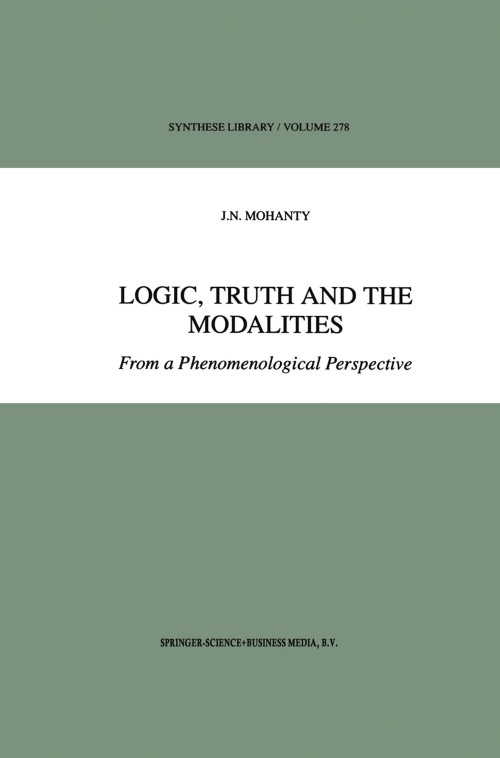
Logic, Truth and the Modalities [electronic resource] : From a Phenomenological Perspective / by J.N. Mohanty.
Erişim Adresi
ISBN
9789401721134
Dil Kodu
İngilizce
Yer Numarası
DK/11812
Yazar
Basım Bildirimi
1st ed. 1999.
Yayın Bilgisi
Dordrecht : Springer Netherlands : Imprint: Springer, 1999.
Fiziksel Niteleme
X, 238 p. online resource.
Dizi
Synthese Library, Studies in Epistemology, Logic, Methodology, and Philosophy of Science, 2542-8292 ; 278
İçindekiler Notu
Introduction: The Origin of Logic -- 1 / The Concept of “Psychologism” in Frege and Husserl -- 2 / Husserl’s Thoughts on the Foundation of Logic -- 3 / Aspects of Husser’s Philosophy of Logic a propos his Logic Lectures of 1906–7 -- 4 / In Search of the Actual Historical Frege -- 5 / Dummen, Frege, and Phenomenology -- 6 / Heidegger on Logic -- 7 / Josef König’s Distinction between Theoretical and Practical Sentences -- 8 / Lask’s Theory of Judgment -- 9 / Husserl on “Possibility” -- 10 / Phenomenology and the Modalities -- 11 / Husserl’s “Logic of Truth” -- 12 / Kant on “Truth” -- 13 / Hegel’s Concepts of Necessity.
Özet, vb.
This volume is a collection of my essays on philosophy of logic from a phenomenological perspective. They deal with the four kinds of logic I have been concerned with: formal logic, transcendental logic, speculative logic and hermeneutic logic. Of these, only one, the essay on Hegel, touches upon 'speculative logic', and two, those on Heidegger and Konig, are concerned with hermeneutic logic. The rest have to do with Husser! and Kant. I have not tried to show that the four logics are compatible. I believe, they are--once they are given a phenomenological underpinning. The original plan of writing an Introduction in which the issues would have to be formulated, developed and brought together, was abandoned in favor of writing an Introductory Essay on the 'origin'- in the phenomenological sense -of logic. J.N.M. Philadelphia INTRODUCTION: THE ORIGIN OF LOGIC The question of the origin of logic may pertain to historical origin (When did it all begin? Who founded the science of logic?), psychological origin (When, in the course of its mental development, does the child learn logical operations?), cultural origin (What cultural - theological, metaphysical and linguisti- conditions make such a discipline as logic possible?), or transcendental constitutive origin (What sorts of acts and/or practices make logic possible?).
Konu
Logic.
Phenomenology .
Knowledge, Theory of.
Logic.
Phenomenology.
Epistemology.
Phenomenology .
Knowledge, Theory of.
Logic.
Phenomenology.
Epistemology.
Kurum Adı
Eseri Alıntıla
Referansları kullanmadan önce gözden geçirmeniz ve varsa gerekli düzeltmeleri yapmanız önerilir.
Dijital Kaynak
MARC Görünümü
LEADER 04672nam a22005775i 4500
001 810536
003 TR_AnAIT
005 20260131015201
007 cr nn 008mamaa
008 130321s1999 ne | s |||| 0|eng d
020 |a9789401721134|9978-94-017-2113-4
024 7 |a10.1007/978-94-017-2113-4|2doi
041 |aeng
049 |aTürk Tarih Kurumu Kütüphanesi
050 4|aBC1-199
072 7|aHPL|2bicssc
072 7|aPHI011000|2bisacsh
072 7|aQDTL|2thema
082 04|a160|223
090 |aDK/11812
100 1 |aMohanty, J.N.|eauthor.|4aut|4http://id.loc.gov/vocabulary/relators/aut
245 10|aLogic, Truth and the Modalities|h[electronic resource] :|bFrom a Phenomenological Perspective /|cby J.N. Mohanty.
250 |a1st ed. 1999.
264 1|aDordrecht :|bSpringer Netherlands :|bImprint: Springer,|c1999.
300 |aX, 238 p.|bonline resource.
336 |atext|btxt|2rdacontent
337 |acomputer|bc|2rdamedia
338 |aonline resource|bcr|2rdacarrier
347 |atext file|bPDF|2rda
490 1 |aSynthese Library, Studies in Epistemology, Logic, Methodology, and Philosophy of Science,|x2542-8292 ;|v278
505 0 |aIntroduction: The Origin of Logic -- 1 / The Concept of “Psychologism” in Frege and Husserl -- 2 / Husserl’s Thoughts on the Foundation of Logic -- 3 / Aspects of Husser’s Philosophy of Logic a propos his Logic Lectures of 1906–7 -- 4 / In Search of the Actual Historical Frege -- 5 / Dummen, Frege, and Phenomenology -- 6 / Heidegger on Logic -- 7 / Josef König’s Distinction between Theoretical and Practical Sentences -- 8 / Lask’s Theory of Judgment -- 9 / Husserl on “Possibility” -- 10 / Phenomenology and the Modalities -- 11 / Husserl’s “Logic of Truth” -- 12 / Kant on “Truth” -- 13 / Hegel’s Concepts of Necessity.
520 |aThis volume is a collection of my essays on philosophy of logic from a phenomenological perspective. They deal with the four kinds of logic I have been concerned with: formal logic, transcendental logic, speculative logic and hermeneutic logic. Of these, only one, the essay on Hegel, touches upon 'speculative logic', and two, those on Heidegger and Konig, are concerned with hermeneutic logic. The rest have to do with Husser! and Kant. I have not tried to show that the four logics are compatible. I believe, they are--once they are given a phenomenological underpinning. The original plan of writing an Introduction in which the issues would have to be formulated, developed and brought together, was abandoned in favor of writing an Introductory Essay on the 'origin'- in the phenomenological sense -of logic. J.N.M. Philadelphia INTRODUCTION: THE ORIGIN OF LOGIC The question of the origin of logic may pertain to historical origin (When did it all begin? Who founded the science of logic?), psychological origin (When, in the course of its mental development, does the child learn logical operations?), cultural origin (What cultural - theological, metaphysical and linguisti- conditions make such a discipline as logic possible?), or transcendental constitutive origin (What sorts of acts and/or practices make logic possible?).
532 8 |aAccessibility summary: This PDF is not accessible. It is based on scanned pages and does not support features such as screen reader compatibility or described non-text content (images, graphs etc). However, it likely supports searchable and selectable text based on OCR (Optical Character Recognition). Users with accessibility needs may not be able to use this content effectively. Please contact us at accessibilitysupport@springernature.com if you require assistance or an alternative format.
532 8 |aInaccessible, or known limited accessibility
532 8 |aNo reading system accessibility options actively disabled
532 8 |aPublisher contact for further accessibility information: accessibilitysupport@springernature.com
650 0|aLogic.
650 0|aPhenomenology .
650 0|aKnowledge, Theory of.
650 14|aLogic.
650 24|aPhenomenology.
650 24|aEpistemology.
710 2 |aSpringerLink (Online service)
773 0 |tSpringer Nature eBook
776 08|iPrinted edition:|z9780792355502
776 08|iPrinted edition:|z9789048151639
776 08|iPrinted edition:|z9789401721141
830 0|aSynthese Library, Studies in Epistemology, Logic, Methodology, and Philosophy of Science,|x2542-8292 ;|v278
856 40|uhttps://doi.org/10.1007/978-94-017-2113-4
912 |aZDB-2-SHU
912 |aZDB-2-SXPR
912 |aZDB-2-BAE
950 |aHumanities, Social Sciences and Law (SpringerNature-11648)
950 |aPhilosophy and Religion (R0) (SpringerNature-43725)
001 810536
003 TR_AnAIT
005 20260131015201
007 cr nn 008mamaa
008 130321s1999 ne | s |||| 0|eng d
020 |a9789401721134|9978-94-017-2113-4
024 7 |a10.1007/978-94-017-2113-4|2doi
041 |aeng
049 |aTürk Tarih Kurumu Kütüphanesi
050 4|aBC1-199
072 7|aHPL|2bicssc
072 7|aPHI011000|2bisacsh
072 7|aQDTL|2thema
082 04|a160|223
090 |aDK/11812
100 1 |aMohanty, J.N.|eauthor.|4aut|4http://id.loc.gov/vocabulary/relators/aut
245 10|aLogic, Truth and the Modalities|h[electronic resource] :|bFrom a Phenomenological Perspective /|cby J.N. Mohanty.
250 |a1st ed. 1999.
264 1|aDordrecht :|bSpringer Netherlands :|bImprint: Springer,|c1999.
300 |aX, 238 p.|bonline resource.
336 |atext|btxt|2rdacontent
337 |acomputer|bc|2rdamedia
338 |aonline resource|bcr|2rdacarrier
347 |atext file|bPDF|2rda
490 1 |aSynthese Library, Studies in Epistemology, Logic, Methodology, and Philosophy of Science,|x2542-8292 ;|v278
505 0 |aIntroduction: The Origin of Logic -- 1 / The Concept of “Psychologism” in Frege and Husserl -- 2 / Husserl’s Thoughts on the Foundation of Logic -- 3 / Aspects of Husser’s Philosophy of Logic a propos his Logic Lectures of 1906–7 -- 4 / In Search of the Actual Historical Frege -- 5 / Dummen, Frege, and Phenomenology -- 6 / Heidegger on Logic -- 7 / Josef König’s Distinction between Theoretical and Practical Sentences -- 8 / Lask’s Theory of Judgment -- 9 / Husserl on “Possibility” -- 10 / Phenomenology and the Modalities -- 11 / Husserl’s “Logic of Truth” -- 12 / Kant on “Truth” -- 13 / Hegel’s Concepts of Necessity.
520 |aThis volume is a collection of my essays on philosophy of logic from a phenomenological perspective. They deal with the four kinds of logic I have been concerned with: formal logic, transcendental logic, speculative logic and hermeneutic logic. Of these, only one, the essay on Hegel, touches upon 'speculative logic', and two, those on Heidegger and Konig, are concerned with hermeneutic logic. The rest have to do with Husser! and Kant. I have not tried to show that the four logics are compatible. I believe, they are--once they are given a phenomenological underpinning. The original plan of writing an Introduction in which the issues would have to be formulated, developed and brought together, was abandoned in favor of writing an Introductory Essay on the 'origin'- in the phenomenological sense -of logic. J.N.M. Philadelphia INTRODUCTION: THE ORIGIN OF LOGIC The question of the origin of logic may pertain to historical origin (When did it all begin? Who founded the science of logic?), psychological origin (When, in the course of its mental development, does the child learn logical operations?), cultural origin (What cultural - theological, metaphysical and linguisti- conditions make such a discipline as logic possible?), or transcendental constitutive origin (What sorts of acts and/or practices make logic possible?).
532 8 |aAccessibility summary: This PDF is not accessible. It is based on scanned pages and does not support features such as screen reader compatibility or described non-text content (images, graphs etc). However, it likely supports searchable and selectable text based on OCR (Optical Character Recognition). Users with accessibility needs may not be able to use this content effectively. Please contact us at accessibilitysupport@springernature.com if you require assistance or an alternative format.
532 8 |aInaccessible, or known limited accessibility
532 8 |aNo reading system accessibility options actively disabled
532 8 |aPublisher contact for further accessibility information: accessibilitysupport@springernature.com
650 0|aLogic.
650 0|aPhenomenology .
650 0|aKnowledge, Theory of.
650 14|aLogic.
650 24|aPhenomenology.
650 24|aEpistemology.
710 2 |aSpringerLink (Online service)
773 0 |tSpringer Nature eBook
776 08|iPrinted edition:|z9780792355502
776 08|iPrinted edition:|z9789048151639
776 08|iPrinted edition:|z9789401721141
830 0|aSynthese Library, Studies in Epistemology, Logic, Methodology, and Philosophy of Science,|x2542-8292 ;|v278
856 40|uhttps://doi.org/10.1007/978-94-017-2113-4
912 |aZDB-2-SHU
912 |aZDB-2-SXPR
912 |aZDB-2-BAE
950 |aHumanities, Social Sciences and Law (SpringerNature-11648)
950 |aPhilosophy and Religion (R0) (SpringerNature-43725)
Materyaller
Depodan talep edilen materyal sadece kütüphane içerisinde kullanılmaktadır.
Materyal dışarıya ödünç verilmemektedir.
Materyal dışarıya ödünç verilmemektedir.
