

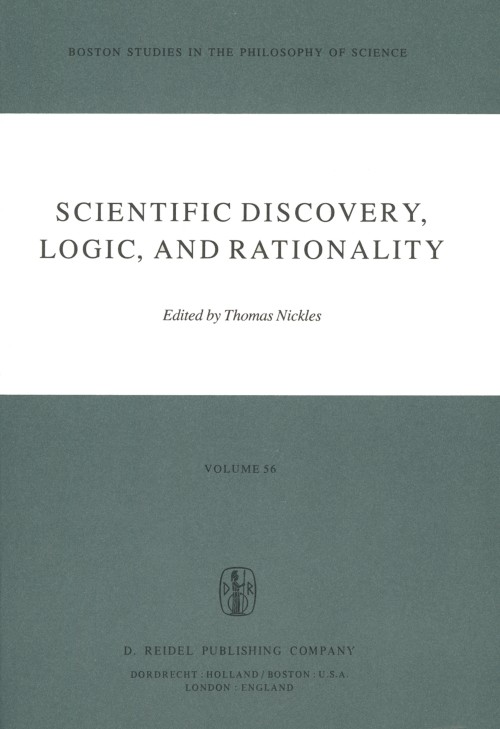
Scientific Discovery, Logic, and Rationality [electronic resource] / edited by Thomas Nickles.
Erişim Adresi
ISBN
9789400989863
Dil Kodu
İngilizce
Yer Numarası
DK/11815
Basım Bildirimi
1st ed. 1980.
Yayın Bilgisi
Dordrecht : Springer Netherlands : Imprint: Springer, 1980.
Fiziksel Niteleme
XII, 388 p. online resource.
Dizi
Boston Studies in the Philosophy and History of Science, 2214-7942 ; 56
İçindekiler Notu
Introductory Essay: Scientific Discovery and the Future of Philosophy of Science -- The Character of Scientific Change -- Discussion of Shapere -- Discovery and Rule-Books -- Discussion of Achinstein -- Analysis as a Method of Discovery During the Scientific Revolution -- The Method of Analysis in Mathematics -- Why Was the Logic of Discovery Abandoned? -- The Rationality of Discovery -- The Logic of Discovery: An Analysis of Three Approaches -- The Logic of Invention -- Scientific Discoveries as Growth of Understanding: The Case of Newton’s Gravitation -- The Vanishing Context of Discovery: Newton’s Discovery of Gravity -- The Role of Models in Theory Construction -- Can Scientific Constraints Be Violated Rationally? -- Why Philosophers Should Not Despair Of Understanding Scientific Discovery -- Productive Reasoning and the Structure of Scientific Research -- Structural Explanations in Social Science -- Index of Names -- Index of Subjects.
Özet, vb.
It is fast becoming a cliche that scientific discovery is being rediscovered. For two philosophical generations (that of the Founders and that of the Followers of the logical positivist and logical empiricist movements), discovery had been consigned to the domain of the intractable, the ineffable, the inscrutable. The philosophy of science was focused on the so-called context of justification as its proper domain. More recently, as the exclusivity of the logical reconstruc tion program in philosophy of science came under question, and as the critique of justification developed within the framework of logical and epistemological analysis, the old question of scientific discovery, which had been put on the back burner, began to emerge once again. Emphasis on the relation of the history of science to the philosophy of science, and attention to the question of theory change and theory replacement, also served to legitimate a new concern with the origins of scientific change to be found within discovery and invention. How welcome then to see what a wide range of issues and what a broad representation of philosophers and historians of science have been brought together in the present two volumes of the Boston Studies in the Philosophy of Science! For what these volumes achieve, in effect, is the continuation of a tradition which had once been strong in the philosophy of science - namely, that tradition which addressed the question of scientific discovery as a central question in the understanding of science.
Konu
Science __ Philosophy.
History.
Philosophy and social sciences.
Philosophy of Science.
History.
Philosophy of the Social Sciences.
History.
Philosophy and social sciences.
Philosophy of Science.
History.
Philosophy of the Social Sciences.
Diğer Yazarlar
Kurum Adı
Eseri Alıntıla
Referansları kullanmadan önce gözden geçirmeniz ve varsa gerekli düzeltmeleri yapmanız önerilir.
Dijital Kaynak
MARC Görünümü
LEADER 05155nam a22005895i 4500
001 810539
003 TR_AnAIT
005 20260131015157
007 cr nn 008mamaa
008 121227s1980 ne | s |||| 0|eng d
020 |a9789400989863|9978-94-009-8986-3
024 7 |a10.1007/978-94-009-8986-3|2doi
041 |aeng
049 |aTürk Tarih Kurumu Kütüphanesi
050 4|aQ174-175.3
050 4|aB67
072 7|aPDA|2bicssc
072 7|aSCI075000|2bisacsh
072 7|aPDA|2thema
082 04|a501|223
090 |aDK/11815
245 10|aScientific Discovery, Logic, and Rationality|h[electronic resource] /|cedited by Thomas Nickles.
250 |a1st ed. 1980.
264 1|aDordrecht :|bSpringer Netherlands :|bImprint: Springer,|c1980.
300 |aXII, 388 p.|bonline resource.
336 |atext|btxt|2rdacontent
337 |acomputer|bc|2rdamedia
338 |aonline resource|bcr|2rdacarrier
347 |atext file|bPDF|2rda
490 1 |aBoston Studies in the Philosophy and History of Science,|x2214-7942 ;|v56
505 0 |aIntroductory Essay: Scientific Discovery and the Future of Philosophy of Science -- The Character of Scientific Change -- Discussion of Shapere -- Discovery and Rule-Books -- Discussion of Achinstein -- Analysis as a Method of Discovery During the Scientific Revolution -- The Method of Analysis in Mathematics -- Why Was the Logic of Discovery Abandoned? -- The Rationality of Discovery -- The Logic of Discovery: An Analysis of Three Approaches -- The Logic of Invention -- Scientific Discoveries as Growth of Understanding: The Case of Newton’s Gravitation -- The Vanishing Context of Discovery: Newton’s Discovery of Gravity -- The Role of Models in Theory Construction -- Can Scientific Constraints Be Violated Rationally? -- Why Philosophers Should Not Despair Of Understanding Scientific Discovery -- Productive Reasoning and the Structure of Scientific Research -- Structural Explanations in Social Science -- Index of Names -- Index of Subjects.
520 |aIt is fast becoming a cliche that scientific discovery is being rediscovered. For two philosophical generations (that of the Founders and that of the Followers of the logical positivist and logical empiricist movements), discovery had been consigned to the domain of the intractable, the ineffable, the inscrutable. The philosophy of science was focused on the so-called context of justification as its proper domain. More recently, as the exclusivity of the logical reconstruc tion program in philosophy of science came under question, and as the critique of justification developed within the framework of logical and epistemological analysis, the old question of scientific discovery, which had been put on the back burner, began to emerge once again. Emphasis on the relation of the history of science to the philosophy of science, and attention to the question of theory change and theory replacement, also served to legitimate a new concern with the origins of scientific change to be found within discovery and invention. How welcome then to see what a wide range of issues and what a broad representation of philosophers and historians of science have been brought together in the present two volumes of the Boston Studies in the Philosophy of Science! For what these volumes achieve, in effect, is the continuation of a tradition which had once been strong in the philosophy of science - namely, that tradition which addressed the question of scientific discovery as a central question in the understanding of science.
532 8 |aAccessibility summary: This PDF is not accessible. It is based on scanned pages and does not support features such as screen reader compatibility or described non-text content (images, graphs etc). However, it likely supports searchable and selectable text based on OCR (Optical Character Recognition). Users with accessibility needs may not be able to use this content effectively. Please contact us at accessibilitysupport@springernature.com if you require assistance or an alternative format.
532 8 |aInaccessible, or known limited accessibility
532 8 |aNo reading system accessibility options actively disabled
532 8 |aPublisher contact for further accessibility information: accessibilitysupport@springernature.com
650 0|aScience|xPhilosophy.
650 0|aHistory.
650 0|aPhilosophy and social sciences.
650 14|aPhilosophy of Science.
650 24|aHistory.
650 24|aPhilosophy of the Social Sciences.
700 1 |aNickles, Thomas.|eeditor.|4edt|4http://id.loc.gov/vocabulary/relators/edt
710 2 |aSpringerLink (Online service)
773 0 |tSpringer Nature eBook
776 08|iPrinted edition:|z9789027710697
776 08|iPrinted edition:|z9789027710703
776 08|iPrinted edition:|z9789400989870
830 0|aBoston Studies in the Philosophy and History of Science,|x2214-7942 ;|v56
856 40|uhttps://doi.org/10.1007/978-94-009-8986-3
912 |aZDB-2-SHU
912 |aZDB-2-SXPR
912 |aZDB-2-BAE
950 |aHumanities, Social Sciences and Law (SpringerNature-11648)
950 |aPhilosophy and Religion (R0) (SpringerNature-43725)
001 810539
003 TR_AnAIT
005 20260131015157
007 cr nn 008mamaa
008 121227s1980 ne | s |||| 0|eng d
020 |a9789400989863|9978-94-009-8986-3
024 7 |a10.1007/978-94-009-8986-3|2doi
041 |aeng
049 |aTürk Tarih Kurumu Kütüphanesi
050 4|aQ174-175.3
050 4|aB67
072 7|aPDA|2bicssc
072 7|aSCI075000|2bisacsh
072 7|aPDA|2thema
082 04|a501|223
090 |aDK/11815
245 10|aScientific Discovery, Logic, and Rationality|h[electronic resource] /|cedited by Thomas Nickles.
250 |a1st ed. 1980.
264 1|aDordrecht :|bSpringer Netherlands :|bImprint: Springer,|c1980.
300 |aXII, 388 p.|bonline resource.
336 |atext|btxt|2rdacontent
337 |acomputer|bc|2rdamedia
338 |aonline resource|bcr|2rdacarrier
347 |atext file|bPDF|2rda
490 1 |aBoston Studies in the Philosophy and History of Science,|x2214-7942 ;|v56
505 0 |aIntroductory Essay: Scientific Discovery and the Future of Philosophy of Science -- The Character of Scientific Change -- Discussion of Shapere -- Discovery and Rule-Books -- Discussion of Achinstein -- Analysis as a Method of Discovery During the Scientific Revolution -- The Method of Analysis in Mathematics -- Why Was the Logic of Discovery Abandoned? -- The Rationality of Discovery -- The Logic of Discovery: An Analysis of Three Approaches -- The Logic of Invention -- Scientific Discoveries as Growth of Understanding: The Case of Newton’s Gravitation -- The Vanishing Context of Discovery: Newton’s Discovery of Gravity -- The Role of Models in Theory Construction -- Can Scientific Constraints Be Violated Rationally? -- Why Philosophers Should Not Despair Of Understanding Scientific Discovery -- Productive Reasoning and the Structure of Scientific Research -- Structural Explanations in Social Science -- Index of Names -- Index of Subjects.
520 |aIt is fast becoming a cliche that scientific discovery is being rediscovered. For two philosophical generations (that of the Founders and that of the Followers of the logical positivist and logical empiricist movements), discovery had been consigned to the domain of the intractable, the ineffable, the inscrutable. The philosophy of science was focused on the so-called context of justification as its proper domain. More recently, as the exclusivity of the logical reconstruc tion program in philosophy of science came under question, and as the critique of justification developed within the framework of logical and epistemological analysis, the old question of scientific discovery, which had been put on the back burner, began to emerge once again. Emphasis on the relation of the history of science to the philosophy of science, and attention to the question of theory change and theory replacement, also served to legitimate a new concern with the origins of scientific change to be found within discovery and invention. How welcome then to see what a wide range of issues and what a broad representation of philosophers and historians of science have been brought together in the present two volumes of the Boston Studies in the Philosophy of Science! For what these volumes achieve, in effect, is the continuation of a tradition which had once been strong in the philosophy of science - namely, that tradition which addressed the question of scientific discovery as a central question in the understanding of science.
532 8 |aAccessibility summary: This PDF is not accessible. It is based on scanned pages and does not support features such as screen reader compatibility or described non-text content (images, graphs etc). However, it likely supports searchable and selectable text based on OCR (Optical Character Recognition). Users with accessibility needs may not be able to use this content effectively. Please contact us at accessibilitysupport@springernature.com if you require assistance or an alternative format.
532 8 |aInaccessible, or known limited accessibility
532 8 |aNo reading system accessibility options actively disabled
532 8 |aPublisher contact for further accessibility information: accessibilitysupport@springernature.com
650 0|aScience|xPhilosophy.
650 0|aHistory.
650 0|aPhilosophy and social sciences.
650 14|aPhilosophy of Science.
650 24|aHistory.
650 24|aPhilosophy of the Social Sciences.
700 1 |aNickles, Thomas.|eeditor.|4edt|4http://id.loc.gov/vocabulary/relators/edt
710 2 |aSpringerLink (Online service)
773 0 |tSpringer Nature eBook
776 08|iPrinted edition:|z9789027710697
776 08|iPrinted edition:|z9789027710703
776 08|iPrinted edition:|z9789400989870
830 0|aBoston Studies in the Philosophy and History of Science,|x2214-7942 ;|v56
856 40|uhttps://doi.org/10.1007/978-94-009-8986-3
912 |aZDB-2-SHU
912 |aZDB-2-SXPR
912 |aZDB-2-BAE
950 |aHumanities, Social Sciences and Law (SpringerNature-11648)
950 |aPhilosophy and Religion (R0) (SpringerNature-43725)
Materyaller
Depodan talep edilen materyal sadece kütüphane içerisinde kullanılmaktadır.
Materyal dışarıya ödünç verilmemektedir.
Materyal dışarıya ödünç verilmemektedir.
