

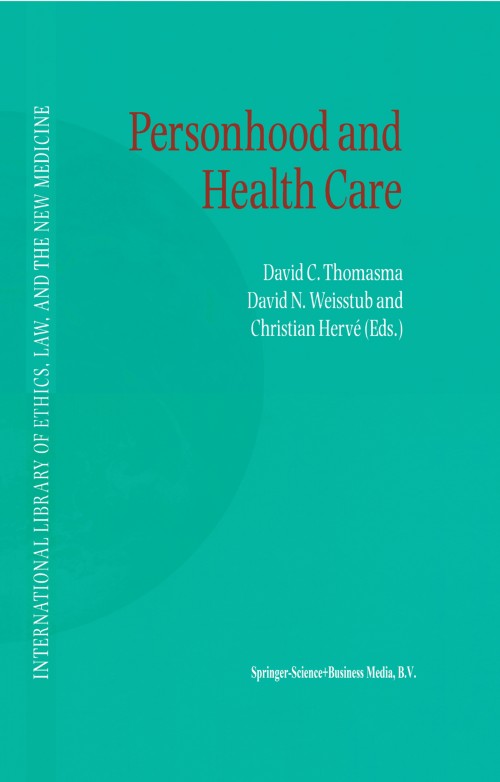
Personhood and Health Care [electronic resource] / edited by David C. Thomasma, David N. Weisstub, Christian Hervé.
Erişim Adresi
ISBN
9789401725729
Dil Kodu
İngilizce
Yer Numarası
DK/11829
Basım Bildirimi
1st ed. 2001.
Yayın Bilgisi
Dordrecht : Springer Netherlands : Imprint: Springer, 2001.
Fiziksel Niteleme
XV, 451 p. online resource.
Dizi
International Library of Ethics, Law, and the New Medicine, 2351-955X ; 7
İçindekiler Notu
Homage to Yves Pélicier -- 1: The Development of the Concept of Personhood -- 2: Persons -- 3: The Human Person as The Image of God -- 4: The Person -- 5: The Failure of Theories of Personhood -- 6: Personhood: The Vain and Pointless Quest for a Definition -- 7: Genetic Knowledge and Our Conception of Ourselves as Persons -- 8: The Concept of the Person and the Value of Life -- 9: The Just and Medical Ethics -- 10: The Concept of Person in Bioethics: Impasse and Beyond -- 11: Towards a Social Concept of Person -- 12: A Key Term in Ethics: The Person and His Dignity -- 13: The Confucian Relational Concept of the Person and Its Modern Predicament -- 14: The Traditional African Perception of a Person -- 15: The Anthropological Concept of Modern Medicine in the Perspective of Theological Ethics -- 16: The Procedural Morphing of the Person: From Self to Property -- 17: Personal Identity and Mental Health -- 18: The Person, Filiation, Possession: Concerning Dissociative Identity Disorder (DID) -- 19: Moral and Metaphysical Reflections on Multiple Personality Disorder -- 20: Personhood and a Paradox About Capacity -- 21: Precedent Autonomy and Personal Identity -- 22: Some Reflections on the Problem of Advance Directives, Personhood, and Personal Identity -- 23: Cloning, Naturalness and Personhood -- 24: Vulnerable Persons -- 25: Human Dignity, Vulnerability, Personhood -- 26: Personhood and Relational Persons -- 27: Professionalism and Personhood -- 28: Autonomy and Dialogue: About the Patient-Doctor Relationship -- 29: The Medical Interpretation of Pain and the Concept of Person -- 30: Suffering, Time, Narrative and the Self.
Özet, vb.
PERSONHOOD AND HEALTH CARE This book arose as a result of a pre-conference devoted to the topic held June 28, 1999 in Paris, France. The pre-conference preceded the Annual Congress of the International Academy ofLaw and Mental Health. Other chapters were solicited after the conference in order to more completely explore the relation of personhood to health care. The pre conference was held in honor of Yves Pelicier who led so many of our French colleagues in medicine, philosophy, and ethics as Christian Herve notes in his Tribute. As health care is aimed at healing persons, it is important to realize how difficult it is to construct a theory of personhood for health care, and thus, a theory of how healing in health care comes about or ought to occur. The book is divided into four parts, Concepts of the Person, Theories of Personhood in Relation to Health Care and Bioethics, Person and Identity, and Personhood and Hs Relations. Each section explores a critical arena in constructing the relation of personhood to health care. Although no exploration ofthis nature can be exhaustive, every effort was made to present both conflicting and complementary views of personhood from within similar and different philosophical and religious traditions. PART ONE: CONCEPTS OF THE PERSON Tracing the origins of the concept of person from antiquity through present day, Jean Delemeau provides an historical sketch of the development of a wide range of meanings.
Konu
Philosophy.
Bioethics.
Medicine __ Philosophy.
Law of the sea.
International law.
Aeronautics __ Law and legislation.
Medical laws and legislation.
Philosophy.
Bioethics.
Philosophy of Medicine.
Law of the Sea, Air and Outer Space.
Medical Law.
Public International Law.
Bioethics.
Medicine __ Philosophy.
Law of the sea.
International law.
Aeronautics __ Law and legislation.
Medical laws and legislation.
Philosophy.
Bioethics.
Philosophy of Medicine.
Law of the Sea, Air and Outer Space.
Medical Law.
Public International Law.
Diğer Yazarlar
Kurum Adı
Eseri Alıntıla
Referansları kullanmadan önce gözden geçirmeniz ve varsa gerekli düzeltmeleri yapmanız önerilir.
Dijital Kaynak
MARC Görünümü
LEADER 06218nam a22006855i 4500
001 810554
003 TR_AnAIT
005 20260131015059
007 cr nn 008mamaa
008 130321s2001 ne | s |||| 0|eng d
020 |a9789401725729|9978-94-017-2572-9
024 7 |a10.1007/978-94-017-2572-9|2doi
041 |aeng
049 |aTürk Tarih Kurumu Kütüphanesi
050 4|aB1-5802
072 7|aHP|2bicssc
072 7|aPHI000000|2bisacsh
072 7|aQD|2thema
082 04|a100|223
090 |aDK/11829
245 10|aPersonhood and Health Care|h[electronic resource] /|cedited by David C. Thomasma, David N. Weisstub, Christian Hervé.
250 |a1st ed. 2001.
264 1|aDordrecht :|bSpringer Netherlands :|bImprint: Springer,|c2001.
300 |aXV, 451 p.|bonline resource.
336 |atext|btxt|2rdacontent
337 |acomputer|bc|2rdamedia
338 |aonline resource|bcr|2rdacarrier
347 |atext file|bPDF|2rda
490 1 |aInternational Library of Ethics, Law, and the New Medicine,|x2351-955X ;|v7
505 0 |aHomage to Yves Pélicier -- 1: The Development of the Concept of Personhood -- 2: Persons -- 3: The Human Person as The Image of God -- 4: The Person -- 5: The Failure of Theories of Personhood -- 6: Personhood: The Vain and Pointless Quest for a Definition -- 7: Genetic Knowledge and Our Conception of Ourselves as Persons -- 8: The Concept of the Person and the Value of Life -- 9: The Just and Medical Ethics -- 10: The Concept of Person in Bioethics: Impasse and Beyond -- 11: Towards a Social Concept of Person -- 12: A Key Term in Ethics: The Person and His Dignity -- 13: The Confucian Relational Concept of the Person and Its Modern Predicament -- 14: The Traditional African Perception of a Person -- 15: The Anthropological Concept of Modern Medicine in the Perspective of Theological Ethics -- 16: The Procedural Morphing of the Person: From Self to Property -- 17: Personal Identity and Mental Health -- 18: The Person, Filiation, Possession: Concerning Dissociative Identity Disorder (DID) -- 19: Moral and Metaphysical Reflections on Multiple Personality Disorder -- 20: Personhood and a Paradox About Capacity -- 21: Precedent Autonomy and Personal Identity -- 22: Some Reflections on the Problem of Advance Directives, Personhood, and Personal Identity -- 23: Cloning, Naturalness and Personhood -- 24: Vulnerable Persons -- 25: Human Dignity, Vulnerability, Personhood -- 26: Personhood and Relational Persons -- 27: Professionalism and Personhood -- 28: Autonomy and Dialogue: About the Patient-Doctor Relationship -- 29: The Medical Interpretation of Pain and the Concept of Person -- 30: Suffering, Time, Narrative and the Self.
520 |aPERSONHOOD AND HEALTH CARE This book arose as a result of a pre-conference devoted to the topic held June 28, 1999 in Paris, France. The pre-conference preceded the Annual Congress of the International Academy ofLaw and Mental Health. Other chapters were solicited after the conference in order to more completely explore the relation of personhood to health care. The pre conference was held in honor of Yves Pelicier who led so many of our French colleagues in medicine, philosophy, and ethics as Christian Herve notes in his Tribute. As health care is aimed at healing persons, it is important to realize how difficult it is to construct a theory of personhood for health care, and thus, a theory of how healing in health care comes about or ought to occur. The book is divided into four parts, Concepts of the Person, Theories of Personhood in Relation to Health Care and Bioethics, Person and Identity, and Personhood and Hs Relations. Each section explores a critical arena in constructing the relation of personhood to health care. Although no exploration ofthis nature can be exhaustive, every effort was made to present both conflicting and complementary views of personhood from within similar and different philosophical and religious traditions. PART ONE: CONCEPTS OF THE PERSON Tracing the origins of the concept of person from antiquity through present day, Jean Delemeau provides an historical sketch of the development of a wide range of meanings.
532 8 |aAccessibility summary: This PDF is not accessible. It is based on scanned pages and does not support features such as screen reader compatibility or described non-text content (images, graphs etc). However, it likely supports searchable and selectable text based on OCR (Optical Character Recognition). Users with accessibility needs may not be able to use this content effectively. Please contact us at accessibilitysupport@springernature.com if you require assistance or an alternative format.
532 8 |aInaccessible, or known limited accessibility
532 8 |aNo reading system accessibility options actively disabled
532 8 |aPublisher contact for further accessibility information: accessibilitysupport@springernature.com
650 0|aPhilosophy.
650 0|aBioethics.
650 0|aMedicine|xPhilosophy.
650 0|aLaw of the sea.
650 0|aInternational law.
650 0|aAeronautics|xLaw and legislation.
650 0|aMedical laws and legislation.
650 14|aPhilosophy.
650 24|aBioethics.
650 24|aPhilosophy of Medicine.
650 24|aLaw of the Sea, Air and Outer Space.
650 24|aMedical Law.
650 24|aPublic International Law.
700 1 |aThomasma, David C.|eeditor.|4edt|4http://id.loc.gov/vocabulary/relators/edt
700 1 |aWeisstub, David N.|eeditor.|4edt|4http://id.loc.gov/vocabulary/relators/edt
700 1 |aHervé, Christian.|eeditor.|4edt|4http://id.loc.gov/vocabulary/relators/edt
710 2 |aSpringerLink (Online service)
773 0 |tSpringer Nature eBook
776 08|iPrinted edition:|z9781402000980
776 08|iPrinted edition:|z9789048158584
776 08|iPrinted edition:|z9789401725736
830 0|aInternational Library of Ethics, Law, and the New Medicine,|x2351-955X ;|v7
856 40|uhttps://doi.org/10.1007/978-94-017-2572-9
912 |aZDB-2-SHU
912 |aZDB-2-SXPR
912 |aZDB-2-BAE
950 |aHumanities, Social Sciences and Law (SpringerNature-11648)
950 |aPhilosophy and Religion (R0) (SpringerNature-43725)
001 810554
003 TR_AnAIT
005 20260131015059
007 cr nn 008mamaa
008 130321s2001 ne | s |||| 0|eng d
020 |a9789401725729|9978-94-017-2572-9
024 7 |a10.1007/978-94-017-2572-9|2doi
041 |aeng
049 |aTürk Tarih Kurumu Kütüphanesi
050 4|aB1-5802
072 7|aHP|2bicssc
072 7|aPHI000000|2bisacsh
072 7|aQD|2thema
082 04|a100|223
090 |aDK/11829
245 10|aPersonhood and Health Care|h[electronic resource] /|cedited by David C. Thomasma, David N. Weisstub, Christian Hervé.
250 |a1st ed. 2001.
264 1|aDordrecht :|bSpringer Netherlands :|bImprint: Springer,|c2001.
300 |aXV, 451 p.|bonline resource.
336 |atext|btxt|2rdacontent
337 |acomputer|bc|2rdamedia
338 |aonline resource|bcr|2rdacarrier
347 |atext file|bPDF|2rda
490 1 |aInternational Library of Ethics, Law, and the New Medicine,|x2351-955X ;|v7
505 0 |aHomage to Yves Pélicier -- 1: The Development of the Concept of Personhood -- 2: Persons -- 3: The Human Person as The Image of God -- 4: The Person -- 5: The Failure of Theories of Personhood -- 6: Personhood: The Vain and Pointless Quest for a Definition -- 7: Genetic Knowledge and Our Conception of Ourselves as Persons -- 8: The Concept of the Person and the Value of Life -- 9: The Just and Medical Ethics -- 10: The Concept of Person in Bioethics: Impasse and Beyond -- 11: Towards a Social Concept of Person -- 12: A Key Term in Ethics: The Person and His Dignity -- 13: The Confucian Relational Concept of the Person and Its Modern Predicament -- 14: The Traditional African Perception of a Person -- 15: The Anthropological Concept of Modern Medicine in the Perspective of Theological Ethics -- 16: The Procedural Morphing of the Person: From Self to Property -- 17: Personal Identity and Mental Health -- 18: The Person, Filiation, Possession: Concerning Dissociative Identity Disorder (DID) -- 19: Moral and Metaphysical Reflections on Multiple Personality Disorder -- 20: Personhood and a Paradox About Capacity -- 21: Precedent Autonomy and Personal Identity -- 22: Some Reflections on the Problem of Advance Directives, Personhood, and Personal Identity -- 23: Cloning, Naturalness and Personhood -- 24: Vulnerable Persons -- 25: Human Dignity, Vulnerability, Personhood -- 26: Personhood and Relational Persons -- 27: Professionalism and Personhood -- 28: Autonomy and Dialogue: About the Patient-Doctor Relationship -- 29: The Medical Interpretation of Pain and the Concept of Person -- 30: Suffering, Time, Narrative and the Self.
520 |aPERSONHOOD AND HEALTH CARE This book arose as a result of a pre-conference devoted to the topic held June 28, 1999 in Paris, France. The pre-conference preceded the Annual Congress of the International Academy ofLaw and Mental Health. Other chapters were solicited after the conference in order to more completely explore the relation of personhood to health care. The pre conference was held in honor of Yves Pelicier who led so many of our French colleagues in medicine, philosophy, and ethics as Christian Herve notes in his Tribute. As health care is aimed at healing persons, it is important to realize how difficult it is to construct a theory of personhood for health care, and thus, a theory of how healing in health care comes about or ought to occur. The book is divided into four parts, Concepts of the Person, Theories of Personhood in Relation to Health Care and Bioethics, Person and Identity, and Personhood and Hs Relations. Each section explores a critical arena in constructing the relation of personhood to health care. Although no exploration ofthis nature can be exhaustive, every effort was made to present both conflicting and complementary views of personhood from within similar and different philosophical and religious traditions. PART ONE: CONCEPTS OF THE PERSON Tracing the origins of the concept of person from antiquity through present day, Jean Delemeau provides an historical sketch of the development of a wide range of meanings.
532 8 |aAccessibility summary: This PDF is not accessible. It is based on scanned pages and does not support features such as screen reader compatibility or described non-text content (images, graphs etc). However, it likely supports searchable and selectable text based on OCR (Optical Character Recognition). Users with accessibility needs may not be able to use this content effectively. Please contact us at accessibilitysupport@springernature.com if you require assistance or an alternative format.
532 8 |aInaccessible, or known limited accessibility
532 8 |aNo reading system accessibility options actively disabled
532 8 |aPublisher contact for further accessibility information: accessibilitysupport@springernature.com
650 0|aPhilosophy.
650 0|aBioethics.
650 0|aMedicine|xPhilosophy.
650 0|aLaw of the sea.
650 0|aInternational law.
650 0|aAeronautics|xLaw and legislation.
650 0|aMedical laws and legislation.
650 14|aPhilosophy.
650 24|aBioethics.
650 24|aPhilosophy of Medicine.
650 24|aLaw of the Sea, Air and Outer Space.
650 24|aMedical Law.
650 24|aPublic International Law.
700 1 |aThomasma, David C.|eeditor.|4edt|4http://id.loc.gov/vocabulary/relators/edt
700 1 |aWeisstub, David N.|eeditor.|4edt|4http://id.loc.gov/vocabulary/relators/edt
700 1 |aHervé, Christian.|eeditor.|4edt|4http://id.loc.gov/vocabulary/relators/edt
710 2 |aSpringerLink (Online service)
773 0 |tSpringer Nature eBook
776 08|iPrinted edition:|z9781402000980
776 08|iPrinted edition:|z9789048158584
776 08|iPrinted edition:|z9789401725736
830 0|aInternational Library of Ethics, Law, and the New Medicine,|x2351-955X ;|v7
856 40|uhttps://doi.org/10.1007/978-94-017-2572-9
912 |aZDB-2-SHU
912 |aZDB-2-SXPR
912 |aZDB-2-BAE
950 |aHumanities, Social Sciences and Law (SpringerNature-11648)
950 |aPhilosophy and Religion (R0) (SpringerNature-43725)
Materyaller
Depodan talep edilen materyal sadece kütüphane içerisinde kullanılmaktadır.
Materyal dışarıya ödünç verilmemektedir.
Materyal dışarıya ödünç verilmemektedir.
