

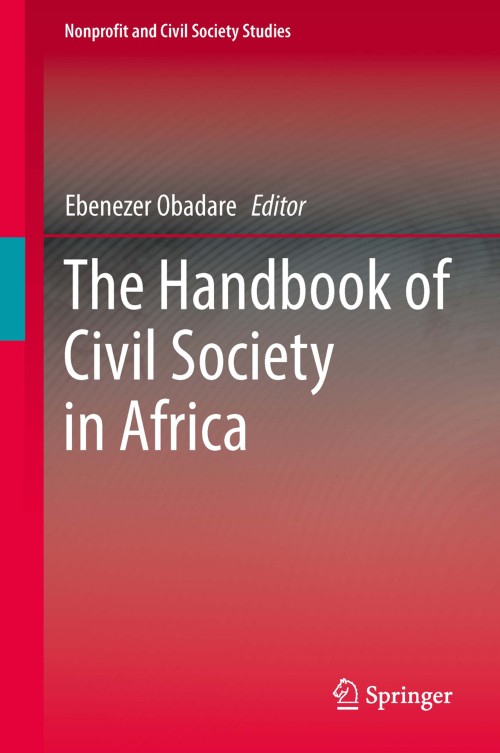
The Handbook of Civil Society in Africa [electronic resource] / edited by Ebenezer Obadare.
Erişim Adresi
ISBN
9781461482628
Dil Kodu
İngilizce
Yer Numarası
DK/11832
Basım Bildirimi
1st ed. 2014.
Yayın Bilgisi
New York, NY : Springer New York : Imprint: Springer, 2014.
Fiziksel Niteleme
XVIII, 490 p. 19 illus., 16 illus. in color. online resource.
Dizi
Nonprofit and Civil Society Studies, An International Multidisciplinary Series ; 20
İçindekiler Notu
Chapter 1: Introduction: Turning the Table on Gellner: Alternative Discourses of Civil Society in Africa- Ebenezer Obadare -- Section I: Core Themes -- Chapter 2: Escape from Tyranny: Civil Society and Democratic Struggles in Africa- Darren Kew and Modupe Oshikoya -- Chapter 3: Civil Society and Religion- Shobana Shankar -- Chapter 4: Theorizing media as/and civil society in Africa- Wendy Willems -- Chapter 5: ‘Good’ State, ‘Bad’ State: Loss and Longing in Postcolonial Zimbabwe- Julia Gallagher -- Chapter 6: NGO Accountability in Africa- Ronelle Burger and Dineo Seabe -- Section II: Regional Perspectives -- Chapter 7: Civil Society in North Africa- James Sater -- Chapter 8: Civil Society Organizations and the State in East Africa: From the Colonial to the Modern Era- Priscilla Wamucii -- Chapter 9: Civil Society and the Politics of Belonging in Southern Africa- Daniel Hammett -- Chapter 10: Building Civil Society in West Africa: Notes from the Field -Titilope Mamattah -- Chapter 11: Civil Societyin Zimbabwe and ‘Most of the World’- Kirk Helliker -- Chapter 12: Viral Messaging, Satire, and Spaces of Resistance in Nigeria- Carole Enahoro -- Chapter 13: Civil Society and Conflict in West Africa- Niklas Hultin -- Section III: Civil Society in the Shadow of Neoliberalism -- Chapter 14: Neoliberalism and the Forms of Civil Society in Kenya and South Africa- Jacob Mati -- Chapter 15: Africa Rising? Afro-Optimism and Uncivil Society in an Era of Economic Volatility- Patrick Bond -- Chapter 16: Civil Society and Neoliberalism- Usman A. Tar -- Section IV: After Development: Gender, Sexuality, and Civic Change -- Chapter 17: Popular Organizations in South Africa: from civics to service delivery protests- Elke Zuern -- Chapter 18: “If Good Food is cooked in One Country, We Will All Eat from It:” Women and Civil Society in Africa- Hannah Britton and Taylor Price -- Chapter 19: NGOs, Civil Society and Development- Badru Bukenya and Samuel Hickey -- Chapter 20: Civil Society and Sexual Struggles in Africa- Ashley Currier and Joëlle M. Cruz -- Chapter 21: Civil Society’s Response to the HIV/AIDS Crisis in Africa- Richard G. Wamai -- Chapter 22: Orature as a Site for Civil Contestation: Film and the Decolonization of Space and Place in Tsitsi Dangarembga’s Kare Kare Zvako (Mother’s Day) 2005- Bunmi Oyinsan -- Section V: Aid, Volunteering and Philanthropy -- Chapter 23: Civil Society and Aid in Africa: A case of mistaken identity? - Alan Fowler -- Chapter 24: Volunteering, Civic Service and Civil Society in Africa- Helene Perold and Lauren Graham -- Chapter 25: Philanthropic Foundations and Civil Society in Sub-Saharan Africa- Christiana Atibil -- Chapter 26: Volunteering, Civic Agency and Citizenship in Africa- Ebenezer Obadare.
Özet, vb.
This volume brings together the most up to date analyses of civil society in Africa from the best scholars and researchers working on the subject. Being the first of its kind, it casts a panoramic look at the African continent, drawing out persisting, if often under-communicated, variations in regional discourses. In a majority of notionally ‘global’ studies, Africa has received marginal attention, a marginality often highlighted by the usual token chapter. Filling a critical hiatus, the Handbook of Civil Society in Africa takes Africa, African developments, and African perspectives very seriously and worthy of academic interrogation in their own right. It offers a critical, clear-sighted perspective on civil society in Africa, and positions African discourses within the framework of important regional and global debates. It promises to be an invaluable reference work for researchers and practitioners working in the fields of civil society, nonprofit studies, development studies, volunteerism, civic service, and African studies. Endorsements: "This volume signposts a critical turning point in the renewed engagement with the theory and practice of civil society in Africa. Moving from traditional concerns with disquisitions on the appropriateness and possibility of the existence and vibrancy of the idea of civil society on the continent, the volume approaches the forms, contents, and features of the actually existing civil society in Africa from thematic, regional, and national angles. It demonstrates clearly the extent to which core intellectual work on civil society in Africa has largely moved from concerns with cultural reductionism to a nuanced examination of the complexities of (formal, non-formal, organizational, non-organizational, traditional, newer, usual, unusual) engagements, detailing the extent to which, over time, civil society as a concept has been indigenized, appropriated and adapted in theterrains of politics, society, economy, culture and new technologies on the continent. In all this, the book accomplishes the near-impossible. Without sacrificing the vigour, rigor and freshness of the often unpredictable fruits of up-to-date research into regional and national differences that crop up in the documentation of Africa's multiple realities and discourses, the volume weaves together a rich tapestry of the historical, theoretical and practical dimensions of an expanding civil society sector, and accompanying growth in popular discourse, advocacy, and academic literature, in such a diverse continent as Africa, into a meaningful whole of insightful themes. Written and edited by a very distinguished cross-continental and multi-disciplinary collection of researchers, research students, practitioners and activists, the volume provides cutting-edge evidence and makes a definitive case for a new lease of life for civil society research in Africa." -Adigun Agbaje, Professor of Political Science, University of Ibadan, Nigeria. "Throughout Africa, forms of civic engagement and political participation have seen dynamic change in recent decades, yet conceptions of civil society have rarely accounted for this evolution. This volume is an essential source of new thinking about political association and collective action in Africa. The authors offer a wealth of analysis on changing organizations and social movements, new forms of interaction and communication, emerging strategies and issues, diverse social foundations, and the theoretical implications of a shifting associational landscape. The contributors provide an invaluable addition to the comparative literature on political change, democratic development, and social movements in Africa." Peter Lewis, Johns Hopkins University School of Advanced international Studies .
Konu
Sociology.
Business ethics.
Ethnology.
Culture.
Sociology.
Business Ethics.
Regional Cultural Studies.
Business ethics.
Ethnology.
Culture.
Sociology.
Business Ethics.
Regional Cultural Studies.
Diğer Yazarlar
Kurum Adı
Eseri Alıntıla
Referansları kullanmadan önce gözden geçirmeniz ve varsa gerekli düzeltmeleri yapmanız önerilir.
Dijital Kaynak
MARC Görünümü
LEADER 08544nam a22005535i 4500
001 810557
003 TR_AnAIT
005 20260131015042
007 cr nn 008mamaa
008 130921s2014 xxu| s |||| 0|eng d
020 |a9781461482628|9978-1-4614-8262-8
024 7 |a10.1007/978-1-4614-8262-8|2doi
041 |aeng
049 |aTürk Tarih Kurumu Kütüphanesi
050 4|aHM
072 7|aJHB|2bicssc
072 7|aJHB|2bicssc
072 7|aSOC026000|2bisacsh
072 7|aJHB|2thema
072 7|aJHB|2thema
082 04|a301|223
090 |aDK/11832
245 14|aThe Handbook of Civil Society in Africa|h[electronic resource] /|cedited by Ebenezer Obadare.
250 |a1st ed. 2014.
264 1|aNew York, NY :|bSpringer New York :|bImprint: Springer,|c2014.
300 |aXVIII, 490 p. 19 illus., 16 illus. in color.|bonline resource.
336 |atext|btxt|2rdacontent
337 |acomputer|bc|2rdamedia
338 |aonline resource|bcr|2rdacarrier
347 |atext file|bPDF|2rda
490 1 |aNonprofit and Civil Society Studies, An International Multidisciplinary Series ;|v20
505 0 |aChapter 1: Introduction: Turning the Table on Gellner: Alternative Discourses of Civil Society in Africa- Ebenezer Obadare -- Section I: Core Themes -- Chapter 2: Escape from Tyranny: Civil Society and Democratic Struggles in Africa- Darren Kew and Modupe Oshikoya -- Chapter 3: Civil Society and Religion- Shobana Shankar -- Chapter 4: Theorizing media as/and civil society in Africa- Wendy Willems -- Chapter 5: ‘Good’ State, ‘Bad’ State: Loss and Longing in Postcolonial Zimbabwe- Julia Gallagher -- Chapter 6: NGO Accountability in Africa- Ronelle Burger and Dineo Seabe -- Section II: Regional Perspectives -- Chapter 7: Civil Society in North Africa- James Sater -- Chapter 8: Civil Society Organizations and the State in East Africa: From the Colonial to the Modern Era- Priscilla Wamucii -- Chapter 9: Civil Society and the Politics of Belonging in Southern Africa- Daniel Hammett -- Chapter 10: Building Civil Society in West Africa: Notes from the Field -Titilope Mamattah -- Chapter 11: Civil Societyin Zimbabwe and ‘Most of the World’- Kirk Helliker -- Chapter 12: Viral Messaging, Satire, and Spaces of Resistance in Nigeria- Carole Enahoro -- Chapter 13: Civil Society and Conflict in West Africa- Niklas Hultin -- Section III: Civil Society in the Shadow of Neoliberalism -- Chapter 14: Neoliberalism and the Forms of Civil Society in Kenya and South Africa- Jacob Mati -- Chapter 15: Africa Rising? Afro-Optimism and Uncivil Society in an Era of Economic Volatility- Patrick Bond -- Chapter 16: Civil Society and Neoliberalism- Usman A. Tar -- Section IV: After Development: Gender, Sexuality, and Civic Change -- Chapter 17: Popular Organizations in South Africa: from civics to service delivery protests- Elke Zuern -- Chapter 18: “If Good Food is cooked in One Country, We Will All Eat from It:” Women and Civil Society in Africa- Hannah Britton and Taylor Price -- Chapter 19: NGOs, Civil Society and Development- Badru Bukenya and Samuel Hickey -- Chapter 20: Civil Society and Sexual Struggles in Africa- Ashley Currier and Joëlle M. Cruz -- Chapter 21: Civil Society’s Response to the HIV/AIDS Crisis in Africa- Richard G. Wamai -- Chapter 22: Orature as a Site for Civil Contestation: Film and the Decolonization of Space and Place in Tsitsi Dangarembga’s Kare Kare Zvako (Mother’s Day) 2005- Bunmi Oyinsan -- Section V: Aid, Volunteering and Philanthropy -- Chapter 23: Civil Society and Aid in Africa: A case of mistaken identity? - Alan Fowler -- Chapter 24: Volunteering, Civic Service and Civil Society in Africa- Helene Perold and Lauren Graham -- Chapter 25: Philanthropic Foundations and Civil Society in Sub-Saharan Africa- Christiana Atibil -- Chapter 26: Volunteering, Civic Agency and Citizenship in Africa- Ebenezer Obadare.
520 |aThis volume brings together the most up to date analyses of civil society in Africa from the best scholars and researchers working on the subject. Being the first of its kind, it casts a panoramic look at the African continent, drawing out persisting, if often under-communicated, variations in regional discourses. In a majority of notionally ‘global’ studies, Africa has received marginal attention, a marginality often highlighted by the usual token chapter. Filling a critical hiatus, the Handbook of Civil Society in Africa takes Africa, African developments, and African perspectives very seriously and worthy of academic interrogation in their own right. It offers a critical, clear-sighted perspective on civil society in Africa, and positions African discourses within the framework of important regional and global debates. It promises to be an invaluable reference work for researchers and practitioners working in the fields of civil society, nonprofit studies, development studies, volunteerism, civic service, and African studies. Endorsements: "This volume signposts a critical turning point in the renewed engagement with the theory and practice of civil society in Africa. Moving from traditional concerns with disquisitions on the appropriateness and possibility of the existence and vibrancy of the idea of civil society on the continent, the volume approaches the forms, contents, and features of the actually existing civil society in Africa from thematic, regional, and national angles. It demonstrates clearly the extent to which core intellectual work on civil society in Africa has largely moved from concerns with cultural reductionism to a nuanced examination of the complexities of (formal, non-formal, organizational, non-organizational, traditional, newer, usual, unusual) engagements, detailing the extent to which, over time, civil society as a concept has been indigenized, appropriated and adapted in theterrains of politics, society, economy, culture and new technologies on the continent. In all this, the book accomplishes the near-impossible. Without sacrificing the vigour, rigor and freshness of the often unpredictable fruits of up-to-date research into regional and national differences that crop up in the documentation of Africa's multiple realities and discourses, the volume weaves together a rich tapestry of the historical, theoretical and practical dimensions of an expanding civil society sector, and accompanying growth in popular discourse, advocacy, and academic literature, in such a diverse continent as Africa, into a meaningful whole of insightful themes. Written and edited by a very distinguished cross-continental and multi-disciplinary collection of researchers, research students, practitioners and activists, the volume provides cutting-edge evidence and makes a definitive case for a new lease of life for civil society research in Africa." -Adigun Agbaje, Professor of Political Science, University of Ibadan, Nigeria. "Throughout Africa, forms of civic engagement and political participation have seen dynamic change in recent decades, yet conceptions of civil society have rarely accounted for this evolution. This volume is an essential source of new thinking about political association and collective action in Africa. The authors offer a wealth of analysis on changing organizations and social movements, new forms of interaction and communication, emerging strategies and issues, diverse social foundations, and the theoretical implications of a shifting associational landscape. The contributors provide an invaluable addition to the comparative literature on political change, democratic development, and social movements in Africa." Peter Lewis, Johns Hopkins University School of Advanced international Studies .
650 0|aSociology.
650 0|aBusiness ethics.
650 0|aEthnology.
650 0|aCulture.
650 14|aSociology.
650 24|aBusiness Ethics.
650 24|aRegional Cultural Studies.
700 1 |aObadare, Ebenezer.|eeditor.|4edt|4http://id.loc.gov/vocabulary/relators/edt
710 2 |aSpringerLink (Online service)
773 0 |tSpringer Nature eBook
776 08|iPrinted edition:|z9781461482611
776 08|iPrinted edition:|z9781461482635
776 08|iPrinted edition:|z9781493945368
830 0|aNonprofit and Civil Society Studies, An International Multidisciplinary Series ;|v20
856 40|uhttps://doi.org/10.1007/978-1-4614-8262-8
912 |aZDB-2-SHU
912 |aZDB-2-SXS
950 |aHumanities, Social Sciences and Law (SpringerNature-11648)
950 |aSocial Sciences (R0) (SpringerNature-43726)
001 810557
003 TR_AnAIT
005 20260131015042
007 cr nn 008mamaa
008 130921s2014 xxu| s |||| 0|eng d
020 |a9781461482628|9978-1-4614-8262-8
024 7 |a10.1007/978-1-4614-8262-8|2doi
041 |aeng
049 |aTürk Tarih Kurumu Kütüphanesi
050 4|aHM
072 7|aJHB|2bicssc
072 7|aJHB|2bicssc
072 7|aSOC026000|2bisacsh
072 7|aJHB|2thema
072 7|aJHB|2thema
082 04|a301|223
090 |aDK/11832
245 14|aThe Handbook of Civil Society in Africa|h[electronic resource] /|cedited by Ebenezer Obadare.
250 |a1st ed. 2014.
264 1|aNew York, NY :|bSpringer New York :|bImprint: Springer,|c2014.
300 |aXVIII, 490 p. 19 illus., 16 illus. in color.|bonline resource.
336 |atext|btxt|2rdacontent
337 |acomputer|bc|2rdamedia
338 |aonline resource|bcr|2rdacarrier
347 |atext file|bPDF|2rda
490 1 |aNonprofit and Civil Society Studies, An International Multidisciplinary Series ;|v20
505 0 |aChapter 1: Introduction: Turning the Table on Gellner: Alternative Discourses of Civil Society in Africa- Ebenezer Obadare -- Section I: Core Themes -- Chapter 2: Escape from Tyranny: Civil Society and Democratic Struggles in Africa- Darren Kew and Modupe Oshikoya -- Chapter 3: Civil Society and Religion- Shobana Shankar -- Chapter 4: Theorizing media as/and civil society in Africa- Wendy Willems -- Chapter 5: ‘Good’ State, ‘Bad’ State: Loss and Longing in Postcolonial Zimbabwe- Julia Gallagher -- Chapter 6: NGO Accountability in Africa- Ronelle Burger and Dineo Seabe -- Section II: Regional Perspectives -- Chapter 7: Civil Society in North Africa- James Sater -- Chapter 8: Civil Society Organizations and the State in East Africa: From the Colonial to the Modern Era- Priscilla Wamucii -- Chapter 9: Civil Society and the Politics of Belonging in Southern Africa- Daniel Hammett -- Chapter 10: Building Civil Society in West Africa: Notes from the Field -Titilope Mamattah -- Chapter 11: Civil Societyin Zimbabwe and ‘Most of the World’- Kirk Helliker -- Chapter 12: Viral Messaging, Satire, and Spaces of Resistance in Nigeria- Carole Enahoro -- Chapter 13: Civil Society and Conflict in West Africa- Niklas Hultin -- Section III: Civil Society in the Shadow of Neoliberalism -- Chapter 14: Neoliberalism and the Forms of Civil Society in Kenya and South Africa- Jacob Mati -- Chapter 15: Africa Rising? Afro-Optimism and Uncivil Society in an Era of Economic Volatility- Patrick Bond -- Chapter 16: Civil Society and Neoliberalism- Usman A. Tar -- Section IV: After Development: Gender, Sexuality, and Civic Change -- Chapter 17: Popular Organizations in South Africa: from civics to service delivery protests- Elke Zuern -- Chapter 18: “If Good Food is cooked in One Country, We Will All Eat from It:” Women and Civil Society in Africa- Hannah Britton and Taylor Price -- Chapter 19: NGOs, Civil Society and Development- Badru Bukenya and Samuel Hickey -- Chapter 20: Civil Society and Sexual Struggles in Africa- Ashley Currier and Joëlle M. Cruz -- Chapter 21: Civil Society’s Response to the HIV/AIDS Crisis in Africa- Richard G. Wamai -- Chapter 22: Orature as a Site for Civil Contestation: Film and the Decolonization of Space and Place in Tsitsi Dangarembga’s Kare Kare Zvako (Mother’s Day) 2005- Bunmi Oyinsan -- Section V: Aid, Volunteering and Philanthropy -- Chapter 23: Civil Society and Aid in Africa: A case of mistaken identity? - Alan Fowler -- Chapter 24: Volunteering, Civic Service and Civil Society in Africa- Helene Perold and Lauren Graham -- Chapter 25: Philanthropic Foundations and Civil Society in Sub-Saharan Africa- Christiana Atibil -- Chapter 26: Volunteering, Civic Agency and Citizenship in Africa- Ebenezer Obadare.
520 |aThis volume brings together the most up to date analyses of civil society in Africa from the best scholars and researchers working on the subject. Being the first of its kind, it casts a panoramic look at the African continent, drawing out persisting, if often under-communicated, variations in regional discourses. In a majority of notionally ‘global’ studies, Africa has received marginal attention, a marginality often highlighted by the usual token chapter. Filling a critical hiatus, the Handbook of Civil Society in Africa takes Africa, African developments, and African perspectives very seriously and worthy of academic interrogation in their own right. It offers a critical, clear-sighted perspective on civil society in Africa, and positions African discourses within the framework of important regional and global debates. It promises to be an invaluable reference work for researchers and practitioners working in the fields of civil society, nonprofit studies, development studies, volunteerism, civic service, and African studies. Endorsements: "This volume signposts a critical turning point in the renewed engagement with the theory and practice of civil society in Africa. Moving from traditional concerns with disquisitions on the appropriateness and possibility of the existence and vibrancy of the idea of civil society on the continent, the volume approaches the forms, contents, and features of the actually existing civil society in Africa from thematic, regional, and national angles. It demonstrates clearly the extent to which core intellectual work on civil society in Africa has largely moved from concerns with cultural reductionism to a nuanced examination of the complexities of (formal, non-formal, organizational, non-organizational, traditional, newer, usual, unusual) engagements, detailing the extent to which, over time, civil society as a concept has been indigenized, appropriated and adapted in theterrains of politics, society, economy, culture and new technologies on the continent. In all this, the book accomplishes the near-impossible. Without sacrificing the vigour, rigor and freshness of the often unpredictable fruits of up-to-date research into regional and national differences that crop up in the documentation of Africa's multiple realities and discourses, the volume weaves together a rich tapestry of the historical, theoretical and practical dimensions of an expanding civil society sector, and accompanying growth in popular discourse, advocacy, and academic literature, in such a diverse continent as Africa, into a meaningful whole of insightful themes. Written and edited by a very distinguished cross-continental and multi-disciplinary collection of researchers, research students, practitioners and activists, the volume provides cutting-edge evidence and makes a definitive case for a new lease of life for civil society research in Africa." -Adigun Agbaje, Professor of Political Science, University of Ibadan, Nigeria. "Throughout Africa, forms of civic engagement and political participation have seen dynamic change in recent decades, yet conceptions of civil society have rarely accounted for this evolution. This volume is an essential source of new thinking about political association and collective action in Africa. The authors offer a wealth of analysis on changing organizations and social movements, new forms of interaction and communication, emerging strategies and issues, diverse social foundations, and the theoretical implications of a shifting associational landscape. The contributors provide an invaluable addition to the comparative literature on political change, democratic development, and social movements in Africa." Peter Lewis, Johns Hopkins University School of Advanced international Studies .
650 0|aSociology.
650 0|aBusiness ethics.
650 0|aEthnology.
650 0|aCulture.
650 14|aSociology.
650 24|aBusiness Ethics.
650 24|aRegional Cultural Studies.
700 1 |aObadare, Ebenezer.|eeditor.|4edt|4http://id.loc.gov/vocabulary/relators/edt
710 2 |aSpringerLink (Online service)
773 0 |tSpringer Nature eBook
776 08|iPrinted edition:|z9781461482611
776 08|iPrinted edition:|z9781461482635
776 08|iPrinted edition:|z9781493945368
830 0|aNonprofit and Civil Society Studies, An International Multidisciplinary Series ;|v20
856 40|uhttps://doi.org/10.1007/978-1-4614-8262-8
912 |aZDB-2-SHU
912 |aZDB-2-SXS
950 |aHumanities, Social Sciences and Law (SpringerNature-11648)
950 |aSocial Sciences (R0) (SpringerNature-43726)
Materyaller
Depodan talep edilen materyal sadece kütüphane içerisinde kullanılmaktadır.
Materyal dışarıya ödünç verilmemektedir.
Materyal dışarıya ödünç verilmemektedir.
