LEADER 03671nam a22005415i 4500
001 810598
003 TR_AnAIT
005 20260131014734
007 cr nn 008mamaa
008 121116s2013 xxu| s |||| 0|eng d
020 |a9781461458647|9978-1-4614-5864-7
024 7 |a10.1007/978-1-4614-5864-7|2doi
041 |aeng
049 |aTürk Tarih Kurumu Kütüphanesi
050 4|aJA1-92
072 7|aJPA|2bicssc
072 7|aPOL000000|2bisacsh
072 7|aJPA|2thema
082 04|a320|223
090 |aDK/11873
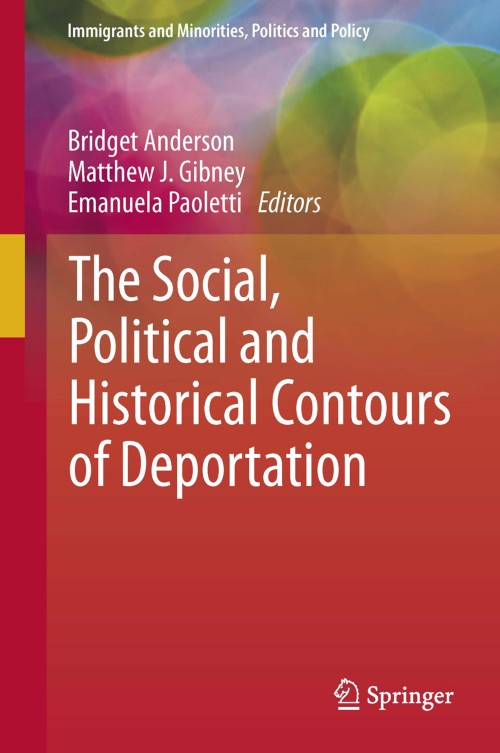
245 14|aThe Social, Political and Historical Contours of Deportation|h[electronic resource] /|cedited by Bridget Anderson, Matthew J. Gibney, Emanuela Paoletti.
250 |a1st ed. 2013.
264 1|aNew York, NY :|bSpringer New York :|bImprint: Springer,|c2013.
300 |aVI, 162 p.|bonline resource.
336 |atext|btxt|2rdacontent
337 |acomputer|bc|2rdamedia
338 |aonline resource|bcr|2rdacarrier
347 |atext file|bPDF|2rda
490 1 |aImmigrants and Minorities, Politics and Policy,|x2625-8552
520 |aIn recent years states across the world have boosted their legal and institutional capacity to deport noncitizens residing on their territory, including failed asylum seekers, “illegal” migrants, and convicted criminals. Scholars have analyzed this development primarily through the lens of immigration control. Deportation has been viewed as one amongst a range of measures designed to control entrance, distinguished primarily by the fact that it is exercised inside the territory of the state. But deportation also has broader social and political effects. It provides a powerful way through which the state reminds noncitizens that their presence in the polity is contingent upon acceptable behavior. Furthermore, in liberal democratic states immunity from deportation is one of the key privileges that citizens enjoy that distinguishes them from permanent residents. This book examines the historical, institutional and social dimensions of the relationship between deportation and citizenship in liberal democracies. Contributions also include analysis of the formal and informal functions of administrative immigration detention, and the role of the European Parliament in the area of irregular immigration and borders. The book also develops an analytical framework that identifies and critically appraises grassroots and sub national responses to migration policy in liberal democratic societies, and considers how groups form after deportation and the employment of citizenship in this particular context, making it of interest to scholars and international policy makers alike.
650 0|aPolitical science.
650 0|aSocial policy.
650 0|aDemography.
650 0|aPopulation.
650 14|aPolitical Science.
650 24|aSocial Policy.
650 24|aPopulation and Demography.
700 1 |aAnderson, Bridget.|eeditor.|4edt|4http://id.loc.gov/vocabulary/relators/edt
700 1 |aGibney, Matthew J.|eeditor.|4edt|4http://id.loc.gov/vocabulary/relators/edt
700 1 |aPaoletti, Emanuela.|eeditor.|4edt|4http://id.loc.gov/vocabulary/relators/edt
710 2 |aSpringerLink (Online service)
773 0 |tSpringer Nature eBook
776 08|iPrinted edition:|z9781461458630
776 08|iPrinted edition:|z9781461458654
776 08|iPrinted edition:|z9781493900954
830 0|aImmigrants and Minorities, Politics and Policy,|x2625-8552
856 40|uhttps://doi.org/10.1007/978-1-4614-5864-7
912 |aZDB-2-SHU
912 |aZDB-2-SXPI
950 |aHumanities, Social Sciences and Law (SpringerNature-11648)
950 |aPolitical Science and International Studies (R0) (SpringerNature-43724)