

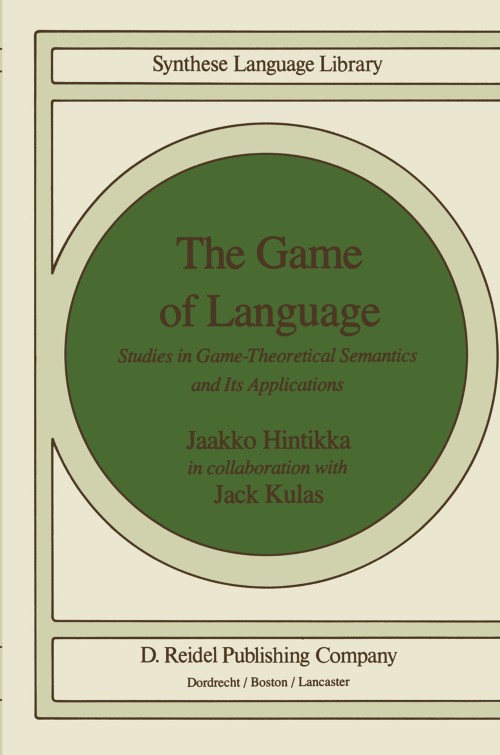
The Game of Language [electronic resource] : Studies in Game-Theoretical Semantics and Its Applications / by Jaakko Hintikka.
Erişim Adresi
ISBN
9789401098472
Dil Kodu
İngilizce
Yer Numarası
DK/11910
Yazar
Basım Bildirimi
1st ed. 1983.
Yayın Bilgisi
Dordrecht : Springer Netherlands : Imprint: Springer, 1983.
Fiziksel Niteleme
356 p. online resource.
Dizi
Studies in Linguistics and Philosophy, 2215-034X ; 22
İçindekiler Notu
1 / Game-Theoretical Semantics: Insights and Prospects -- 2 / Semantical Games and Transcendental Arguments -- 3 / Semantical Games, Subgames, and Functional Interpretations -- 4 / Any Problems — No Problems -- 5 / Temporal Discourse and Semantical Games -- 6 / Definite Descriptions in Game-Theoretical Semantics -- 7 / “Is”, Semantical Games, and Semantical Relativity -- 8 / Semantical Games and Aristotelian Categories -- 9 / On the Any-Thesis and the Methodology of Linguistics -- 10 / Theories of Truth and Learnable Languages -- Index of Names -- Index of Subjects.
Özet, vb.
Since the first chapter of this book presents an intro duction to the present state of game-theoretical semantics (GTS), there is no point in giving a briefer survey here. Instead, it may be helpful to indicate what this volume attempts to do. The first chapter gives a short intro duction to GTS and a survey of what is has accomplished. Chapter 2 puts the enterprise of GTS into new philo sophical perspective by relating its basic ideas to Kant's phi losophy of mathematics, space, and time. Chapters 3-6 are samples of GTS's accomplishments in understanding different kinds of semantical phenomena, mostly in natural languages. Beyond presenting results, some of these chapters also have other aims. Chapter 3 relates GTS to an interesting line of logical and foundational studies - the so-called functional interpretations - while chapter 4 leads to certain important methodological theses. Chapter 7 marks an application of GTS in a more philo sophical direction by criticizing the Frege-Russell thesis that words like "is" are multiply ambiguous. This leads in turn to a criticism of recent logical languages (logical notation), which since Frege have been based on the ambi guity thesis, and also to certain methodological sug gestions. In chapter 8, GTS is shown to have important implications for our understanding of Aristotle's doctrine of categories, while chapter 9 continues my earlier criticism of Chomsky's generative approach to linguistic theorizing.
Konu
Language and languages __ Philosophy.
Computational linguistics.
Philosophy of Language.
Computational Linguistics.
Computational linguistics.
Philosophy of Language.
Computational Linguistics.
Kurum Adı
Eseri Alıntıla
Referansları kullanmadan önce gözden geçirmeniz ve varsa gerekli düzeltmeleri yapmanız önerilir.
Dijital Kaynak
MARC Görünümü
LEADER 04653nam a22005535i 4500
001 810636
003 TR_AnAIT
005 20260131014550
007 cr nn 008mamaa
008 121227s1983 ne | s |||| 0|eng d
020 |a9789401098472|9978-94-010-9847-2
024 7 |a10.1007/978-94-010-9847-2|2doi
041 |aeng
049 |aTürk Tarih Kurumu Kütüphanesi
050 4|aP101-120
072 7|aCFA|2bicssc
072 7|aPHI038000|2bisacsh
072 7|aCFA|2thema
082 04|a149.94|223
090 |aDK/11910
100 1 |aHintikka, Jaakko.|eauthor.|4aut|4http://id.loc.gov/vocabulary/relators/aut
245 14|aThe Game of Language|h[electronic resource] :|bStudies in Game-Theoretical Semantics and Its Applications /|cby Jaakko Hintikka.
250 |a1st ed. 1983.
264 1|aDordrecht :|bSpringer Netherlands :|bImprint: Springer,|c1983.
300 |a356 p.|bonline resource.
336 |atext|btxt|2rdacontent
337 |acomputer|bc|2rdamedia
338 |aonline resource|bcr|2rdacarrier
347 |atext file|bPDF|2rda
490 1 |aStudies in Linguistics and Philosophy,|x2215-034X ;|v22
505 0 |a1 / Game-Theoretical Semantics: Insights and Prospects -- 2 / Semantical Games and Transcendental Arguments -- 3 / Semantical Games, Subgames, and Functional Interpretations -- 4 / Any Problems — No Problems -- 5 / Temporal Discourse and Semantical Games -- 6 / Definite Descriptions in Game-Theoretical Semantics -- 7 / “Is”, Semantical Games, and Semantical Relativity -- 8 / Semantical Games and Aristotelian Categories -- 9 / On the Any-Thesis and the Methodology of Linguistics -- 10 / Theories of Truth and Learnable Languages -- Index of Names -- Index of Subjects.
520 |aSince the first chapter of this book presents an intro duction to the present state of game-theoretical semantics (GTS), there is no point in giving a briefer survey here. Instead, it may be helpful to indicate what this volume attempts to do. The first chapter gives a short intro duction to GTS and a survey of what is has accomplished. Chapter 2 puts the enterprise of GTS into new philo sophical perspective by relating its basic ideas to Kant's phi losophy of mathematics, space, and time. Chapters 3-6 are samples of GTS's accomplishments in understanding different kinds of semantical phenomena, mostly in natural languages. Beyond presenting results, some of these chapters also have other aims. Chapter 3 relates GTS to an interesting line of logical and foundational studies - the so-called functional interpretations - while chapter 4 leads to certain important methodological theses. Chapter 7 marks an application of GTS in a more philo sophical direction by criticizing the Frege-Russell thesis that words like "is" are multiply ambiguous. This leads in turn to a criticism of recent logical languages (logical notation), which since Frege have been based on the ambi guity thesis, and also to certain methodological sug gestions. In chapter 8, GTS is shown to have important implications for our understanding of Aristotle's doctrine of categories, while chapter 9 continues my earlier criticism of Chomsky's generative approach to linguistic theorizing.
532 8 |aAccessibility summary: This PDF is not accessible. It is based on scanned pages and does not support features such as screen reader compatibility or described non-text content (images, graphs etc). However, it likely supports searchable and selectable text based on OCR (Optical Character Recognition). Users with accessibility needs may not be able to use this content effectively. Please contact us at accessibilitysupport@springernature.com if you require assistance or an alternative format.
532 8 |aInaccessible, or known limited accessibility
532 8 |aNo reading system accessibility options actively disabled
532 8 |aPublisher contact for further accessibility information: accessibilitysupport@springernature.com
650 0|aLanguage and languages|xPhilosophy.
650 0|aComputational linguistics.
650 14|aPhilosophy of Language.
650 24|aComputational Linguistics.
710 2 |aSpringerLink (Online service)
773 0 |tSpringer Nature eBook
776 08|iPrinted edition:|z9789027716873
776 08|iPrinted edition:|z9789027719508
776 08|iPrinted edition:|z9789401098489
830 0|aStudies in Linguistics and Philosophy,|x2215-034X ;|v22
856 40|uhttps://doi.org/10.1007/978-94-010-9847-2
912 |aZDB-2-SHU
912 |aZDB-2-SXPR
912 |aZDB-2-BAE
950 |aHumanities, Social Sciences and Law (SpringerNature-11648)
950 |aPhilosophy and Religion (R0) (SpringerNature-43725)
001 810636
003 TR_AnAIT
005 20260131014550
007 cr nn 008mamaa
008 121227s1983 ne | s |||| 0|eng d
020 |a9789401098472|9978-94-010-9847-2
024 7 |a10.1007/978-94-010-9847-2|2doi
041 |aeng
049 |aTürk Tarih Kurumu Kütüphanesi
050 4|aP101-120
072 7|aCFA|2bicssc
072 7|aPHI038000|2bisacsh
072 7|aCFA|2thema
082 04|a149.94|223
090 |aDK/11910
100 1 |aHintikka, Jaakko.|eauthor.|4aut|4http://id.loc.gov/vocabulary/relators/aut
245 14|aThe Game of Language|h[electronic resource] :|bStudies in Game-Theoretical Semantics and Its Applications /|cby Jaakko Hintikka.
250 |a1st ed. 1983.
264 1|aDordrecht :|bSpringer Netherlands :|bImprint: Springer,|c1983.
300 |a356 p.|bonline resource.
336 |atext|btxt|2rdacontent
337 |acomputer|bc|2rdamedia
338 |aonline resource|bcr|2rdacarrier
347 |atext file|bPDF|2rda
490 1 |aStudies in Linguistics and Philosophy,|x2215-034X ;|v22
505 0 |a1 / Game-Theoretical Semantics: Insights and Prospects -- 2 / Semantical Games and Transcendental Arguments -- 3 / Semantical Games, Subgames, and Functional Interpretations -- 4 / Any Problems — No Problems -- 5 / Temporal Discourse and Semantical Games -- 6 / Definite Descriptions in Game-Theoretical Semantics -- 7 / “Is”, Semantical Games, and Semantical Relativity -- 8 / Semantical Games and Aristotelian Categories -- 9 / On the Any-Thesis and the Methodology of Linguistics -- 10 / Theories of Truth and Learnable Languages -- Index of Names -- Index of Subjects.
520 |aSince the first chapter of this book presents an intro duction to the present state of game-theoretical semantics (GTS), there is no point in giving a briefer survey here. Instead, it may be helpful to indicate what this volume attempts to do. The first chapter gives a short intro duction to GTS and a survey of what is has accomplished. Chapter 2 puts the enterprise of GTS into new philo sophical perspective by relating its basic ideas to Kant's phi losophy of mathematics, space, and time. Chapters 3-6 are samples of GTS's accomplishments in understanding different kinds of semantical phenomena, mostly in natural languages. Beyond presenting results, some of these chapters also have other aims. Chapter 3 relates GTS to an interesting line of logical and foundational studies - the so-called functional interpretations - while chapter 4 leads to certain important methodological theses. Chapter 7 marks an application of GTS in a more philo sophical direction by criticizing the Frege-Russell thesis that words like "is" are multiply ambiguous. This leads in turn to a criticism of recent logical languages (logical notation), which since Frege have been based on the ambi guity thesis, and also to certain methodological sug gestions. In chapter 8, GTS is shown to have important implications for our understanding of Aristotle's doctrine of categories, while chapter 9 continues my earlier criticism of Chomsky's generative approach to linguistic theorizing.
532 8 |aAccessibility summary: This PDF is not accessible. It is based on scanned pages and does not support features such as screen reader compatibility or described non-text content (images, graphs etc). However, it likely supports searchable and selectable text based on OCR (Optical Character Recognition). Users with accessibility needs may not be able to use this content effectively. Please contact us at accessibilitysupport@springernature.com if you require assistance or an alternative format.
532 8 |aInaccessible, or known limited accessibility
532 8 |aNo reading system accessibility options actively disabled
532 8 |aPublisher contact for further accessibility information: accessibilitysupport@springernature.com
650 0|aLanguage and languages|xPhilosophy.
650 0|aComputational linguistics.
650 14|aPhilosophy of Language.
650 24|aComputational Linguistics.
710 2 |aSpringerLink (Online service)
773 0 |tSpringer Nature eBook
776 08|iPrinted edition:|z9789027716873
776 08|iPrinted edition:|z9789027719508
776 08|iPrinted edition:|z9789401098489
830 0|aStudies in Linguistics and Philosophy,|x2215-034X ;|v22
856 40|uhttps://doi.org/10.1007/978-94-010-9847-2
912 |aZDB-2-SHU
912 |aZDB-2-SXPR
912 |aZDB-2-BAE
950 |aHumanities, Social Sciences and Law (SpringerNature-11648)
950 |aPhilosophy and Religion (R0) (SpringerNature-43725)
Materyaller
Depodan talep edilen materyal sadece kütüphane içerisinde kullanılmaktadır.
Materyal dışarıya ödünç verilmemektedir.
Materyal dışarıya ödünç verilmemektedir.
