

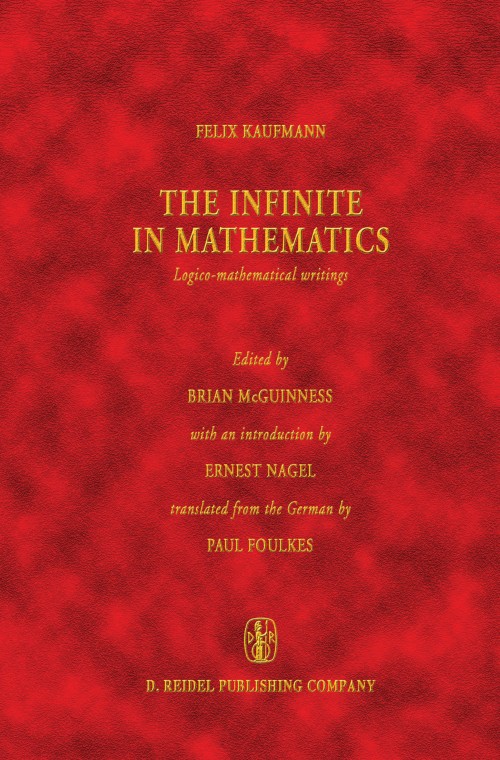
The Infinite in Mathematics [electronic resource] : Logico-mathematical writings / by Felix Kaufmann ; edited by B.F. McGuinness.
Erişim Adresi
ISBN
9789400997950
Dil Kodu
İngilizce
Yer Numarası
DK/11911
Yazar
Basım Bildirimi
1st ed. 1978.
Yayın Bilgisi
Dordrecht : Springer Netherlands : Imprint: Springer, 1978.
Fiziksel Niteleme
XVII, 237 p. online resource.
Dizi
Vienna Circle Collection ; 9
İçindekiler Notu
The Infinite in Mathematics and its Elimination (1930) -- Preface -- Analytic Table of Contents -- 1. Basic Facts of Cognition -- II. Symbolism and Axiomatics -- III. Natural Number and Set -- IV. Negative Numbers, Fractions and Irrational Numbers -- V. Set Theory -- VI. The Problem of Complete Decidability of Arithmetical Questions -- VII. The Antinomies -- Remarks on the Controversy about the Foundations of Logic and Mathematics (1931) -- Questions of Logical Principle in the Investigation of the Foundations of Mathematics (ca. 1931) -- Bibliography of the Published Writings of Felix Kaufman -- Bibliography of Works cited in the Present Volume -- Index of Names.
Özet, vb.
The main item in the present volume was published in 1930 under the title Das Unendliche in der Mathematik und seine Ausschaltung. It was at that time the fullest systematic account from the standpoint of Husserl's phenomenology of what is known as 'finitism' (also as 'intuitionism' and 'constructivism') in mathematics. Since then, important changes have been required in philosophies of mathematics, in part because of Kurt Godel's epoch-making paper of 1931 which established the essential in completeness of arithmetic. In the light of that finding, a number of the claims made in the book (and in the accompanying articles) are demon strably mistaken. Nevertheless, as a whole it retains much of its original interest and value. It presents the issues in the foundations of mathematics that were under debate when it was written (and in some cases still are); , and it offers one alternative to the currently dominant set-theoretical definitions of the cardinal numbers and other arithmetical concepts. While still a student at the University of Vienna, Felix Kaufmann was greatly impressed by the early philosophical writings (especially by the Logische Untersuchungen) of Edmund Husser!' He was never an uncritical disciple of Husserl, and he integrated into his mature philosophy ideas from a wide assortment of intellectual sources. But he thought of himself as a phenomenologist, and made frequent use in all his major publications of many of Husserl's logical and epistemological theses.
Konu
Science __ Philosophy.
Mathematical logic.
Philosophy of Science.
Mathematical Logic and Foundations.
Mathematical logic.
Philosophy of Science.
Mathematical Logic and Foundations.
Diğer Yazarlar
Kurum Adı
Eseri Alıntıla
Referansları kullanmadan önce gözden geçirmeniz ve varsa gerekli düzeltmeleri yapmanız önerilir.
Dijital Kaynak
MARC Görünümü
LEADER 04821nam a22005775i 4500
001 810637
003 TR_AnAIT
005 20260131014548
007 cr nn 008mamaa
008 121227s1978 ne | s |||| 0|eng d
020 |a9789400997950|9978-94-009-9795-0
024 7 |a10.1007/978-94-009-9795-0|2doi
041 |aeng
049 |aTürk Tarih Kurumu Kütüphanesi
050 4|aQ174-175.3
050 4|aB67
072 7|aPDA|2bicssc
072 7|aSCI075000|2bisacsh
072 7|aPDA|2thema
082 04|a501|223
090 |aDK/11911
100 1 |aKaufmann, Felix.|eauthor.|4aut|4http://id.loc.gov/vocabulary/relators/aut
245 14|aThe Infinite in Mathematics|h[electronic resource] :|bLogico-mathematical writings /|cby Felix Kaufmann ; edited by B.F. McGuinness.
250 |a1st ed. 1978.
264 1|aDordrecht :|bSpringer Netherlands :|bImprint: Springer,|c1978.
300 |aXVII, 237 p.|bonline resource.
336 |atext|btxt|2rdacontent
337 |acomputer|bc|2rdamedia
338 |aonline resource|bcr|2rdacarrier
347 |atext file|bPDF|2rda
490 1 |aVienna Circle Collection ;|v9
505 0 |aThe Infinite in Mathematics and its Elimination (1930) -- Preface -- Analytic Table of Contents -- 1. Basic Facts of Cognition -- II. Symbolism and Axiomatics -- III. Natural Number and Set -- IV. Negative Numbers, Fractions and Irrational Numbers -- V. Set Theory -- VI. The Problem of Complete Decidability of Arithmetical Questions -- VII. The Antinomies -- Remarks on the Controversy about the Foundations of Logic and Mathematics (1931) -- Questions of Logical Principle in the Investigation of the Foundations of Mathematics (ca. 1931) -- Bibliography of the Published Writings of Felix Kaufman -- Bibliography of Works cited in the Present Volume -- Index of Names.
520 |aThe main item in the present volume was published in 1930 under the title Das Unendliche in der Mathematik und seine Ausschaltung. It was at that time the fullest systematic account from the standpoint of Husserl's phenomenology of what is known as 'finitism' (also as 'intuitionism' and 'constructivism') in mathematics. Since then, important changes have been required in philosophies of mathematics, in part because of Kurt Godel's epoch-making paper of 1931 which established the essential in completeness of arithmetic. In the light of that finding, a number of the claims made in the book (and in the accompanying articles) are demon strably mistaken. Nevertheless, as a whole it retains much of its original interest and value. It presents the issues in the foundations of mathematics that were under debate when it was written (and in some cases still are); , and it offers one alternative to the currently dominant set-theoretical definitions of the cardinal numbers and other arithmetical concepts. While still a student at the University of Vienna, Felix Kaufmann was greatly impressed by the early philosophical writings (especially by the Logische Untersuchungen) of Edmund Husser!' He was never an uncritical disciple of Husserl, and he integrated into his mature philosophy ideas from a wide assortment of intellectual sources. But he thought of himself as a phenomenologist, and made frequent use in all his major publications of many of Husserl's logical and epistemological theses.
532 8 |aAccessibility summary: This PDF is not accessible. It is based on scanned pages and does not support features such as screen reader compatibility or described non-text content (images, graphs etc). However, it likely supports searchable and selectable text based on OCR (Optical Character Recognition). Users with accessibility needs may not be able to use this content effectively. Please contact us at accessibilitysupport@springernature.com if you require assistance or an alternative format.
532 8 |aInaccessible, or known limited accessibility
532 8 |aNo reading system accessibility options actively disabled
532 8 |aPublisher contact for further accessibility information: accessibilitysupport@springernature.com
650 0|aScience|xPhilosophy.
650 0|aMathematical logic.
650 14|aPhilosophy of Science.
650 24|aMathematical Logic and Foundations.
700 1 |aMcGuinness, B.F.|eeditor.|4edt|4http://id.loc.gov/vocabulary/relators/edt
710 2 |aSpringerLink (Online service)
773 0 |tSpringer Nature eBook
776 08|iPrinted edition:|z9789027708472
776 08|iPrinted edition:|z9789027708489
776 08|iPrinted edition:|z9789400997967
830 0|aVienna Circle Collection ;|v9
856 40|uhttps://doi.org/10.1007/978-94-009-9795-0
912 |aZDB-2-SHU
912 |aZDB-2-SXPR
912 |aZDB-2-BAE
950 |aHumanities, Social Sciences and Law (SpringerNature-11648)
950 |aPhilosophy and Religion (R0) (SpringerNature-43725)
001 810637
003 TR_AnAIT
005 20260131014548
007 cr nn 008mamaa
008 121227s1978 ne | s |||| 0|eng d
020 |a9789400997950|9978-94-009-9795-0
024 7 |a10.1007/978-94-009-9795-0|2doi
041 |aeng
049 |aTürk Tarih Kurumu Kütüphanesi
050 4|aQ174-175.3
050 4|aB67
072 7|aPDA|2bicssc
072 7|aSCI075000|2bisacsh
072 7|aPDA|2thema
082 04|a501|223
090 |aDK/11911
100 1 |aKaufmann, Felix.|eauthor.|4aut|4http://id.loc.gov/vocabulary/relators/aut
245 14|aThe Infinite in Mathematics|h[electronic resource] :|bLogico-mathematical writings /|cby Felix Kaufmann ; edited by B.F. McGuinness.
250 |a1st ed. 1978.
264 1|aDordrecht :|bSpringer Netherlands :|bImprint: Springer,|c1978.
300 |aXVII, 237 p.|bonline resource.
336 |atext|btxt|2rdacontent
337 |acomputer|bc|2rdamedia
338 |aonline resource|bcr|2rdacarrier
347 |atext file|bPDF|2rda
490 1 |aVienna Circle Collection ;|v9
505 0 |aThe Infinite in Mathematics and its Elimination (1930) -- Preface -- Analytic Table of Contents -- 1. Basic Facts of Cognition -- II. Symbolism and Axiomatics -- III. Natural Number and Set -- IV. Negative Numbers, Fractions and Irrational Numbers -- V. Set Theory -- VI. The Problem of Complete Decidability of Arithmetical Questions -- VII. The Antinomies -- Remarks on the Controversy about the Foundations of Logic and Mathematics (1931) -- Questions of Logical Principle in the Investigation of the Foundations of Mathematics (ca. 1931) -- Bibliography of the Published Writings of Felix Kaufman -- Bibliography of Works cited in the Present Volume -- Index of Names.
520 |aThe main item in the present volume was published in 1930 under the title Das Unendliche in der Mathematik und seine Ausschaltung. It was at that time the fullest systematic account from the standpoint of Husserl's phenomenology of what is known as 'finitism' (also as 'intuitionism' and 'constructivism') in mathematics. Since then, important changes have been required in philosophies of mathematics, in part because of Kurt Godel's epoch-making paper of 1931 which established the essential in completeness of arithmetic. In the light of that finding, a number of the claims made in the book (and in the accompanying articles) are demon strably mistaken. Nevertheless, as a whole it retains much of its original interest and value. It presents the issues in the foundations of mathematics that were under debate when it was written (and in some cases still are); , and it offers one alternative to the currently dominant set-theoretical definitions of the cardinal numbers and other arithmetical concepts. While still a student at the University of Vienna, Felix Kaufmann was greatly impressed by the early philosophical writings (especially by the Logische Untersuchungen) of Edmund Husser!' He was never an uncritical disciple of Husserl, and he integrated into his mature philosophy ideas from a wide assortment of intellectual sources. But he thought of himself as a phenomenologist, and made frequent use in all his major publications of many of Husserl's logical and epistemological theses.
532 8 |aAccessibility summary: This PDF is not accessible. It is based on scanned pages and does not support features such as screen reader compatibility or described non-text content (images, graphs etc). However, it likely supports searchable and selectable text based on OCR (Optical Character Recognition). Users with accessibility needs may not be able to use this content effectively. Please contact us at accessibilitysupport@springernature.com if you require assistance or an alternative format.
532 8 |aInaccessible, or known limited accessibility
532 8 |aNo reading system accessibility options actively disabled
532 8 |aPublisher contact for further accessibility information: accessibilitysupport@springernature.com
650 0|aScience|xPhilosophy.
650 0|aMathematical logic.
650 14|aPhilosophy of Science.
650 24|aMathematical Logic and Foundations.
700 1 |aMcGuinness, B.F.|eeditor.|4edt|4http://id.loc.gov/vocabulary/relators/edt
710 2 |aSpringerLink (Online service)
773 0 |tSpringer Nature eBook
776 08|iPrinted edition:|z9789027708472
776 08|iPrinted edition:|z9789027708489
776 08|iPrinted edition:|z9789400997967
830 0|aVienna Circle Collection ;|v9
856 40|uhttps://doi.org/10.1007/978-94-009-9795-0
912 |aZDB-2-SHU
912 |aZDB-2-SXPR
912 |aZDB-2-BAE
950 |aHumanities, Social Sciences and Law (SpringerNature-11648)
950 |aPhilosophy and Religion (R0) (SpringerNature-43725)
Materyaller
Depodan talep edilen materyal sadece kütüphane içerisinde kullanılmaktadır.
Materyal dışarıya ödünç verilmemektedir.
Materyal dışarıya ödünç verilmemektedir.
