

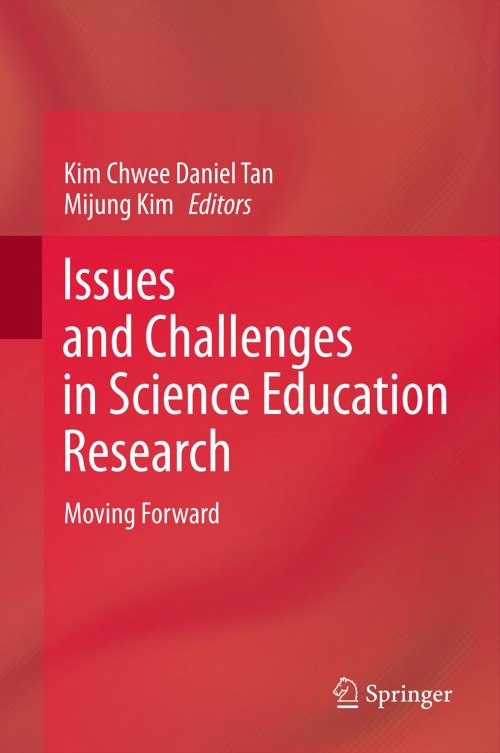
Issues and Challenges in Science Education Research [electronic resource] : Moving Forward / edited by Kim Chwee Daniel Tan, Mijung Kim.
Erişim Adresi
ISBN
9789400739802
Dil Kodu
İngilizce
Yer Numarası
DK/11918
Basım Bildirimi
1st ed. 2012.
Yayın Bilgisi
Dordrecht : Springer Netherlands : Imprint: Springer, 2012.
Fiziksel Niteleme
VIII, 352 p. online resource.
İçindekiler Notu
Issues and challenges in science education research, Kim Chwee Daniel Tan, Mijung Kim -- Science Literacy For All – More than a slogan, logo, or rally flag!, Larry D. Yore -- Moving the essence of inquiry into the classroom: Engaging teachers and students in authentic science, Barbara A. Crawford -- Conceptual Change – Still a powerful framework for improving the practice of science instruction, Reinders H. Duit, David F. Treagust -- Multimodality in problem solving, Shien Chue, Kim Chwee Daniel Tan -- Understanding photosynthesis and respiration – is it a problem? Eighth graders’ written and oral reasoning about photosynthesis and respiration, Helena Näs -- Introducing Students to Authentic Inquiry Investigation Using an Artificial Olfactory System, Niwat Srisawasdi -- Developing a peer coaching model for enhancing the pedagogical content knowledge of preservice science teachers, Syh-Jong Jang -- Issues and Challenges in School-based Assessment of Science Practical Work, Benny Hin Wai Yung -- Creative and co-operative science and technology education course: Theory and practice in Finnish teacher education context, Ossi Autio & Jari Lavonen -- Increasing accessibility to science in early childhood teacher education through collaboration between teacher educators and science/engineering academics, Christine Howitt, Elaine Blake, Martina Calais, Yvonne Carnellor, Sandra Frid, Simon Lewis, Mauro Mocerino, Lesley Parker, Len Sparrow, Jo Ward, Marjan Zadnik -- Stories of teaching hypothesis-verification process in elementary science classrooms, Mijung Kim, Yong Jae Joung, Hye-Gyoung Yoon -- Pedagogical practices and science learning with a focus on educating for sustainability for pre-service primary and middle years educators, Kathryn Paige, David Lloyd.-Using simulations in science: An exploration of pupil behavior, Susan Rodrigues -- Integrating Digital Technologies into the Contemporary Science Classroom, Karen Murcia -- Epistemological and pedagogical bases of design-for-learning with computer and video games, Yam San Chee, Kim Chwee Daniel Tan, Ek Ming Tan, Mingfong Jan -- Challenging Opportunities: Integrating ICT in School Science Education, Julie Crough, Louise Fogg, Jenni Webber -- Science in early learning centres: Satisfying curiosity, guided play, or lost opportunities?, Elaine Blake, Christine Howitt -- Engaging children in learning ecological science: Two botanic garden educators’ pedagogical practices, Junqing Zhai -- Knowledge Advancement in Environmental Science through Knowledge Building, Jennifer Yeo, Yew-Jin Lee -- Issues and challenges: Impacting practice and policy, Kim Chwee Daniel Tan, Mijung Kim.
Özet, vb.
In contemporary society, science constitutes a significant part of human life in that it impacts on how people experience and understand the world and themselves. The rapid advances in science and technology, newly established societal and cultural norms and values, and changes in the climate and environment, as well as, the depletion of natural resources all greatly impact the lives of children and youths, and hence their ways of learning, viewing the world, experiencing phenomena around them and interacting with others. These changes challenge science educators to rethink the epistemology and pedagogy in science classrooms today as the practice of science education needs to be proactive and relevant to students and prepare them for life in the present and in the future. Featuring contributions from highly experienced and celebrated science educators, as well as research perspectives from Europe, the USA, Asia and Australia, this book addresses theoretical and practical examples inscience education that, on the one hand, plays a key role in our understanding of the world, and yet, paradoxically, now acknowledges a growing number of uncertainties of knowledge about the world. The material is in four sections that cover the learning and teaching of science from science literacy to multiple representations; science teacher education; the use of innovations and new technologies in science teaching and learning; and science learning in informal settings including outdoor environmental learning activities. Acknowledging the issues and challenges in science education, this book hopes to generate collaborative discussions among scholars, researchers, and educators to develop critical and creative ways of science teaching to improve and enrich the lives of our children and youths.
Konu
Science __ Study and teaching.
Learning, Psychology of.
Teachers __ Training of.
Educational technology.
Science Education.
Instructional Psychology.
Teaching and Teacher Education.
Digital Education and Educational Technology.
Learning, Psychology of.
Teachers __ Training of.
Educational technology.
Science Education.
Instructional Psychology.
Teaching and Teacher Education.
Digital Education and Educational Technology.
Diğer Yazarlar
Kurum Adı
Eseri Alıntıla
Referansları kullanmadan önce gözden geçirmeniz ve varsa gerekli düzeltmeleri yapmanız önerilir.
Dijital Kaynak
MARC Görünümü
LEADER 06469nam a22005535i 4500
001 810644
003 TR_AnAIT
005 20260131014530
007 cr nn 008mamaa
008 120426s2012 ne | s |||| 0|eng d
020 |a9789400739802|9978-94-007-3980-2
024 7 |a10.1007/978-94-007-3980-2|2doi
041 |aeng
049 |aTürk Tarih Kurumu Kütüphanesi
050 4|aQ181-183.4
072 7|aJNU|2bicssc
072 7|aPD|2bicssc
072 7|aSCI063000|2bisacsh
072 7|aJNU|2thema
072 7|aPD|2thema
082 04|a507.1|223
090 |aDK/11918
245 10|aIssues and Challenges in Science Education Research|h[electronic resource] :|bMoving Forward /|cedited by Kim Chwee Daniel Tan, Mijung Kim.
250 |a1st ed. 2012.
264 1|aDordrecht :|bSpringer Netherlands :|bImprint: Springer,|c2012.
300 |aVIII, 352 p.|bonline resource.
336 |atext|btxt|2rdacontent
337 |acomputer|bc|2rdamedia
338 |aonline resource|bcr|2rdacarrier
347 |atext file|bPDF|2rda
505 0 |aIssues and challenges in science education research, Kim Chwee Daniel Tan, Mijung Kim -- Science Literacy For All – More than a slogan, logo, or rally flag!, Larry D. Yore -- Moving the essence of inquiry into the classroom: Engaging teachers and students in authentic science, Barbara A. Crawford -- Conceptual Change – Still a powerful framework for improving the practice of science instruction, Reinders H. Duit, David F. Treagust -- Multimodality in problem solving, Shien Chue, Kim Chwee Daniel Tan -- Understanding photosynthesis and respiration – is it a problem? Eighth graders’ written and oral reasoning about photosynthesis and respiration, Helena Näs -- Introducing Students to Authentic Inquiry Investigation Using an Artificial Olfactory System, Niwat Srisawasdi -- Developing a peer coaching model for enhancing the pedagogical content knowledge of preservice science teachers, Syh-Jong Jang -- Issues and Challenges in School-based Assessment of Science Practical Work, Benny Hin Wai Yung -- Creative and co-operative science and technology education course: Theory and practice in Finnish teacher education context, Ossi Autio & Jari Lavonen -- Increasing accessibility to science in early childhood teacher education through collaboration between teacher educators and science/engineering academics, Christine Howitt, Elaine Blake, Martina Calais, Yvonne Carnellor, Sandra Frid, Simon Lewis, Mauro Mocerino, Lesley Parker, Len Sparrow, Jo Ward, Marjan Zadnik -- Stories of teaching hypothesis-verification process in elementary science classrooms, Mijung Kim, Yong Jae Joung, Hye-Gyoung Yoon -- Pedagogical practices and science learning with a focus on educating for sustainability for pre-service primary and middle years educators, Kathryn Paige, David Lloyd.-Using simulations in science: An exploration of pupil behavior, Susan Rodrigues -- Integrating Digital Technologies into the Contemporary Science Classroom, Karen Murcia -- Epistemological and pedagogical bases of design-for-learning with computer and video games, Yam San Chee, Kim Chwee Daniel Tan, Ek Ming Tan, Mingfong Jan -- Challenging Opportunities: Integrating ICT in School Science Education, Julie Crough, Louise Fogg, Jenni Webber -- Science in early learning centres: Satisfying curiosity, guided play, or lost opportunities?, Elaine Blake, Christine Howitt -- Engaging children in learning ecological science: Two botanic garden educators’ pedagogical practices, Junqing Zhai -- Knowledge Advancement in Environmental Science through Knowledge Building, Jennifer Yeo, Yew-Jin Lee -- Issues and challenges: Impacting practice and policy, Kim Chwee Daniel Tan, Mijung Kim.
520 |aIn contemporary society, science constitutes a significant part of human life in that it impacts on how people experience and understand the world and themselves. The rapid advances in science and technology, newly established societal and cultural norms and values, and changes in the climate and environment, as well as, the depletion of natural resources all greatly impact the lives of children and youths, and hence their ways of learning, viewing the world, experiencing phenomena around them and interacting with others. These changes challenge science educators to rethink the epistemology and pedagogy in science classrooms today as the practice of science education needs to be proactive and relevant to students and prepare them for life in the present and in the future. Featuring contributions from highly experienced and celebrated science educators, as well as research perspectives from Europe, the USA, Asia and Australia, this book addresses theoretical and practical examples inscience education that, on the one hand, plays a key role in our understanding of the world, and yet, paradoxically, now acknowledges a growing number of uncertainties of knowledge about the world. The material is in four sections that cover the learning and teaching of science from science literacy to multiple representations; science teacher education; the use of innovations and new technologies in science teaching and learning; and science learning in informal settings including outdoor environmental learning activities. Acknowledging the issues and challenges in science education, this book hopes to generate collaborative discussions among scholars, researchers, and educators to develop critical and creative ways of science teaching to improve and enrich the lives of our children and youths.
650 0|aScience|xStudy and teaching.
650 0|aLearning, Psychology of.
650 0|aTeachers|xTraining of.
650 0|aEducational technology.
650 14|aScience Education.
650 24|aInstructional Psychology.
650 24|aTeaching and Teacher Education.
650 24|aDigital Education and Educational Technology.
700 1 |aTan, Kim Chwee Daniel.|eeditor.|4edt|4http://id.loc.gov/vocabulary/relators/edt
700 1 |aKim, Mijung.|eeditor.|4edt|4http://id.loc.gov/vocabulary/relators/edt
710 2 |aSpringerLink (Online service)
773 0 |tSpringer Nature eBook
776 08|iPrinted edition:|z9789400739796
776 08|iPrinted edition:|z9789400739819
776 08|iPrinted edition:|z9789401781923
856 40|uhttps://doi.org/10.1007/978-94-007-3980-2
912 |aZDB-2-SHU
912 |aZDB-2-SXED
950 |aHumanities, Social Sciences and Law (SpringerNature-11648)
950 |aEducation (R0) (SpringerNature-43721)
001 810644
003 TR_AnAIT
005 20260131014530
007 cr nn 008mamaa
008 120426s2012 ne | s |||| 0|eng d
020 |a9789400739802|9978-94-007-3980-2
024 7 |a10.1007/978-94-007-3980-2|2doi
041 |aeng
049 |aTürk Tarih Kurumu Kütüphanesi
050 4|aQ181-183.4
072 7|aJNU|2bicssc
072 7|aPD|2bicssc
072 7|aSCI063000|2bisacsh
072 7|aJNU|2thema
072 7|aPD|2thema
082 04|a507.1|223
090 |aDK/11918
245 10|aIssues and Challenges in Science Education Research|h[electronic resource] :|bMoving Forward /|cedited by Kim Chwee Daniel Tan, Mijung Kim.
250 |a1st ed. 2012.
264 1|aDordrecht :|bSpringer Netherlands :|bImprint: Springer,|c2012.
300 |aVIII, 352 p.|bonline resource.
336 |atext|btxt|2rdacontent
337 |acomputer|bc|2rdamedia
338 |aonline resource|bcr|2rdacarrier
347 |atext file|bPDF|2rda
505 0 |aIssues and challenges in science education research, Kim Chwee Daniel Tan, Mijung Kim -- Science Literacy For All – More than a slogan, logo, or rally flag!, Larry D. Yore -- Moving the essence of inquiry into the classroom: Engaging teachers and students in authentic science, Barbara A. Crawford -- Conceptual Change – Still a powerful framework for improving the practice of science instruction, Reinders H. Duit, David F. Treagust -- Multimodality in problem solving, Shien Chue, Kim Chwee Daniel Tan -- Understanding photosynthesis and respiration – is it a problem? Eighth graders’ written and oral reasoning about photosynthesis and respiration, Helena Näs -- Introducing Students to Authentic Inquiry Investigation Using an Artificial Olfactory System, Niwat Srisawasdi -- Developing a peer coaching model for enhancing the pedagogical content knowledge of preservice science teachers, Syh-Jong Jang -- Issues and Challenges in School-based Assessment of Science Practical Work, Benny Hin Wai Yung -- Creative and co-operative science and technology education course: Theory and practice in Finnish teacher education context, Ossi Autio & Jari Lavonen -- Increasing accessibility to science in early childhood teacher education through collaboration between teacher educators and science/engineering academics, Christine Howitt, Elaine Blake, Martina Calais, Yvonne Carnellor, Sandra Frid, Simon Lewis, Mauro Mocerino, Lesley Parker, Len Sparrow, Jo Ward, Marjan Zadnik -- Stories of teaching hypothesis-verification process in elementary science classrooms, Mijung Kim, Yong Jae Joung, Hye-Gyoung Yoon -- Pedagogical practices and science learning with a focus on educating for sustainability for pre-service primary and middle years educators, Kathryn Paige, David Lloyd.-Using simulations in science: An exploration of pupil behavior, Susan Rodrigues -- Integrating Digital Technologies into the Contemporary Science Classroom, Karen Murcia -- Epistemological and pedagogical bases of design-for-learning with computer and video games, Yam San Chee, Kim Chwee Daniel Tan, Ek Ming Tan, Mingfong Jan -- Challenging Opportunities: Integrating ICT in School Science Education, Julie Crough, Louise Fogg, Jenni Webber -- Science in early learning centres: Satisfying curiosity, guided play, or lost opportunities?, Elaine Blake, Christine Howitt -- Engaging children in learning ecological science: Two botanic garden educators’ pedagogical practices, Junqing Zhai -- Knowledge Advancement in Environmental Science through Knowledge Building, Jennifer Yeo, Yew-Jin Lee -- Issues and challenges: Impacting practice and policy, Kim Chwee Daniel Tan, Mijung Kim.
520 |aIn contemporary society, science constitutes a significant part of human life in that it impacts on how people experience and understand the world and themselves. The rapid advances in science and technology, newly established societal and cultural norms and values, and changes in the climate and environment, as well as, the depletion of natural resources all greatly impact the lives of children and youths, and hence their ways of learning, viewing the world, experiencing phenomena around them and interacting with others. These changes challenge science educators to rethink the epistemology and pedagogy in science classrooms today as the practice of science education needs to be proactive and relevant to students and prepare them for life in the present and in the future. Featuring contributions from highly experienced and celebrated science educators, as well as research perspectives from Europe, the USA, Asia and Australia, this book addresses theoretical and practical examples inscience education that, on the one hand, plays a key role in our understanding of the world, and yet, paradoxically, now acknowledges a growing number of uncertainties of knowledge about the world. The material is in four sections that cover the learning and teaching of science from science literacy to multiple representations; science teacher education; the use of innovations and new technologies in science teaching and learning; and science learning in informal settings including outdoor environmental learning activities. Acknowledging the issues and challenges in science education, this book hopes to generate collaborative discussions among scholars, researchers, and educators to develop critical and creative ways of science teaching to improve and enrich the lives of our children and youths.
650 0|aScience|xStudy and teaching.
650 0|aLearning, Psychology of.
650 0|aTeachers|xTraining of.
650 0|aEducational technology.
650 14|aScience Education.
650 24|aInstructional Psychology.
650 24|aTeaching and Teacher Education.
650 24|aDigital Education and Educational Technology.
700 1 |aTan, Kim Chwee Daniel.|eeditor.|4edt|4http://id.loc.gov/vocabulary/relators/edt
700 1 |aKim, Mijung.|eeditor.|4edt|4http://id.loc.gov/vocabulary/relators/edt
710 2 |aSpringerLink (Online service)
773 0 |tSpringer Nature eBook
776 08|iPrinted edition:|z9789400739796
776 08|iPrinted edition:|z9789400739819
776 08|iPrinted edition:|z9789401781923
856 40|uhttps://doi.org/10.1007/978-94-007-3980-2
912 |aZDB-2-SHU
912 |aZDB-2-SXED
950 |aHumanities, Social Sciences and Law (SpringerNature-11648)
950 |aEducation (R0) (SpringerNature-43721)
Materyaller
Depodan talep edilen materyal sadece kütüphane içerisinde kullanılmaktadır.
Materyal dışarıya ödünç verilmemektedir.
Materyal dışarıya ödünç verilmemektedir.
