

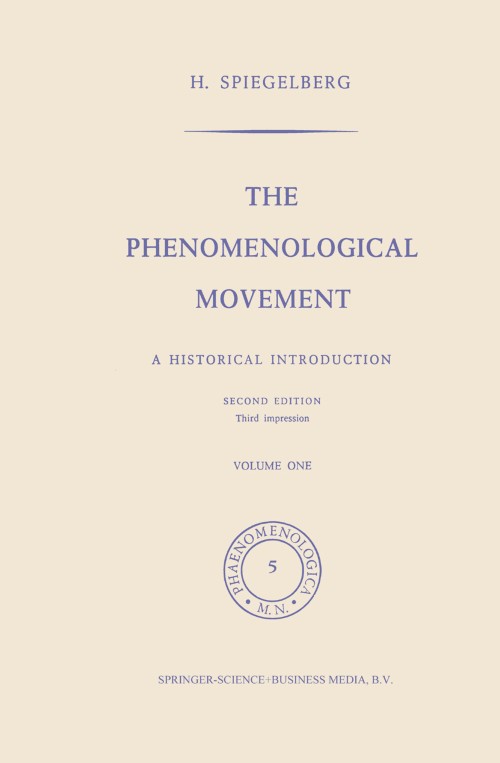
The Phenomenological Movement [electronic resource] : A Historical Introduction / by Herbert Spiegelberg.
Erişim Adresi
ISBN
9789401747424
Dil Kodu
İngilizce
Yer Numarası
DK/11936
Yazar
Basım Bildirimi
2nd ed. 1971.
Yayın Bilgisi
Dordrecht : Springer Netherlands : Imprint: Springer, 1971.
Fiziksel Niteleme
XXXVI, 391 p. online resource.
Dizi
Phaenomenologica, Series Founded by H. L. Van Breda and Published Under the Auspices of the Husserl-Archives, 2215-0331 ; 5
İçindekiler Notu
One / The Preparatory Phase -- I. Franz Brentano (1838–1917): Forerunner of the Phenomenological Movement -- II. Carl Stumpf (1848–1936): Founder of Experimental Phenomenology -- Two / The German Phase of the Movement -- III. The Pure Phenomenology of Edmund Husserl (1859–1938) -- IV. The Older Phenomenological Movement -- V. The Phenomenology of Essences: Max Scheler (1874–1928) -- VI. Martin Heidegger (1889- ) as a Phenomenologist -- VII. Phenomenology in the Critical Ontology of Nicolai Hartmann (1882–1950).
Özet, vb.
The present attempt to introduce the general philosophical reader to the Phenomenological Movement by way of its history has itself a history which is pertinent to its objective. It may suitably be opened by the following excerpts from a review which Herbert W. Schneider of Columbia University, the Head of the Division for Internc. . tional Cultural Cooperation, Department of Cultural Activities of Unesco from 1953 to 56, wrote in 1950 from France: The influence of Husser! has revolutionized continental philosophies, not because his philosophy has become dominant, but because any philosophy now seeks to accommodate itself to, and express itself in, phenomenological method. It is the sine qua non of critical respectability. In America, on the contrary, phenomenology is in its infancy. The aver age American student of philosophy, when he picks up a recent volume of philosophy published on the continent of Europe, must first learn the "tricks" of the phenomenological trade and then translate as best he can the real import of what is said into the kind of analysis with which he is familiar. . . . . . . No doubt, American education will gradually take account of the spread of phenomenological method and terminology, but until it does, American readers of European philosophy have a severe handicap; and this applies not only to existentialism but to almost all current philosophicalliterature.
Konu
Logic.
Philosophy.
Logic.
Philosophy.
Philosophy.
Logic.
Philosophy.
Kurum Adı
Eseri Alıntıla
Referansları kullanmadan önce gözden geçirmeniz ve varsa gerekli düzeltmeleri yapmanız önerilir.
Dijital Kaynak
MARC Görünümü
LEADER 04534nam a22005415i 4500
001 810662
003 TR_AnAIT
005 20260131014503
007 cr nn 008mamaa
008 130730s1971 ne | s |||| 0|eng d
020 |a9789401747424|9978-94-017-4742-4
024 7 |a10.1007/978-94-017-4742-4|2doi
041 |aeng
049 |aTürk Tarih Kurumu Kütüphanesi
050 4|aBC1-199
072 7|aHPL|2bicssc
072 7|aPHI011000|2bisacsh
072 7|aQDTL|2thema
082 04|a160|223
090 |aDK/11936
100 1 |aSpiegelberg, Herbert.|eauthor.|4aut|4http://id.loc.gov/vocabulary/relators/aut
245 14|aThe Phenomenological Movement|h[electronic resource] :|bA Historical Introduction /|cby Herbert Spiegelberg.
250 |a2nd ed. 1971.
264 1|aDordrecht :|bSpringer Netherlands :|bImprint: Springer,|c1971.
300 |aXXXVI, 391 p.|bonline resource.
336 |atext|btxt|2rdacontent
337 |acomputer|bc|2rdamedia
338 |aonline resource|bcr|2rdacarrier
347 |atext file|bPDF|2rda
490 1 |aPhaenomenologica, Series Founded by H. L. Van Breda and Published Under the Auspices of the Husserl-Archives,|x2215-0331 ;|v5
505 0 |aOne / The Preparatory Phase -- I. Franz Brentano (1838–1917): Forerunner of the Phenomenological Movement -- II. Carl Stumpf (1848–1936): Founder of Experimental Phenomenology -- Two / The German Phase of the Movement -- III. The Pure Phenomenology of Edmund Husserl (1859–1938) -- IV. The Older Phenomenological Movement -- V. The Phenomenology of Essences: Max Scheler (1874–1928) -- VI. Martin Heidegger (1889- ) as a Phenomenologist -- VII. Phenomenology in the Critical Ontology of Nicolai Hartmann (1882–1950).
520 |aThe present attempt to introduce the general philosophical reader to the Phenomenological Movement by way of its history has itself a history which is pertinent to its objective. It may suitably be opened by the following excerpts from a review which Herbert W. Schneider of Columbia University, the Head of the Division for Internc. . tional Cultural Cooperation, Department of Cultural Activities of Unesco from 1953 to 56, wrote in 1950 from France: The influence of Husser! has revolutionized continental philosophies, not because his philosophy has become dominant, but because any philosophy now seeks to accommodate itself to, and express itself in, phenomenological method. It is the sine qua non of critical respectability. In America, on the contrary, phenomenology is in its infancy. The aver age American student of philosophy, when he picks up a recent volume of philosophy published on the continent of Europe, must first learn the "tricks" of the phenomenological trade and then translate as best he can the real import of what is said into the kind of analysis with which he is familiar. . . . . . . No doubt, American education will gradually take account of the spread of phenomenological method and terminology, but until it does, American readers of European philosophy have a severe handicap; and this applies not only to existentialism but to almost all current philosophicalliterature.
532 8 |aAccessibility summary: This PDF is not accessible. It is based on scanned pages and does not support features such as screen reader compatibility or described non-text content (images, graphs etc). However, it likely supports searchable and selectable text based on OCR (Optical Character Recognition). Users with accessibility needs may not be able to use this content effectively. Please contact us at accessibilitysupport@springernature.com if you require assistance or an alternative format.
532 8 |aInaccessible, or known limited accessibility
532 8 |aNo reading system accessibility options actively disabled
532 8 |aPublisher contact for further accessibility information: accessibilitysupport@springernature.com
650 0|aLogic.
650 0|aPhilosophy.
650 14|aLogic.
650 24|aPhilosophy.
710 2 |aSpringerLink (Online service)
773 0 |tSpringer Nature eBook
776 08|iPrinted edition:|z9789024702398
776 08|iPrinted edition:|z9789401747431
830 0|aPhaenomenologica, Series Founded by H. L. Van Breda and Published Under the Auspices of the Husserl-Archives,|x2215-0331 ;|v5
856 40|uhttps://doi.org/10.1007/978-94-017-4742-4
912 |aZDB-2-SHU
912 |aZDB-2-SXPR
912 |aZDB-2-BAE
950 |aHumanities, Social Sciences and Law (SpringerNature-11648)
950 |aPhilosophy and Religion (R0) (SpringerNature-43725)
001 810662
003 TR_AnAIT
005 20260131014503
007 cr nn 008mamaa
008 130730s1971 ne | s |||| 0|eng d
020 |a9789401747424|9978-94-017-4742-4
024 7 |a10.1007/978-94-017-4742-4|2doi
041 |aeng
049 |aTürk Tarih Kurumu Kütüphanesi
050 4|aBC1-199
072 7|aHPL|2bicssc
072 7|aPHI011000|2bisacsh
072 7|aQDTL|2thema
082 04|a160|223
090 |aDK/11936
100 1 |aSpiegelberg, Herbert.|eauthor.|4aut|4http://id.loc.gov/vocabulary/relators/aut
245 14|aThe Phenomenological Movement|h[electronic resource] :|bA Historical Introduction /|cby Herbert Spiegelberg.
250 |a2nd ed. 1971.
264 1|aDordrecht :|bSpringer Netherlands :|bImprint: Springer,|c1971.
300 |aXXXVI, 391 p.|bonline resource.
336 |atext|btxt|2rdacontent
337 |acomputer|bc|2rdamedia
338 |aonline resource|bcr|2rdacarrier
347 |atext file|bPDF|2rda
490 1 |aPhaenomenologica, Series Founded by H. L. Van Breda and Published Under the Auspices of the Husserl-Archives,|x2215-0331 ;|v5
505 0 |aOne / The Preparatory Phase -- I. Franz Brentano (1838–1917): Forerunner of the Phenomenological Movement -- II. Carl Stumpf (1848–1936): Founder of Experimental Phenomenology -- Two / The German Phase of the Movement -- III. The Pure Phenomenology of Edmund Husserl (1859–1938) -- IV. The Older Phenomenological Movement -- V. The Phenomenology of Essences: Max Scheler (1874–1928) -- VI. Martin Heidegger (1889- ) as a Phenomenologist -- VII. Phenomenology in the Critical Ontology of Nicolai Hartmann (1882–1950).
520 |aThe present attempt to introduce the general philosophical reader to the Phenomenological Movement by way of its history has itself a history which is pertinent to its objective. It may suitably be opened by the following excerpts from a review which Herbert W. Schneider of Columbia University, the Head of the Division for Internc. . tional Cultural Cooperation, Department of Cultural Activities of Unesco from 1953 to 56, wrote in 1950 from France: The influence of Husser! has revolutionized continental philosophies, not because his philosophy has become dominant, but because any philosophy now seeks to accommodate itself to, and express itself in, phenomenological method. It is the sine qua non of critical respectability. In America, on the contrary, phenomenology is in its infancy. The aver age American student of philosophy, when he picks up a recent volume of philosophy published on the continent of Europe, must first learn the "tricks" of the phenomenological trade and then translate as best he can the real import of what is said into the kind of analysis with which he is familiar. . . . . . . No doubt, American education will gradually take account of the spread of phenomenological method and terminology, but until it does, American readers of European philosophy have a severe handicap; and this applies not only to existentialism but to almost all current philosophicalliterature.
532 8 |aAccessibility summary: This PDF is not accessible. It is based on scanned pages and does not support features such as screen reader compatibility or described non-text content (images, graphs etc). However, it likely supports searchable and selectable text based on OCR (Optical Character Recognition). Users with accessibility needs may not be able to use this content effectively. Please contact us at accessibilitysupport@springernature.com if you require assistance or an alternative format.
532 8 |aInaccessible, or known limited accessibility
532 8 |aNo reading system accessibility options actively disabled
532 8 |aPublisher contact for further accessibility information: accessibilitysupport@springernature.com
650 0|aLogic.
650 0|aPhilosophy.
650 14|aLogic.
650 24|aPhilosophy.
710 2 |aSpringerLink (Online service)
773 0 |tSpringer Nature eBook
776 08|iPrinted edition:|z9789024702398
776 08|iPrinted edition:|z9789401747431
830 0|aPhaenomenologica, Series Founded by H. L. Van Breda and Published Under the Auspices of the Husserl-Archives,|x2215-0331 ;|v5
856 40|uhttps://doi.org/10.1007/978-94-017-4742-4
912 |aZDB-2-SHU
912 |aZDB-2-SXPR
912 |aZDB-2-BAE
950 |aHumanities, Social Sciences and Law (SpringerNature-11648)
950 |aPhilosophy and Religion (R0) (SpringerNature-43725)
Materyaller
Depodan talep edilen materyal sadece kütüphane içerisinde kullanılmaktadır.
Materyal dışarıya ödünç verilmemektedir.
Materyal dışarıya ödünç verilmemektedir.
