

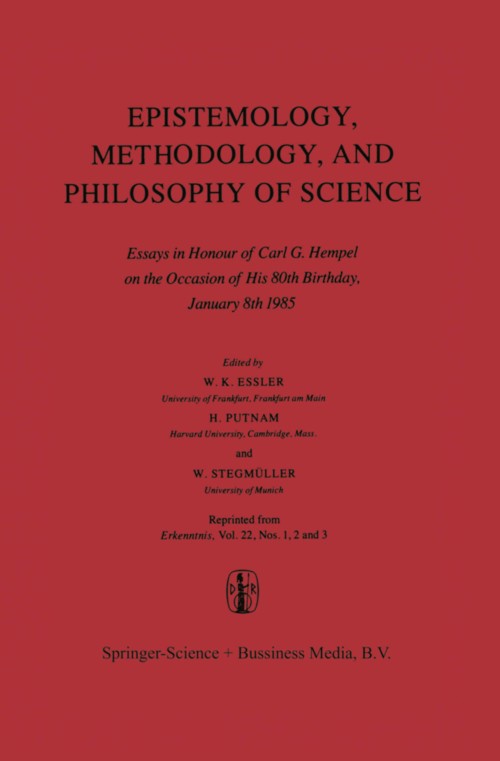
Epistemology, Methodology, and Philosophy of Science [electronic resource] : Essays in Honour of Carl G. Hempel on the Occasion of His 80th Birthday, January 8th 1985 / edited by Wilhelm K. Essler, H. Putnam, W. Stegmüller.
Erişim Adresi
ISBN
9789401714563
Dil Kodu
İngilizce
Yer Numarası
DK/11958
Basım Bildirimi
1st ed. 1985.
Yayın Bilgisi
Dordrecht : Springer Netherlands : Imprint: Springer, 1985.
Fiziksel Niteleme
III, 484 p. online resource.
İçindekiler Notu
On Inductive Support and Some Recent Tricks -- Inductive Inference in the Limit -- Probability and Laws -- Commensurability, Incommensurability and Cumulativity in Scientific Knowledge -- Social Habits and Enlightened Cooperation: Do Humans Measure Up to Lewis Conventions? -- Theoretical Terms and Bridge Principles: A Critique of Hempel’s (Self-) Criticisms -- On Reduction of Theories -- Reflexive Reflections -- Explaining the Actions of the Explainers -- On Explaining Beliefs -- Explaining the Unpredictable -- The Logician’s Dilemma: Deductive Logic, Inductive Inference and Logical Empiricism -- Explanation in Physical Cosmology: Essay in Honor of C. G. Hempel’s Eightieth Birthday -- Statements and Pictures -- Truth and Best Explanation -- Utility Theory and Preference Logic -- Der erste Wiener Kreis -- Are Synoptic Questions Illegitimate? -- On Determining Dispositions -- Die Logik der Unbestimmtheiten und Paradoxien -- Bemerkungen zur pragmatisch-epistemischen Wende in der Wissenschaftstheoretischen Analyse der Ereigniserklärungen -- Zur Verteidigung einiger Hempelscher Thesen gegen Kritiken Stegmüllers.
Özet, vb.
Professor C. G. Hempel (known to a host of admirers and friends as 'Peter' Hempel) is one of the most esteemed and best loved philosophers in the If an Empiricist Saint were not somewhat of a Meinongian Impos world. sible Object, one might describe Peter Hempel as an Empiricist Saint. In deed, he is as admired for his brilliance, intellectual flexibility, and crea tivity as he is for his warmth, kindness, and integrity, and does not the presence of so many wonderful qualities in one human being assume the dimensions of an impossibility? But Peter Hempel is not only possible but actual! One of us (Hilary Putnam) remembers vividly the occasion on which he first witnessed Hempel 'in action'. It was 1950, and Quine had begun to attack the analytic/synthetic distinction (a distinction which Carnap and Reichenbach had made a cornerstone, if not the keystone, of Logical Em piricist philosophy). Hempel, who is as quick to accept any idea that seems to contain real substance and insight as he is to demolish ideas that are empty or confused, was one of the first leading philosophers outside of Quine's immediate circle to join Quine in his attack. Hempel had come to Los Angeles (where Reichenbach taught) on a visit, and a small group consisting of Reichenbach and a few of his graduate students were gath ered together in Reichenbach's home to hear Hempel defend the new posi tion.
Konu
Science __ Philosophy.
Knowledge, Theory of.
Philosophy of Science.
Epistemology.
Knowledge, Theory of.
Philosophy of Science.
Epistemology.
Diğer Yazarlar
Kurum Adı
Eseri Alıntıla
Referansları kullanmadan önce gözden geçirmeniz ve varsa gerekli düzeltmeleri yapmanız önerilir.
Dijital Kaynak
MARC Görünümü
LEADER 05247nam a22005655i 4500
001 810685
003 TR_AnAIT
005 20260131014251
007 cr nn 008mamaa
008 130602s1985 ne | s |||| 0|eng d
020 |a9789401714563|9978-94-017-1456-3
024 7 |a10.1007/978-94-017-1456-3|2doi
041 |aeng
049 |aTürk Tarih Kurumu Kütüphanesi
050 4|aQ174-175.3
050 4|aB67
072 7|aPDA|2bicssc
072 7|aSCI075000|2bisacsh
072 7|aPDA|2thema
082 04|a501|223
090 |aDK/11958
245 10|aEpistemology, Methodology, and Philosophy of Science|h[electronic resource] :|bEssays in Honour of Carl G. Hempel on the Occasion of His 80th Birthday, January 8th 1985 /|cedited by Wilhelm K. Essler, H. Putnam, W. Stegmüller.
250 |a1st ed. 1985.
264 1|aDordrecht :|bSpringer Netherlands :|bImprint: Springer,|c1985.
300 |aIII, 484 p.|bonline resource.
336 |atext|btxt|2rdacontent
337 |acomputer|bc|2rdamedia
338 |aonline resource|bcr|2rdacarrier
347 |atext file|bPDF|2rda
505 0 |aOn Inductive Support and Some Recent Tricks -- Inductive Inference in the Limit -- Probability and Laws -- Commensurability, Incommensurability and Cumulativity in Scientific Knowledge -- Social Habits and Enlightened Cooperation: Do Humans Measure Up to Lewis Conventions? -- Theoretical Terms and Bridge Principles: A Critique of Hempel’s (Self-) Criticisms -- On Reduction of Theories -- Reflexive Reflections -- Explaining the Actions of the Explainers -- On Explaining Beliefs -- Explaining the Unpredictable -- The Logician’s Dilemma: Deductive Logic, Inductive Inference and Logical Empiricism -- Explanation in Physical Cosmology: Essay in Honor of C. G. Hempel’s Eightieth Birthday -- Statements and Pictures -- Truth and Best Explanation -- Utility Theory and Preference Logic -- Der erste Wiener Kreis -- Are Synoptic Questions Illegitimate? -- On Determining Dispositions -- Die Logik der Unbestimmtheiten und Paradoxien -- Bemerkungen zur pragmatisch-epistemischen Wende in der Wissenschaftstheoretischen Analyse der Ereigniserklärungen -- Zur Verteidigung einiger Hempelscher Thesen gegen Kritiken Stegmüllers.
520 |aProfessor C. G. Hempel (known to a host of admirers and friends as 'Peter' Hempel) is one of the most esteemed and best loved philosophers in the If an Empiricist Saint were not somewhat of a Meinongian Impos world. sible Object, one might describe Peter Hempel as an Empiricist Saint. In deed, he is as admired for his brilliance, intellectual flexibility, and crea tivity as he is for his warmth, kindness, and integrity, and does not the presence of so many wonderful qualities in one human being assume the dimensions of an impossibility? But Peter Hempel is not only possible but actual! One of us (Hilary Putnam) remembers vividly the occasion on which he first witnessed Hempel 'in action'. It was 1950, and Quine had begun to attack the analytic/synthetic distinction (a distinction which Carnap and Reichenbach had made a cornerstone, if not the keystone, of Logical Em piricist philosophy). Hempel, who is as quick to accept any idea that seems to contain real substance and insight as he is to demolish ideas that are empty or confused, was one of the first leading philosophers outside of Quine's immediate circle to join Quine in his attack. Hempel had come to Los Angeles (where Reichenbach taught) on a visit, and a small group consisting of Reichenbach and a few of his graduate students were gath ered together in Reichenbach's home to hear Hempel defend the new posi tion.
532 8 |aAccessibility summary: This PDF is not accessible. It is based on scanned pages and does not support features such as screen reader compatibility or described non-text content (images, graphs etc). However, it likely supports searchable and selectable text based on OCR (Optical Character Recognition). Users with accessibility needs may not be able to use this content effectively. Please contact us at accessibilitysupport@springernature.com if you require assistance or an alternative format.
532 8 |aInaccessible, or known limited accessibility
532 8 |aNo reading system accessibility options actively disabled
532 8 |aPublisher contact for further accessibility information: accessibilitysupport@springernature.com
650 0|aScience|xPhilosophy.
650 0|aKnowledge, Theory of.
650 14|aPhilosophy of Science.
650 24|aEpistemology.
700 1 |aEssler, Wilhelm K.|eeditor.|4edt|4http://id.loc.gov/vocabulary/relators/edt
700 1 |aPutnam, H.|eeditor.|4edt|4http://id.loc.gov/vocabulary/relators/edt
700 1 |aStegmüller, W.|eeditor.|4edt|4http://id.loc.gov/vocabulary/relators/edt
710 2 |aSpringerLink (Online service)
773 0 |tSpringer Nature eBook
776 08|iPrinted edition:|z9789027719126
776 08|iPrinted edition:|z9789048184101
776 08|iPrinted edition:|z9789401714570
856 40|uhttps://doi.org/10.1007/978-94-017-1456-3
912 |aZDB-2-SHU
912 |aZDB-2-SXPR
912 |aZDB-2-BAE
950 |aHumanities, Social Sciences and Law (SpringerNature-11648)
950 |aPhilosophy and Religion (R0) (SpringerNature-43725)
001 810685
003 TR_AnAIT
005 20260131014251
007 cr nn 008mamaa
008 130602s1985 ne | s |||| 0|eng d
020 |a9789401714563|9978-94-017-1456-3
024 7 |a10.1007/978-94-017-1456-3|2doi
041 |aeng
049 |aTürk Tarih Kurumu Kütüphanesi
050 4|aQ174-175.3
050 4|aB67
072 7|aPDA|2bicssc
072 7|aSCI075000|2bisacsh
072 7|aPDA|2thema
082 04|a501|223
090 |aDK/11958
245 10|aEpistemology, Methodology, and Philosophy of Science|h[electronic resource] :|bEssays in Honour of Carl G. Hempel on the Occasion of His 80th Birthday, January 8th 1985 /|cedited by Wilhelm K. Essler, H. Putnam, W. Stegmüller.
250 |a1st ed. 1985.
264 1|aDordrecht :|bSpringer Netherlands :|bImprint: Springer,|c1985.
300 |aIII, 484 p.|bonline resource.
336 |atext|btxt|2rdacontent
337 |acomputer|bc|2rdamedia
338 |aonline resource|bcr|2rdacarrier
347 |atext file|bPDF|2rda
505 0 |aOn Inductive Support and Some Recent Tricks -- Inductive Inference in the Limit -- Probability and Laws -- Commensurability, Incommensurability and Cumulativity in Scientific Knowledge -- Social Habits and Enlightened Cooperation: Do Humans Measure Up to Lewis Conventions? -- Theoretical Terms and Bridge Principles: A Critique of Hempel’s (Self-) Criticisms -- On Reduction of Theories -- Reflexive Reflections -- Explaining the Actions of the Explainers -- On Explaining Beliefs -- Explaining the Unpredictable -- The Logician’s Dilemma: Deductive Logic, Inductive Inference and Logical Empiricism -- Explanation in Physical Cosmology: Essay in Honor of C. G. Hempel’s Eightieth Birthday -- Statements and Pictures -- Truth and Best Explanation -- Utility Theory and Preference Logic -- Der erste Wiener Kreis -- Are Synoptic Questions Illegitimate? -- On Determining Dispositions -- Die Logik der Unbestimmtheiten und Paradoxien -- Bemerkungen zur pragmatisch-epistemischen Wende in der Wissenschaftstheoretischen Analyse der Ereigniserklärungen -- Zur Verteidigung einiger Hempelscher Thesen gegen Kritiken Stegmüllers.
520 |aProfessor C. G. Hempel (known to a host of admirers and friends as 'Peter' Hempel) is one of the most esteemed and best loved philosophers in the If an Empiricist Saint were not somewhat of a Meinongian Impos world. sible Object, one might describe Peter Hempel as an Empiricist Saint. In deed, he is as admired for his brilliance, intellectual flexibility, and crea tivity as he is for his warmth, kindness, and integrity, and does not the presence of so many wonderful qualities in one human being assume the dimensions of an impossibility? But Peter Hempel is not only possible but actual! One of us (Hilary Putnam) remembers vividly the occasion on which he first witnessed Hempel 'in action'. It was 1950, and Quine had begun to attack the analytic/synthetic distinction (a distinction which Carnap and Reichenbach had made a cornerstone, if not the keystone, of Logical Em piricist philosophy). Hempel, who is as quick to accept any idea that seems to contain real substance and insight as he is to demolish ideas that are empty or confused, was one of the first leading philosophers outside of Quine's immediate circle to join Quine in his attack. Hempel had come to Los Angeles (where Reichenbach taught) on a visit, and a small group consisting of Reichenbach and a few of his graduate students were gath ered together in Reichenbach's home to hear Hempel defend the new posi tion.
532 8 |aAccessibility summary: This PDF is not accessible. It is based on scanned pages and does not support features such as screen reader compatibility or described non-text content (images, graphs etc). However, it likely supports searchable and selectable text based on OCR (Optical Character Recognition). Users with accessibility needs may not be able to use this content effectively. Please contact us at accessibilitysupport@springernature.com if you require assistance or an alternative format.
532 8 |aInaccessible, or known limited accessibility
532 8 |aNo reading system accessibility options actively disabled
532 8 |aPublisher contact for further accessibility information: accessibilitysupport@springernature.com
650 0|aScience|xPhilosophy.
650 0|aKnowledge, Theory of.
650 14|aPhilosophy of Science.
650 24|aEpistemology.
700 1 |aEssler, Wilhelm K.|eeditor.|4edt|4http://id.loc.gov/vocabulary/relators/edt
700 1 |aPutnam, H.|eeditor.|4edt|4http://id.loc.gov/vocabulary/relators/edt
700 1 |aStegmüller, W.|eeditor.|4edt|4http://id.loc.gov/vocabulary/relators/edt
710 2 |aSpringerLink (Online service)
773 0 |tSpringer Nature eBook
776 08|iPrinted edition:|z9789027719126
776 08|iPrinted edition:|z9789048184101
776 08|iPrinted edition:|z9789401714570
856 40|uhttps://doi.org/10.1007/978-94-017-1456-3
912 |aZDB-2-SHU
912 |aZDB-2-SXPR
912 |aZDB-2-BAE
950 |aHumanities, Social Sciences and Law (SpringerNature-11648)
950 |aPhilosophy and Religion (R0) (SpringerNature-43725)
Materyaller
Depodan talep edilen materyal sadece kütüphane içerisinde kullanılmaktadır.
Materyal dışarıya ödünç verilmemektedir.
Materyal dışarıya ödünç verilmemektedir.
