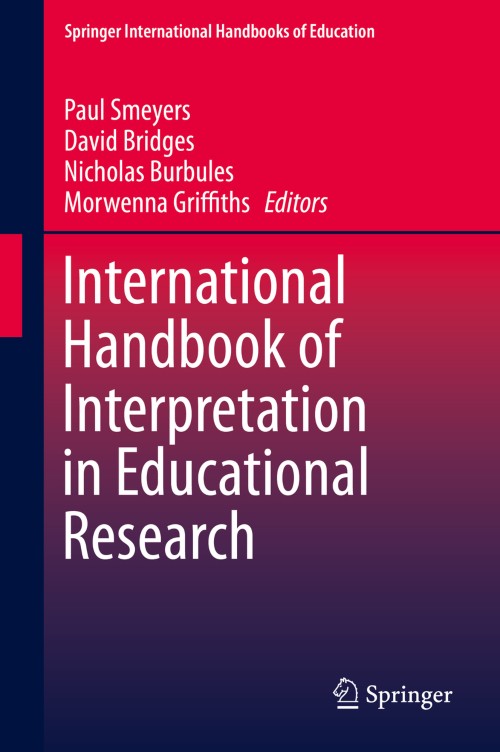
International Handbook of Interpretation in Educational Research [electronic resource] / edited by Paul Smeyers, David Bridges, Nicholas C. Burbules, Morwenna Griffiths.
Erişim Adresi
ISBN
9789401792820
Dil Kodu
İngilizce
Yer Numarası
DK/11993
Basım Bildirimi
1st ed. 2015.
Yayın Bilgisi
Dordrecht : Springer Netherlands : Imprint: Springer, 2015.
Fiziksel Niteleme
XXIV, 1662 p. 81 illus., 35 illus. in color. online resource.
Dizi
Springer International Handbooks of Education, 2197-196X
İçindekiler Notu
Preface: How the Handbook Came into Being; Paul Smeyers -- General Introduction; Morwenna Griffiths, David Bridges, Nicholas C. Burbules and Paul Smeyers -- The Theoretical Landscape -- GENRE 1: Narrative Approaches -- GENRE 2: Analysis of Language and Significations -- GENRE 3: Ethnography of Education: Sociological and anthropological approaches -- GENRE 4: Ethnography in Educational Research: Applying ethnographic methods in educational inquiry -- GENRE 5: Historical Approaches -- GENRE 6: Philosophical Approaches -- GENRE 7: Quantitative Approaches -- GENRE 8: Cultural-transgressive Approaches -- Afterword; David Bridges, Nicholas C. Burbules, Morwenna Griffiths and Paul Smeyers.
Özet, vb.
This handbook focuses on the often neglected dimension of interpretation in educational research. It argues that all educational research is in some sense ‘interpretive’, and that understanding this issue belies some usual dualisms of thought and practice, such as the sharp dichotomy between ‘qualitative’ and ‘quantitative’ research. Interpretation extends from the very framing of the research task, through the sources which constitute the data, the process of their recording, representation and analysis, to the way in which the research is finally or provisionally presented. The thesis of the handbook is that interpretation cuts across the fields (both philosophically, organizationally and methodologically). By covering a comprehensive range of research approaches and methodologies, the handbook gives (early career) researchers what they need to know in order to decide what particular methods can offer for various educational research contexts/fields. An extensive overview includes concrete examples of different kinds of research (not limited for example to ‘teaching’ and ‘learning’ examples as present in the Anglo-Saxon tradition, but including as well what in the German Continental tradition is labelled ‘pädagogisch’, examples from child rearing and other contexts of non-formal education) with full description and explanation of why these were chosen in particular circumstances and reflection on the wisdom or otherwise of the choice – combined in each case with consideration of the role of interpretation in the process. The handbook includes examples of a large number of methods traditionally classified as qualitative, interpretive and quantitative used across the area of the study of education. Examples are drawn from across the globe, thus exemplifying the different ‘opportunities and constraints’ that educational research has to confront in different societies.
Konu
Education __ Philosophy.
Sociology __ Methodology.
Philosophy and social sciences.
Educational Philosophy.
Sociological Methods.
Philosophy of Education.
Philosophy of the Social Sciences.
Sociology __ Methodology.
Philosophy and social sciences.
Educational Philosophy.
Sociological Methods.
Philosophy of Education.
Philosophy of the Social Sciences.
Kurum Adı

Eseri Alıntıla
Referansları kullanmadan önce gözden geçirmeniz ve varsa gerekli düzeltmeleri yapmanız önerilir.
Dijital Kaynak
MARC Görünümü
LEADER 04894nam a22005655i 4500
001 810720
003 TR_AnAIT
005 20260131014115
007 cr nn 008mamaa
008 150106s2015 ne | s |||| 0|eng d
020 |a9789401792820|9978-94-017-9282-0
024 7 |a10.1007/978-94-017-9282-0|2doi
041 |aeng
049 |aTürk Tarih Kurumu Kütüphanesi
050 4|aLB1-3640
072 7|aJNA|2bicssc
072 7|aEDU040000|2bisacsh
072 7|aJNA|2thema
082 04|a370.1|223
090 |aDK/11993
245 10|aInternational Handbook of Interpretation in Educational Research|h[electronic resource] /|cedited by Paul Smeyers, David Bridges, Nicholas C. Burbules, Morwenna Griffiths.
250 |a1st ed. 2015.
264 1|aDordrecht :|bSpringer Netherlands :|bImprint: Springer,|c2015.
300 |aXXIV, 1662 p. 81 illus., 35 illus. in color.|bonline resource.
336 |atext|btxt|2rdacontent
337 |acomputer|bc|2rdamedia
338 |aonline resource|bcr|2rdacarrier
347 |atext file|bPDF|2rda
490 1 |aSpringer International Handbooks of Education,|x2197-196X
505 0 |aPreface: How the Handbook Came into Being; Paul Smeyers -- General Introduction; Morwenna Griffiths, David Bridges, Nicholas C. Burbules and Paul Smeyers -- The Theoretical Landscape -- GENRE 1: Narrative Approaches -- GENRE 2: Analysis of Language and Significations -- GENRE 3: Ethnography of Education: Sociological and anthropological approaches -- GENRE 4: Ethnography in Educational Research: Applying ethnographic methods in educational inquiry -- GENRE 5: Historical Approaches -- GENRE 6: Philosophical Approaches -- GENRE 7: Quantitative Approaches -- GENRE 8: Cultural-transgressive Approaches -- Afterword; David Bridges, Nicholas C. Burbules, Morwenna Griffiths and Paul Smeyers.
520 |aThis handbook focuses on the often neglected dimension of interpretation in educational research. It argues that all educational research is in some sense ‘interpretive’, and that understanding this issue belies some usual dualisms of thought and practice, such as the sharp dichotomy between ‘qualitative’ and ‘quantitative’ research. Interpretation extends from the very framing of the research task, through the sources which constitute the data, the process of their recording, representation and analysis, to the way in which the research is finally or provisionally presented. The thesis of the handbook is that interpretation cuts across the fields (both philosophically, organizationally and methodologically). By covering a comprehensive range of research approaches and methodologies, the handbook gives (early career) researchers what they need to know in order to decide what particular methods can offer for various educational research contexts/fields. An extensive overview includes concrete examples of different kinds of research (not limited for example to ‘teaching’ and ‘learning’ examples as present in the Anglo-Saxon tradition, but including as well what in the German Continental tradition is labelled ‘pädagogisch’, examples from child rearing and other contexts of non-formal education) with full description and explanation of why these were chosen in particular circumstances and reflection on the wisdom or otherwise of the choice – combined in each case with consideration of the role of interpretation in the process. The handbook includes examples of a large number of methods traditionally classified as qualitative, interpretive and quantitative used across the area of the study of education. Examples are drawn from across the globe, thus exemplifying the different ‘opportunities and constraints’ that educational research has to confront in different societies.
650 0|aEducation|xPhilosophy.
650 0|aSociology|xMethodology.
650 0|aPhilosophy and social sciences.
650 14|aEducational Philosophy.
650 24|aSociological Methods.
650 24|aPhilosophy of Education.
650 24|aPhilosophy of the Social Sciences.
700 1 |aSmeyers, Paul.|eeditor.|4edt|4http://id.loc.gov/vocabulary/relators/edt
700 1 |aBridges, David.|eeditor.|4edt|4http://id.loc.gov/vocabulary/relators/edt
700 1 |aBurbules, Nicholas C.|eeditor.|4edt|4http://id.loc.gov/vocabulary/relators/edt
700 1 |aGriffiths, Morwenna.|eeditor.|4edt|4http://id.loc.gov/vocabulary/relators/edt
710 2 |aSpringerLink (Online service)
773 0 |tSpringer Nature eBook
776 08|iPrinted edition:|z9789401792813
776 08|iPrinted edition:|z9789401792837
776 08|iPrinted edition:|z9789402408058
830 0|aSpringer International Handbooks of Education,|x2197-196X
856 40|uhttps://doi.org/10.1007/978-94-017-9282-0
912 |aZDB-2-SHU
912 |aZDB-2-SXED
950 |aHumanities, Social Sciences and Law (SpringerNature-11648)
950 |aEducation (R0) (SpringerNature-43721)
001 810720
003 TR_AnAIT
005 20260131014115
007 cr nn 008mamaa
008 150106s2015 ne | s |||| 0|eng d
020 |a9789401792820|9978-94-017-9282-0
024 7 |a10.1007/978-94-017-9282-0|2doi
041 |aeng
049 |aTürk Tarih Kurumu Kütüphanesi
050 4|aLB1-3640
072 7|aJNA|2bicssc
072 7|aEDU040000|2bisacsh
072 7|aJNA|2thema
082 04|a370.1|223
090 |aDK/11993
245 10|aInternational Handbook of Interpretation in Educational Research|h[electronic resource] /|cedited by Paul Smeyers, David Bridges, Nicholas C. Burbules, Morwenna Griffiths.
250 |a1st ed. 2015.
264 1|aDordrecht :|bSpringer Netherlands :|bImprint: Springer,|c2015.
300 |aXXIV, 1662 p. 81 illus., 35 illus. in color.|bonline resource.
336 |atext|btxt|2rdacontent
337 |acomputer|bc|2rdamedia
338 |aonline resource|bcr|2rdacarrier
347 |atext file|bPDF|2rda
490 1 |aSpringer International Handbooks of Education,|x2197-196X
505 0 |aPreface: How the Handbook Came into Being; Paul Smeyers -- General Introduction; Morwenna Griffiths, David Bridges, Nicholas C. Burbules and Paul Smeyers -- The Theoretical Landscape -- GENRE 1: Narrative Approaches -- GENRE 2: Analysis of Language and Significations -- GENRE 3: Ethnography of Education: Sociological and anthropological approaches -- GENRE 4: Ethnography in Educational Research: Applying ethnographic methods in educational inquiry -- GENRE 5: Historical Approaches -- GENRE 6: Philosophical Approaches -- GENRE 7: Quantitative Approaches -- GENRE 8: Cultural-transgressive Approaches -- Afterword; David Bridges, Nicholas C. Burbules, Morwenna Griffiths and Paul Smeyers.
520 |aThis handbook focuses on the often neglected dimension of interpretation in educational research. It argues that all educational research is in some sense ‘interpretive’, and that understanding this issue belies some usual dualisms of thought and practice, such as the sharp dichotomy between ‘qualitative’ and ‘quantitative’ research. Interpretation extends from the very framing of the research task, through the sources which constitute the data, the process of their recording, representation and analysis, to the way in which the research is finally or provisionally presented. The thesis of the handbook is that interpretation cuts across the fields (both philosophically, organizationally and methodologically). By covering a comprehensive range of research approaches and methodologies, the handbook gives (early career) researchers what they need to know in order to decide what particular methods can offer for various educational research contexts/fields. An extensive overview includes concrete examples of different kinds of research (not limited for example to ‘teaching’ and ‘learning’ examples as present in the Anglo-Saxon tradition, but including as well what in the German Continental tradition is labelled ‘pädagogisch’, examples from child rearing and other contexts of non-formal education) with full description and explanation of why these were chosen in particular circumstances and reflection on the wisdom or otherwise of the choice – combined in each case with consideration of the role of interpretation in the process. The handbook includes examples of a large number of methods traditionally classified as qualitative, interpretive and quantitative used across the area of the study of education. Examples are drawn from across the globe, thus exemplifying the different ‘opportunities and constraints’ that educational research has to confront in different societies.
650 0|aEducation|xPhilosophy.
650 0|aSociology|xMethodology.
650 0|aPhilosophy and social sciences.
650 14|aEducational Philosophy.
650 24|aSociological Methods.
650 24|aPhilosophy of Education.
650 24|aPhilosophy of the Social Sciences.
700 1 |aSmeyers, Paul.|eeditor.|4edt|4http://id.loc.gov/vocabulary/relators/edt
700 1 |aBridges, David.|eeditor.|4edt|4http://id.loc.gov/vocabulary/relators/edt
700 1 |aBurbules, Nicholas C.|eeditor.|4edt|4http://id.loc.gov/vocabulary/relators/edt
700 1 |aGriffiths, Morwenna.|eeditor.|4edt|4http://id.loc.gov/vocabulary/relators/edt
710 2 |aSpringerLink (Online service)
773 0 |tSpringer Nature eBook
776 08|iPrinted edition:|z9789401792813
776 08|iPrinted edition:|z9789401792837
776 08|iPrinted edition:|z9789402408058
830 0|aSpringer International Handbooks of Education,|x2197-196X
856 40|uhttps://doi.org/10.1007/978-94-017-9282-0
912 |aZDB-2-SHU
912 |aZDB-2-SXED
950 |aHumanities, Social Sciences and Law (SpringerNature-11648)
950 |aEducation (R0) (SpringerNature-43721)
Materyaller
Depodan talep edilen materyal sadece kütüphane içerisinde kullanılmaktadır.
Materyal dışarıya ödünç verilmemektedir.
