LEADER 04253nam a22005775i 4500
001 810728
003 TR_AnAIT
005 20260131014058
007 cr nn 008mamaa
008 100301s2002 xxu| s |||| 0|eng d
020 |a9780306479250|9978-0-306-47925-0
024 7 |a10.1007/b105305|2doi
041 |aeng
049 |aTürk Tarih Kurumu Kütüphanesi
050 4|aHM716-753.2
072 7|aJHBK|2bicssc
072 7|aSOC026010|2bisacsh
072 7|aJHBK|2thema
082 04|a305.2|223
082 04|a306.87|223
090 |aDK/12001
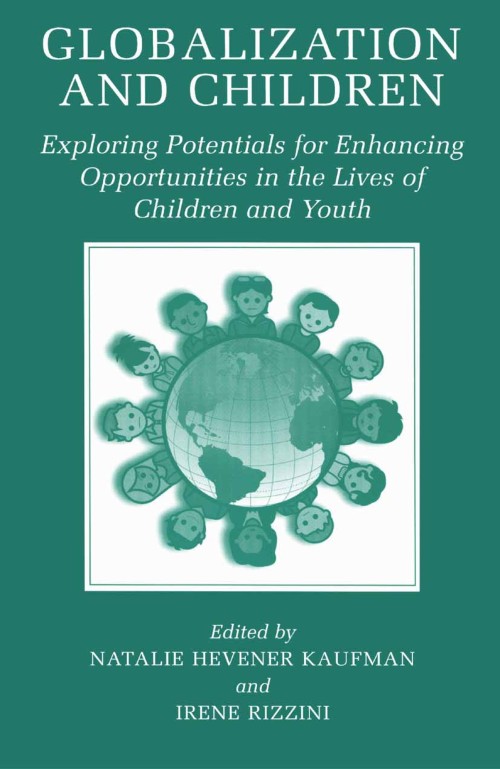
245 10|aGlobalization and Children|h[electronic resource] :|bExploring Potentials for Enhancing Opportunities in the Lives of Children and Youth /|cedited by Natalie Hevener Kaufman, Irene Rizzini.
250 |a1st ed. 2002.
264 1|aNew York, NY :|bSpringer US :|bImprint: Springer,|c2002.
300 |aXIX, 176 p.|bonline resource.
336 |atext|btxt|2rdacontent
337 |acomputer|bc|2rdamedia
338 |aonline resource|bcr|2rdacarrier
347 |atext file|bPDF|2rda
505 0 |aThe Global Perspective -- The Impact of Global Economic, Political, and Social Transformations on the Lives of Children -- Globalization in Cross-Cultural Perspective -- The Status of Children in International Law -- Democratization and Children’s Lives -- Global Trends in Children’s Lives -- Children and Family Life -- Civic Participation by Children and Youth -- The Effects of Political and Economic Transformations on Children -- Children and the Media -- Developmental-Ecological Considerations -- Applying the Lens of Global Change to the Actual Lives of Children -- The Transition to “Democracy” in Latin America -- Promises Kept, Promises Broken -- The Effects of Structural Adjustment Programs on the Lives of Children in Jamaica -- Conclusions -- Conclusions.
520 |aALLISON JAMES Globalization seems to be the word on everyone’s lips, with politicians as much as academics extolling its benefits as well as its contradictions. For some, globali- tion means, in practice, that whether in Bangkok or Boston, in London or Rio, as travelers from wealthy countries they can be sure to find the beer, the pizzas, and the jeans that they can at home; they can be both at home and away simulta- ously. For others, though, globalization has had rather different, often less bene- cial, consequences. In their everyday lives people have come to find themselves tied in, albeit in often unseen ways, into larger economic and political systems over which they have no control; yet these systems cause radical changes—often for the worse rather than the better—in the pattern of their daily lives. And it is those who have least voice whose lives are usually affected the most. In this book attention is drawn systematically—really for the first time—to a consideration of how processes of globalization variously impact upon the lives of children. Such an approach is not only most welcome in the field of childhood studies, but also long overdue. It will, at last, enable us to begin to contextualize in a broader framework some of the many issues to do with ch- dren’s rights and participation which have long been discussed as separate and discrete issues within childhood studies.
650 0|aSociology.
650 0|aSocial groups.
650 0|aSchool Psychology.
650 0|aPersonality.
650 0|aDifference (Psychology).
650 0|aEthnopsychology.
650 14|aSociology of Family, Youth and Aging.
650 24|aSchool Psychology.
650 24|aPersonality and Differential Psychology.
650 24|aCross-Cultural Psychology.
700 1 |aKaufman, Natalie Hevener.|eeditor.|4edt|4http://id.loc.gov/vocabulary/relators/edt
700 1 |aRizzini, Irene.|eeditor.|4edt|4http://id.loc.gov/vocabulary/relators/edt
710 2 |aSpringerLink (Online service)
773 0 |tSpringer Nature eBook
776 08|iPrinted edition:|z9780306473685
776 08|iPrinted edition:|z9781475776454
776 08|iPrinted edition:|z9781475776461
856 40|uhttps://doi.org/10.1007/b105305
912 |aZDB-2-SHU
912 |aZDB-2-SXS
912 |aZDB-2-BAE
950 |aHumanities, Social Sciences and Law (SpringerNature-11648)
950 |aSocial Sciences (R0) (SpringerNature-43726)