

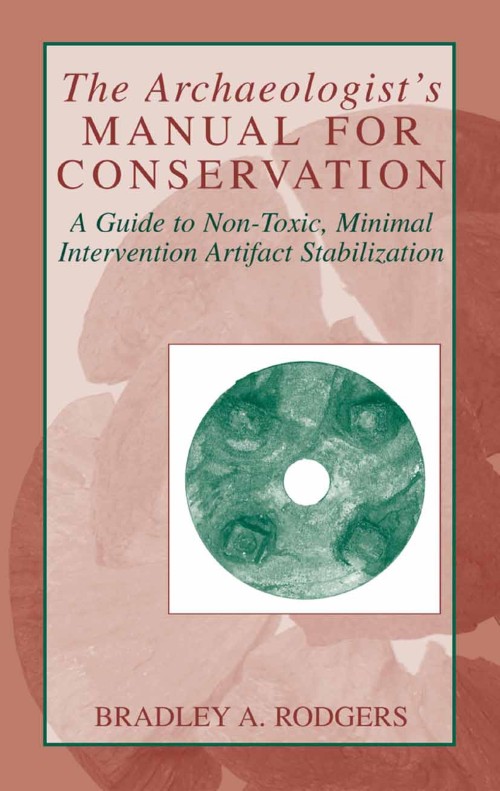
The Archaeologist's Manual for Conservation [electronic resource] : A Guide to Non-Toxic, Minimal Intervention Artifact Stabilization / by Bradley A. Rodgers.
Erişim Adresi
ISBN
9780306486135
Dil Kodu
İngilizce
Yer Numarası
DK/12114
Yazar
Basım Bildirimi
1st ed. 2004.
Yayın Bilgisi
New York, NY : Springer US : Imprint: Springer, 2004.
Fiziksel Niteleme
XVII, 214 p. online resource.
İçindekiler Notu
The Minimal Intervention Laboratory -- Archaeological Wood -- Archaeological Iron (Fe) -- Archaeological Copper (Cu) and Copper Alloys -- Miscellaneous Archaeological Metals -- Archaeological Ceramic, Glass, and Stone -- Organics Other than Wood -- Archaeological Composites.
Özet, vb.
This is a Foreword by an archaeologist, not a conservator, but as Brad Rodgers says, “Conservation has been steadily pulled from archaeology by the forces of specialization”(p. 3),andhewantstoremedythatsituationthroughthismanual. He seesthisworkasa“calltoactionforthenon-professionalconservator,”permitting “curators, conservators, and archaeologists to identify artifacts that need prof- sional attention and, allow these professionals to stabilize most artifacts in their own laboratories with minimal intervention, using simple non-toxic procedures” (p. 5). It is the mission of Brad’s manual to “bring conservation back into arch- ology” (p. 6). The degree of success of that goal depends on the degree to which archaeologists pay attention to, and put to use, what Brad has to say, because as he says, “The conservationist/archaeologist is responsible to make preparation for an artifact’s care even before it is excavated and after its storage into the foreseeable future”. . . a tremendous responsibility” (p. 10). The manual is a combination of highly technical as well as common sense methods of conserving wood, iron and other metals, ceramics, glass and stone, organicsandcomposits—afarbetterguidetoartifactconservationthanwasava- able to me when I ?rst faced that archaeological challenge at colonial Brunswick Town, North Carolina in 1958—a challenge still being faced by archaeologists today. The stage of conservation in 1958 is in dramatic contrast to the procedures Brad describes in this manual—conservation has indeed made great progress. For instance,acommonprocedurethenwastoheattheartifactsredhotinafurnace—a method that made me cringe.
Konu
Archaeology.
Ecology .
Anthropology.
Archaeology.
Ecology.
Anthropology.
Ecology .
Anthropology.
Archaeology.
Ecology.
Anthropology.
Kurum Adı
