

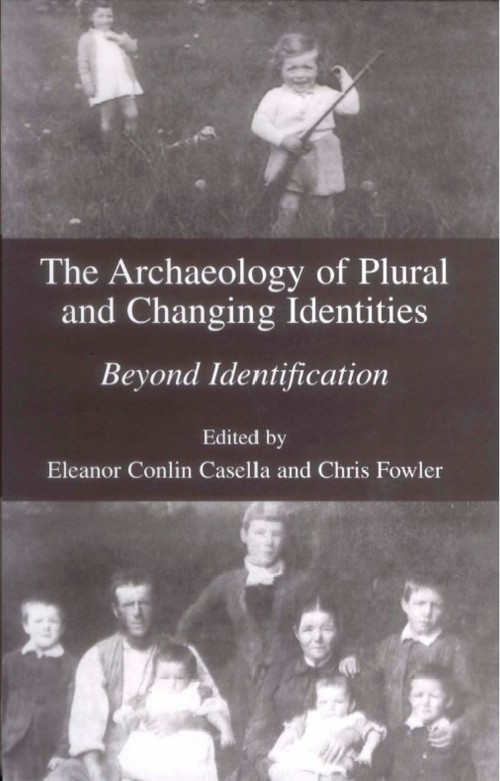
The Archaeology of Plural and Changing Identities [electronic resource] : Beyond Identification / edited by Eleanor Casella, Chris Fowler.
Erişim Adresi
ISBN
9780306486951
Dil Kodu
İngilizce
Yer Numarası
DK/12116
Basım Bildirimi
1st ed. 2005.
Yayın Bilgisi
New York, NY : Springer US : Imprint: Springer, 2005.
Fiziksel Niteleme
XII, 272 p. online resource.
İçindekiler Notu
Identity and Social Change -- Beyond Identification: An Introduction -- Medieval Towns, Modern Signs, Identity Inter-spaces: Some Reflections in Historical Archaeology -- “Either, or, Neither Nor”:Resisting the Production of Gender, Race and Class Dichotomies in the Pre-Colonial Period -- Identity: Category and Practice -- Sexual Subjects: Identity and Taxonomy in Archaeological Research -- The Contribution of Gender to Personal Identity in the Southern Scandinavian Mesolithic -- Identity Politics: Personhood, Kinship, Gender and Power in Neolithic and Early Bronze Age Britain -- Homing Instincts: Grounded Identities and Dividual Selves in the British Bronze Age -- Identity and Place -- “Games, Sports and What-Not”: Regulation of Leisure and the Production of Social Identities in Nineteenth Century America -- Changing Identities in the Arabian Gulf: Archaeology, Religion, and Ethnicity in Context -- Caste in Cuenca: Colonial Identity in the Seventeenth Century Andes -- Natural Histories and Social Identities in Neolithic Orkney.
Özet, vb.
"Questions of identity have plagued the field of archaeology since its earliest antiquarian origins. The ability to discover, recover, or uncover a past culture required the assumption of a direct relationship between its material remains and social identity. Artifacts and architectural features alike have been conceptualized as "signatures" or "representations" of specific cultures – from the "Beaker People" of the European Neolithic to the "Georgian" world view of eighteenth century Colonial America. Thus, archaeologists have employed an explicitly material focus in their examinations of identity. Yet, as people move through life they continually shift affiliation from one position to another, dependent on the wider contexts of their interactions. Different forms of material culture may be employed as affiliations shift, and the connotations of any given set of artifacts may change. In this volume the authors explore these overlapping spheres of social affiliation. Social actors belong to multiple identity groups at any moment in their life. It is possible to deploy one or many potential labels in describing the identities of such an actor. Two main axes exist upon which we can plot experiences of social belonging -- the synchronic and the diachronic. Identities can be understood as multiple during one moment (or the extended moment of brief interaction), over the span of a lifetime, or over a specific historical trajectory." - from the Introduction The international group of contributions each illuminate how the various identifiers of race, ethnicity, sexuality, age, class, gender, personhood, health, and/or religion are part of both material expressions of social affiliations, and transient experiences of identity. The Archaeology of Plural and Changing Identities: Beyond Identification will be of great interest to archaeologists, anthropologists, historians, curators and other social scientists interestedin the mutability of identification through material remains.
Konu
Archaeology.
Anthropology.
Archaeology.
Anthropology.
Anthropology.
Archaeology.
Anthropology.
Diğer Yazarlar
Kurum Adı
Eseri Alıntıla
Referansları kullanmadan önce gözden geçirmeniz ve varsa gerekli düzeltmeleri yapmanız önerilir.
Dijital Kaynak
MARC Görünümü
LEADER 04729nam a22004815i 4500
001 810844
003 TR_AnAIT
005 20260131013356
007 cr nn 008mamaa
008 100301s2005 xxu| s |||| 0|eng d
020 |a9780306486951|9978-0-306-48695-1
024 7 |a10.1007/b109969|2doi
041 |aeng
049 |aTürk Tarih Kurumu Kütüphanesi
050 4|aCC1-960
072 7|aHD|2bicssc
072 7|aSOC003000|2bisacsh
072 7|aNK|2thema
082 04|a930.1|223
090 |aDK/12116
245 14|aThe Archaeology of Plural and Changing Identities|h[electronic resource] :|bBeyond Identification /|cedited by Eleanor Casella, Chris Fowler.
250 |a1st ed. 2005.
264 1|aNew York, NY :|bSpringer US :|bImprint: Springer,|c2005.
300 |aXII, 272 p.|bonline resource.
336 |atext|btxt|2rdacontent
337 |acomputer|bc|2rdamedia
338 |aonline resource|bcr|2rdacarrier
347 |atext file|bPDF|2rda
505 0 |aIdentity and Social Change -- Beyond Identification: An Introduction -- Medieval Towns, Modern Signs, Identity Inter-spaces: Some Reflections in Historical Archaeology -- “Either, or, Neither Nor”:Resisting the Production of Gender, Race and Class Dichotomies in the Pre-Colonial Period -- Identity: Category and Practice -- Sexual Subjects: Identity and Taxonomy in Archaeological Research -- The Contribution of Gender to Personal Identity in the Southern Scandinavian Mesolithic -- Identity Politics: Personhood, Kinship, Gender and Power in Neolithic and Early Bronze Age Britain -- Homing Instincts: Grounded Identities and Dividual Selves in the British Bronze Age -- Identity and Place -- “Games, Sports and What-Not”: Regulation of Leisure and the Production of Social Identities in Nineteenth Century America -- Changing Identities in the Arabian Gulf: Archaeology, Religion, and Ethnicity in Context -- Caste in Cuenca: Colonial Identity in the Seventeenth Century Andes -- Natural Histories and Social Identities in Neolithic Orkney.
520 |a"Questions of identity have plagued the field of archaeology since its earliest antiquarian origins. The ability to discover, recover, or uncover a past culture required the assumption of a direct relationship between its material remains and social identity. Artifacts and architectural features alike have been conceptualized as "signatures" or "representations" of specific cultures – from the "Beaker People" of the European Neolithic to the "Georgian" world view of eighteenth century Colonial America. Thus, archaeologists have employed an explicitly material focus in their examinations of identity. Yet, as people move through life they continually shift affiliation from one position to another, dependent on the wider contexts of their interactions. Different forms of material culture may be employed as affiliations shift, and the connotations of any given set of artifacts may change. In this volume the authors explore these overlapping spheres of social affiliation. Social actors belong to multiple identity groups at any moment in their life. It is possible to deploy one or many potential labels in describing the identities of such an actor. Two main axes exist upon which we can plot experiences of social belonging -- the synchronic and the diachronic. Identities can be understood as multiple during one moment (or the extended moment of brief interaction), over the span of a lifetime, or over a specific historical trajectory." - from the Introduction The international group of contributions each illuminate how the various identifiers of race, ethnicity, sexuality, age, class, gender, personhood, health, and/or religion are part of both material expressions of social affiliations, and transient experiences of identity. The Archaeology of Plural and Changing Identities: Beyond Identification will be of great interest to archaeologists, anthropologists, historians, curators and other social scientists interestedin the mutability of identification through material remains.
650 0|aArchaeology.
650 0|aAnthropology.
650 14|aArchaeology.
650 24|aAnthropology.
700 1 |aCasella, Eleanor.|eeditor.|4edt|4http://id.loc.gov/vocabulary/relators/edt
700 1 |aFowler, Chris.|eeditor.|4edt|4http://id.loc.gov/vocabulary/relators/edt
710 2 |aSpringerLink (Online service)
773 0 |tSpringer Nature eBook
776 08|iPrinted edition:|z9780306486937
776 08|iPrinted edition:|z9780306486944
776 08|iPrinted edition:|z9780387500669
856 40|uhttps://doi.org/10.1007/b109969
912 |aZDB-2-SHU
912 |aZDB-2-SXS
950 |aHumanities, Social Sciences and Law (SpringerNature-11648)
950 |aSocial Sciences (R0) (SpringerNature-43726)
001 810844
003 TR_AnAIT
005 20260131013356
007 cr nn 008mamaa
008 100301s2005 xxu| s |||| 0|eng d
020 |a9780306486951|9978-0-306-48695-1
024 7 |a10.1007/b109969|2doi
041 |aeng
049 |aTürk Tarih Kurumu Kütüphanesi
050 4|aCC1-960
072 7|aHD|2bicssc
072 7|aSOC003000|2bisacsh
072 7|aNK|2thema
082 04|a930.1|223
090 |aDK/12116
245 14|aThe Archaeology of Plural and Changing Identities|h[electronic resource] :|bBeyond Identification /|cedited by Eleanor Casella, Chris Fowler.
250 |a1st ed. 2005.
264 1|aNew York, NY :|bSpringer US :|bImprint: Springer,|c2005.
300 |aXII, 272 p.|bonline resource.
336 |atext|btxt|2rdacontent
337 |acomputer|bc|2rdamedia
338 |aonline resource|bcr|2rdacarrier
347 |atext file|bPDF|2rda
505 0 |aIdentity and Social Change -- Beyond Identification: An Introduction -- Medieval Towns, Modern Signs, Identity Inter-spaces: Some Reflections in Historical Archaeology -- “Either, or, Neither Nor”:Resisting the Production of Gender, Race and Class Dichotomies in the Pre-Colonial Period -- Identity: Category and Practice -- Sexual Subjects: Identity and Taxonomy in Archaeological Research -- The Contribution of Gender to Personal Identity in the Southern Scandinavian Mesolithic -- Identity Politics: Personhood, Kinship, Gender and Power in Neolithic and Early Bronze Age Britain -- Homing Instincts: Grounded Identities and Dividual Selves in the British Bronze Age -- Identity and Place -- “Games, Sports and What-Not”: Regulation of Leisure and the Production of Social Identities in Nineteenth Century America -- Changing Identities in the Arabian Gulf: Archaeology, Religion, and Ethnicity in Context -- Caste in Cuenca: Colonial Identity in the Seventeenth Century Andes -- Natural Histories and Social Identities in Neolithic Orkney.
520 |a"Questions of identity have plagued the field of archaeology since its earliest antiquarian origins. The ability to discover, recover, or uncover a past culture required the assumption of a direct relationship between its material remains and social identity. Artifacts and architectural features alike have been conceptualized as "signatures" or "representations" of specific cultures – from the "Beaker People" of the European Neolithic to the "Georgian" world view of eighteenth century Colonial America. Thus, archaeologists have employed an explicitly material focus in their examinations of identity. Yet, as people move through life they continually shift affiliation from one position to another, dependent on the wider contexts of their interactions. Different forms of material culture may be employed as affiliations shift, and the connotations of any given set of artifacts may change. In this volume the authors explore these overlapping spheres of social affiliation. Social actors belong to multiple identity groups at any moment in their life. It is possible to deploy one or many potential labels in describing the identities of such an actor. Two main axes exist upon which we can plot experiences of social belonging -- the synchronic and the diachronic. Identities can be understood as multiple during one moment (or the extended moment of brief interaction), over the span of a lifetime, or over a specific historical trajectory." - from the Introduction The international group of contributions each illuminate how the various identifiers of race, ethnicity, sexuality, age, class, gender, personhood, health, and/or religion are part of both material expressions of social affiliations, and transient experiences of identity. The Archaeology of Plural and Changing Identities: Beyond Identification will be of great interest to archaeologists, anthropologists, historians, curators and other social scientists interestedin the mutability of identification through material remains.
650 0|aArchaeology.
650 0|aAnthropology.
650 14|aArchaeology.
650 24|aAnthropology.
700 1 |aCasella, Eleanor.|eeditor.|4edt|4http://id.loc.gov/vocabulary/relators/edt
700 1 |aFowler, Chris.|eeditor.|4edt|4http://id.loc.gov/vocabulary/relators/edt
710 2 |aSpringerLink (Online service)
773 0 |tSpringer Nature eBook
776 08|iPrinted edition:|z9780306486937
776 08|iPrinted edition:|z9780306486944
776 08|iPrinted edition:|z9780387500669
856 40|uhttps://doi.org/10.1007/b109969
912 |aZDB-2-SHU
912 |aZDB-2-SXS
950 |aHumanities, Social Sciences and Law (SpringerNature-11648)
950 |aSocial Sciences (R0) (SpringerNature-43726)
Materyaller
Depodan talep edilen materyal sadece kütüphane içerisinde kullanılmaktadır.
Materyal dışarıya ödünç verilmemektedir.
Materyal dışarıya ödünç verilmemektedir.
