LEADER 03810nam a22005415i 4500
001 810853
003 TR_AnAIT
005 20260131013343
007 cr nn 008mamaa
008 100301s2007 xxu| s |||| 0|eng d
020 |a9780387327624|9978-0-387-32762-4
024 7 |a10.1007/978-0-387-32762-4|2doi
041 |aeng
049 |aTürk Tarih Kurumu Kütüphanesi
050 4|aGN
072 7|aJHM|2bicssc
072 7|aSOC002000|2bisacsh
072 7|aJHM|2thema
082 04|a301|223
090 |aDK/12125
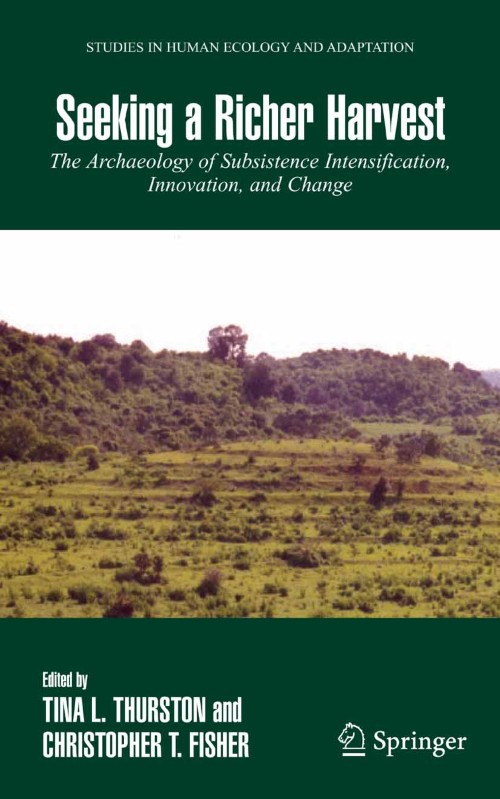
245 10|aSeeking a Richer Harvest|h[electronic resource] :|bThe Archaeology of Subsistence Intensification, Innovation, and Change /|cedited by Tina Thurston, Christopher T Fisher.
250 |a1st ed. 2007.
264 1|aNew York, NY :|bSpringer US :|bImprint: Springer,|c2007.
300 |aX, 274 p.|bonline resource.
336 |atext|btxt|2rdacontent
337 |acomputer|bc|2rdamedia
338 |aonline resource|bcr|2rdacarrier
347 |atext file|bPDF|2rda
490 1 |aStudies in Human Ecology and Adaptation ;|v3
505 0 |aSeeking a Richer Harvest -- Classic Period Agricultural Intensification and Domestic Life at el Palmillo, Valley of Oaxaca, Mexico -- The Wet or the Dry? -- Agricultural Intensification in the Lake Pátzcuaro Basin -- Chinampa Cultivation in the Basin of Mexico -- Agricultural Intensification in the Titicaca Basin -- Animal Intensification at Neolithic Gritille -- Infields, Outfields, and Broken Lands -- Cod Fish, Walrus, and Chieftains -- Intensification and Protohistoric Agropastoral Systems in East Africa -- Rethinking Intensification -- Intensification, Innovation, and Change.
520 |aSubsistence intensification, innovation and change have long figured prominently in explanations for the development of social complexity among foragers and horticulturalists, and the rise of chiefly societies and archaic states, yet there is considerable debate over the actual mechanisms that promote these processes. Traditional approaches to the "intensification question" emphasize population pressure, climate change, bureaucratic management, or even land degradation as prerequisites for the onset of new or changing strategies, or the construction and maintenance of agricultural landscapes. Most often these factors are modeled as external forces outside the realm of human decision-making, but recent archaeological research presents an alternative to this suggesting that subsistence intensification is the result of human driven strategies for power, prestige and status stemming from internal conditions within a group. When responding to environmental adversity, human groups were less frequently the victims, as they have been repeatedly portrayed. Instead human groups were often vigorous actors, responding with resilience, ingenuity, and planning, to flourish or survive within dynamic and sometimes unpredictable social and natural milieux.
650 0|aAnthropology.
650 0|aArchaeology.
650 0|aBiotic communities.
650 0|aPopulation biology.
650 14|aAnthropology.
650 24|aArchaeology.
650 24|aCommunity and Population Ecology.
700 1 |aThurston, Tina.|eeditor.|4edt|4http://id.loc.gov/vocabulary/relators/edt
700 1 |aFisher, Christopher T.|eeditor.|4edt|4http://id.loc.gov/vocabulary/relators/edt
710 2 |aSpringerLink (Online service)
773 0 |tSpringer Nature eBook
776 08|iPrinted edition:|z9780387327617
776 08|iPrinted edition:|z9780387512587
776 08|iPrinted edition:|z9781441941022
830 0|aStudies in Human Ecology and Adaptation ;|v3
856 40|uhttps://doi.org/10.1007/978-0-387-32762-4
912 |aZDB-2-SHU
912 |aZDB-2-SXS
950 |aHumanities, Social Sciences and Law (SpringerNature-11648)
950 |aSocial Sciences (R0) (SpringerNature-43726)