

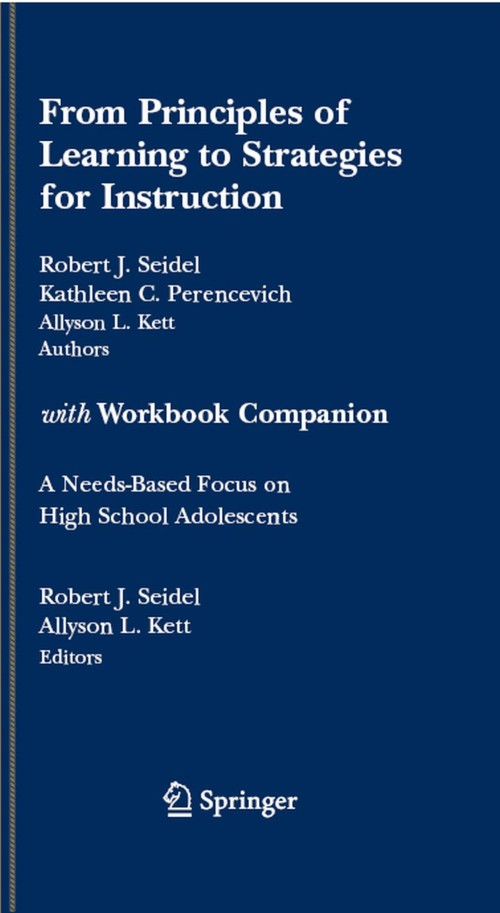
From Principles of Learning to Strategies for Instruction-with Workbook Companion [electronic resource] : A Needs-Based Focus on High School Adolescents / by Robert J. Seidel, Kathy C. Perencevich, Allyson L. Kett ; edited by Robert Seidel, Allyson Kett.
Erişim Adresi
ISBN
9780387710860
Dil Kodu
İngilizce
Yer Numarası
DK/12136
Yazar
Basım Bildirimi
1st ed. 2007.
Yayın Bilgisi
New York, NY : Springer US : Imprint: Springer, 2007.
Fiziksel Niteleme
XXX, 410 p. online resource.
İçindekiler Notu
From Principles of Learning to Strategies for Instruction -- Heuristics And Taxonomy -- A Cognitive Domain Example: Reading -- Psychomotor Domain -- Affective Domain -- Interpersonal Domain -- Suggestions For The Integration Of Technology -- Summary -- Workbook Companion -- Cognitive Domain: Content Area Reading Strategies -- Cognitive Domain: Exponential And Logarithmic Functions In Mathematics -- Psychomotor Domain: Dance -- Affective Domain: Student Perceptions And Motivation -- Affective Domain: Journaling -- Interpersonal Domain: Building Interpersonal Skills Through Environmental Studies.
Özet, vb.
The premise of From Principles of learning to Strategies for Instruction with Workbook Companion is that, in order to provide strategies for instruction, it is both appropriate and necessary to draw upon empirically based principles, or heuristics, from psychological literature on the learning process. The descriptive laws of psychology provide a foundation for the intrinsic relationship between cognitive development, learning, meta-cognition, and other psychological organizing principles and serve as the basis for prescriptions of instructional strategies. The fields of psychology, training, and education are necessarily interrelated, and practitioners/developers of training and education are suggesting new psychological research possibilities based on evidence from their own fields. To continue building effective instructional strategies, the reciprocal relationship between psychology and learning must be recognized and explored. The first part of this volume is a reprint of the original book, which highlights principles of learning which have been synthesized from research literature in psychology. Upon that foundation, the authors develop a taxonomy for tasks and recommend strategies for instruction in acquisition, automaticity, near term transfer, and far term transfer. The second part of this volume is a newly-developed Companion Workbook focusing solely on developing instructional strategies for high school level adolescents. Written by individuals with expertise in training teachers, developing curriculum, and educating high school students, each chapter uses the four tier model from the first section to develop practical and specific strategies to implement in a variety of content areas. Intended for both new and experienced teachers working with high school adolescents, the goal of the Workbook Companion is to provide educators with strategies to incorporate each of the four cognitive domains into their lesson plans, regardless of subject area. .
Konu
Learning, Psychology of.
Education.
Teachers __ Training of.
Instructional Psychology.
Education.
Teaching and Teacher Education.
Education.
Teachers __ Training of.
Instructional Psychology.
Education.
Teaching and Teacher Education.
Kurum Adı
Eseri Alıntıla
Referansları kullanmadan önce gözden geçirmeniz ve varsa gerekli düzeltmeleri yapmanız önerilir.
Dijital Kaynak
MARC Görünümü
LEADER 04732nam a22005295i 4500
001 810865
003 TR_AnAIT
005 20260131013303
007 cr nn 008mamaa
008 100301s2007 xxu| s |||| 0|eng d
020 |a9780387710860|9978-0-387-71086-0
024 7 |a10.1007/978-0-387-71086-0|2doi
041 |aeng
049 |aTürk Tarih Kurumu Kütüphanesi
050 4|aLB1060-1077
072 7|aJNC|2bicssc
072 7|aEDU009000|2bisacsh
072 7|aJNC|2thema
082 04|a370.15|223
090 |aDK/12136
100 1 |aSeidel, Robert J.|eauthor.|4aut|4http://id.loc.gov/vocabulary/relators/aut
245 10|aFrom Principles of Learning to Strategies for Instruction-with Workbook Companion|h[electronic resource] :|bA Needs-Based Focus on High School Adolescents /|cby Robert J. Seidel, Kathy C. Perencevich, Allyson L. Kett ; edited by Robert Seidel, Allyson Kett.
250 |a1st ed. 2007.
264 1|aNew York, NY :|bSpringer US :|bImprint: Springer,|c2007.
300 |aXXX, 410 p.|bonline resource.
336 |atext|btxt|2rdacontent
337 |acomputer|bc|2rdamedia
338 |aonline resource|bcr|2rdacarrier
347 |atext file|bPDF|2rda
505 0 |aFrom Principles of Learning to Strategies for Instruction -- Heuristics And Taxonomy -- A Cognitive Domain Example: Reading -- Psychomotor Domain -- Affective Domain -- Interpersonal Domain -- Suggestions For The Integration Of Technology -- Summary -- Workbook Companion -- Cognitive Domain: Content Area Reading Strategies -- Cognitive Domain: Exponential And Logarithmic Functions In Mathematics -- Psychomotor Domain: Dance -- Affective Domain: Student Perceptions And Motivation -- Affective Domain: Journaling -- Interpersonal Domain: Building Interpersonal Skills Through Environmental Studies.
520 |aThe premise of From Principles of learning to Strategies for Instruction with Workbook Companion is that, in order to provide strategies for instruction, it is both appropriate and necessary to draw upon empirically based principles, or heuristics, from psychological literature on the learning process. The descriptive laws of psychology provide a foundation for the intrinsic relationship between cognitive development, learning, meta-cognition, and other psychological organizing principles and serve as the basis for prescriptions of instructional strategies. The fields of psychology, training, and education are necessarily interrelated, and practitioners/developers of training and education are suggesting new psychological research possibilities based on evidence from their own fields. To continue building effective instructional strategies, the reciprocal relationship between psychology and learning must be recognized and explored. The first part of this volume is a reprint of the original book, which highlights principles of learning which have been synthesized from research literature in psychology. Upon that foundation, the authors develop a taxonomy for tasks and recommend strategies for instruction in acquisition, automaticity, near term transfer, and far term transfer. The second part of this volume is a newly-developed Companion Workbook focusing solely on developing instructional strategies for high school level adolescents. Written by individuals with expertise in training teachers, developing curriculum, and educating high school students, each chapter uses the four tier model from the first section to develop practical and specific strategies to implement in a variety of content areas. Intended for both new and experienced teachers working with high school adolescents, the goal of the Workbook Companion is to provide educators with strategies to incorporate each of the four cognitive domains into their lesson plans, regardless of subject area. .
650 0|aLearning, Psychology of.
650 0|aEducation.
650 0|aTeachers|xTraining of.
650 14|aInstructional Psychology.
650 24|aEducation.
650 24|aTeaching and Teacher Education.
700 1 |aPerencevich, Kathy C.|eauthor.|4aut|4http://id.loc.gov/vocabulary/relators/aut
700 1 |aKett, Allyson L.|eauthor.|4aut|4http://id.loc.gov/vocabulary/relators/aut
700 1 |aSeidel, Robert.|eeditor.|4edt|4http://id.loc.gov/vocabulary/relators/edt
700 1 |aKett, Allyson.|eeditor.|4edt|4http://id.loc.gov/vocabulary/relators/edt
710 2 |aSpringerLink (Online service)
773 0 |tSpringer Nature eBook
776 08|iPrinted edition:|z9780387710853
776 08|iPrinted edition:|z9780387518244
856 40|uhttps://doi.org/10.1007/978-0-387-71086-0
912 |aZDB-2-SHU
912 |aZDB-2-SXED
950 |aHumanities, Social Sciences and Law (SpringerNature-11648)
950 |aEducation (R0) (SpringerNature-43721)
001 810865
003 TR_AnAIT
005 20260131013303
007 cr nn 008mamaa
008 100301s2007 xxu| s |||| 0|eng d
020 |a9780387710860|9978-0-387-71086-0
024 7 |a10.1007/978-0-387-71086-0|2doi
041 |aeng
049 |aTürk Tarih Kurumu Kütüphanesi
050 4|aLB1060-1077
072 7|aJNC|2bicssc
072 7|aEDU009000|2bisacsh
072 7|aJNC|2thema
082 04|a370.15|223
090 |aDK/12136
100 1 |aSeidel, Robert J.|eauthor.|4aut|4http://id.loc.gov/vocabulary/relators/aut
245 10|aFrom Principles of Learning to Strategies for Instruction-with Workbook Companion|h[electronic resource] :|bA Needs-Based Focus on High School Adolescents /|cby Robert J. Seidel, Kathy C. Perencevich, Allyson L. Kett ; edited by Robert Seidel, Allyson Kett.
250 |a1st ed. 2007.
264 1|aNew York, NY :|bSpringer US :|bImprint: Springer,|c2007.
300 |aXXX, 410 p.|bonline resource.
336 |atext|btxt|2rdacontent
337 |acomputer|bc|2rdamedia
338 |aonline resource|bcr|2rdacarrier
347 |atext file|bPDF|2rda
505 0 |aFrom Principles of Learning to Strategies for Instruction -- Heuristics And Taxonomy -- A Cognitive Domain Example: Reading -- Psychomotor Domain -- Affective Domain -- Interpersonal Domain -- Suggestions For The Integration Of Technology -- Summary -- Workbook Companion -- Cognitive Domain: Content Area Reading Strategies -- Cognitive Domain: Exponential And Logarithmic Functions In Mathematics -- Psychomotor Domain: Dance -- Affective Domain: Student Perceptions And Motivation -- Affective Domain: Journaling -- Interpersonal Domain: Building Interpersonal Skills Through Environmental Studies.
520 |aThe premise of From Principles of learning to Strategies for Instruction with Workbook Companion is that, in order to provide strategies for instruction, it is both appropriate and necessary to draw upon empirically based principles, or heuristics, from psychological literature on the learning process. The descriptive laws of psychology provide a foundation for the intrinsic relationship between cognitive development, learning, meta-cognition, and other psychological organizing principles and serve as the basis for prescriptions of instructional strategies. The fields of psychology, training, and education are necessarily interrelated, and practitioners/developers of training and education are suggesting new psychological research possibilities based on evidence from their own fields. To continue building effective instructional strategies, the reciprocal relationship between psychology and learning must be recognized and explored. The first part of this volume is a reprint of the original book, which highlights principles of learning which have been synthesized from research literature in psychology. Upon that foundation, the authors develop a taxonomy for tasks and recommend strategies for instruction in acquisition, automaticity, near term transfer, and far term transfer. The second part of this volume is a newly-developed Companion Workbook focusing solely on developing instructional strategies for high school level adolescents. Written by individuals with expertise in training teachers, developing curriculum, and educating high school students, each chapter uses the four tier model from the first section to develop practical and specific strategies to implement in a variety of content areas. Intended for both new and experienced teachers working with high school adolescents, the goal of the Workbook Companion is to provide educators with strategies to incorporate each of the four cognitive domains into their lesson plans, regardless of subject area. .
650 0|aLearning, Psychology of.
650 0|aEducation.
650 0|aTeachers|xTraining of.
650 14|aInstructional Psychology.
650 24|aEducation.
650 24|aTeaching and Teacher Education.
700 1 |aPerencevich, Kathy C.|eauthor.|4aut|4http://id.loc.gov/vocabulary/relators/aut
700 1 |aKett, Allyson L.|eauthor.|4aut|4http://id.loc.gov/vocabulary/relators/aut
700 1 |aSeidel, Robert.|eeditor.|4edt|4http://id.loc.gov/vocabulary/relators/edt
700 1 |aKett, Allyson.|eeditor.|4edt|4http://id.loc.gov/vocabulary/relators/edt
710 2 |aSpringerLink (Online service)
773 0 |tSpringer Nature eBook
776 08|iPrinted edition:|z9780387710853
776 08|iPrinted edition:|z9780387518244
856 40|uhttps://doi.org/10.1007/978-0-387-71086-0
912 |aZDB-2-SHU
912 |aZDB-2-SXED
950 |aHumanities, Social Sciences and Law (SpringerNature-11648)
950 |aEducation (R0) (SpringerNature-43721)
Materyaller
Depodan talep edilen materyal sadece kütüphane içerisinde kullanılmaktadır.
Materyal dışarıya ödünç verilmemektedir.
Materyal dışarıya ödünç verilmemektedir.
