

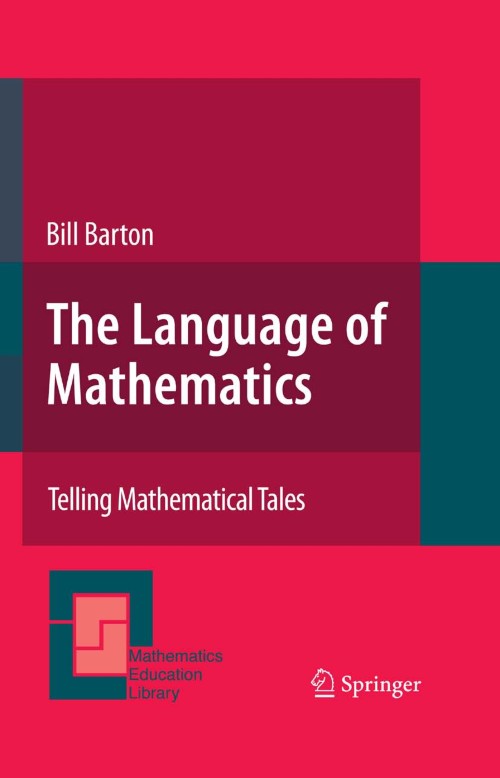
The Language of Mathematics [electronic resource] : Telling Mathematical Tales / by Bill Barton.
Erişim Adresi
ISBN
9780387728599
Dil Kodu
İngilizce
Yer Numarası
DK/12143
Yazar
Basım Bildirimi
1st ed. 2008.
Yayın Bilgisi
New York, NY : Springer US : Imprint: Springer, 2008.
Fiziksel Niteleme
X, 186 p. 12 illus. online resource.
Dizi
Mathematics Education Library, 2214-983X ; 44
İçindekiler Notu
Speaking Mathematics Differently -- Space: Points of Reference -- Space: Static and Dynamic World Views -- Quantity: Trapping Numbers in Grammatical Nets -- Language and Mathematics -- The Evidence from Language -- Mumbling, Metaphors, & Mindlocks: The Origins of Mathematics -- A Never-Ending Braid: the Development of Mathematics -- What is Mathematics? Philosophical Comments -- Implications for Mathematics Education -- Learning Mathematics -- Multilingual and Indigenous Mathematics Education.
Özet, vb.
The Language of Mathematics: Telling Mathematical Tales emerges from several contemporary concerns in mathematics, language, and mathematics education, but takes a different stance with respect to language. Rather than investigating the way language or culture impacts mathematics and how it is learned, this book begins by examining different languages and how they express mathematical ideas. The picture of mathematics that emerges is of a subject that is much more contingent, relative, and subject to human experience than is usually accepted. Barton’s thesis takes the idea of mathematics as a human creation, and, using the evidence from language, comes to more radical conclusions than usual. Everyday mathematical ideas are expressed quite differently in different languages. Variety occurs in the way languages express numbers, describe position, categorise patterns, as well as in the grammar of mathematical discourse. The first part of The Language of Mathematics: Telling Mathematical Tales explores these differences and thus illustrates the possibility of different mathematical worlds. This section both provides evidence of language difference with respect to mathematic talk and also demonstrates the congruence between mathematics as we know it and the English language. Other languages are not so congruent. Part II discusses what this means for mathematics and argues for alternative answers to conventional questions about mathematics: where it comes from, how it develops, what it does and what it means. The notion that mathematics is the same for everyone, that it is an expression of universal human thought, is challenged. In addition, the relationship between language and mathematical thought is used to argue that the mathematical creativity embedded in minority languages should continue to be explored The final section explores implications for mathematics education, discussing the consequences for the waysin which we learn and teach mathematics. The Language of Mathematics: Telling Mathematical Tales will appeal to those interested in exploring the nature of mathematics, mathematics educators, researchers and graduate students of mathematics education.
Konu
Language and languages __ Study and teaching.
Mathematics __ Study and teaching .
Language Education.
Mathematics Education.
Mathematics __ Study and teaching .
Language Education.
Mathematics Education.
Kurum Adı
Eseri Alıntıla
Referansları kullanmadan önce gözden geçirmeniz ve varsa gerekli düzeltmeleri yapmanız önerilir.
Dijital Kaynak
MARC Görünümü
LEADER 04453nam a22004935i 4500
001 810872
003 TR_AnAIT
005 20260131013255
007 cr nn 008mamaa
008 100301s2008 xxu| s |||| 0|eng d
020 |a9780387728599|9978-0-387-72859-9
024 7 |a10.1007/978-0-387-72859-9|2doi
041 |aeng
049 |aTürk Tarih Kurumu Kütüphanesi
050 4|aP51-59.4
072 7|aCJ|2bicssc
072 7|aEDU029080|2bisacsh
072 7|aCJ|2thema
082 04|a418.0071|223
090 |aDK/12143
100 1 |aBarton, Bill.|eauthor.|4aut|4http://id.loc.gov/vocabulary/relators/aut
245 14|aThe Language of Mathematics|h[electronic resource] :|bTelling Mathematical Tales /|cby Bill Barton.
250 |a1st ed. 2008.
264 1|aNew York, NY :|bSpringer US :|bImprint: Springer,|c2008.
300 |aX, 186 p. 12 illus.|bonline resource.
336 |atext|btxt|2rdacontent
337 |acomputer|bc|2rdamedia
338 |aonline resource|bcr|2rdacarrier
347 |atext file|bPDF|2rda
490 1 |aMathematics Education Library,|x2214-983X ;|v44
505 0 |aSpeaking Mathematics Differently -- Space: Points of Reference -- Space: Static and Dynamic World Views -- Quantity: Trapping Numbers in Grammatical Nets -- Language and Mathematics -- The Evidence from Language -- Mumbling, Metaphors, & Mindlocks: The Origins of Mathematics -- A Never-Ending Braid: the Development of Mathematics -- What is Mathematics? Philosophical Comments -- Implications for Mathematics Education -- Learning Mathematics -- Multilingual and Indigenous Mathematics Education.
520 |aThe Language of Mathematics: Telling Mathematical Tales emerges from several contemporary concerns in mathematics, language, and mathematics education, but takes a different stance with respect to language. Rather than investigating the way language or culture impacts mathematics and how it is learned, this book begins by examining different languages and how they express mathematical ideas. The picture of mathematics that emerges is of a subject that is much more contingent, relative, and subject to human experience than is usually accepted. Barton’s thesis takes the idea of mathematics as a human creation, and, using the evidence from language, comes to more radical conclusions than usual. Everyday mathematical ideas are expressed quite differently in different languages. Variety occurs in the way languages express numbers, describe position, categorise patterns, as well as in the grammar of mathematical discourse. The first part of The Language of Mathematics: Telling Mathematical Tales explores these differences and thus illustrates the possibility of different mathematical worlds. This section both provides evidence of language difference with respect to mathematic talk and also demonstrates the congruence between mathematics as we know it and the English language. Other languages are not so congruent. Part II discusses what this means for mathematics and argues for alternative answers to conventional questions about mathematics: where it comes from, how it develops, what it does and what it means. The notion that mathematics is the same for everyone, that it is an expression of universal human thought, is challenged. In addition, the relationship between language and mathematical thought is used to argue that the mathematical creativity embedded in minority languages should continue to be explored The final section explores implications for mathematics education, discussing the consequences for the waysin which we learn and teach mathematics. The Language of Mathematics: Telling Mathematical Tales will appeal to those interested in exploring the nature of mathematics, mathematics educators, researchers and graduate students of mathematics education.
650 0|aLanguage and languages|xStudy and teaching.
650 0|aMathematics|xStudy and teaching .
650 14|aLanguage Education.
650 24|aMathematics Education.
710 2 |aSpringerLink (Online service)
773 0 |tSpringer Nature eBook
776 08|iPrinted edition:|z9780387728582
776 08|iPrinted edition:|z9780387519753
776 08|iPrinted edition:|z9780387929378
830 0|aMathematics Education Library,|x2214-983X ;|v44
856 40|uhttps://doi.org/10.1007/978-0-387-72859-9
912 |aZDB-2-SHU
912 |aZDB-2-SXED
950 |aHumanities, Social Sciences and Law (SpringerNature-11648)
950 |aEducation (R0) (SpringerNature-43721)
001 810872
003 TR_AnAIT
005 20260131013255
007 cr nn 008mamaa
008 100301s2008 xxu| s |||| 0|eng d
020 |a9780387728599|9978-0-387-72859-9
024 7 |a10.1007/978-0-387-72859-9|2doi
041 |aeng
049 |aTürk Tarih Kurumu Kütüphanesi
050 4|aP51-59.4
072 7|aCJ|2bicssc
072 7|aEDU029080|2bisacsh
072 7|aCJ|2thema
082 04|a418.0071|223
090 |aDK/12143
100 1 |aBarton, Bill.|eauthor.|4aut|4http://id.loc.gov/vocabulary/relators/aut
245 14|aThe Language of Mathematics|h[electronic resource] :|bTelling Mathematical Tales /|cby Bill Barton.
250 |a1st ed. 2008.
264 1|aNew York, NY :|bSpringer US :|bImprint: Springer,|c2008.
300 |aX, 186 p. 12 illus.|bonline resource.
336 |atext|btxt|2rdacontent
337 |acomputer|bc|2rdamedia
338 |aonline resource|bcr|2rdacarrier
347 |atext file|bPDF|2rda
490 1 |aMathematics Education Library,|x2214-983X ;|v44
505 0 |aSpeaking Mathematics Differently -- Space: Points of Reference -- Space: Static and Dynamic World Views -- Quantity: Trapping Numbers in Grammatical Nets -- Language and Mathematics -- The Evidence from Language -- Mumbling, Metaphors, & Mindlocks: The Origins of Mathematics -- A Never-Ending Braid: the Development of Mathematics -- What is Mathematics? Philosophical Comments -- Implications for Mathematics Education -- Learning Mathematics -- Multilingual and Indigenous Mathematics Education.
520 |aThe Language of Mathematics: Telling Mathematical Tales emerges from several contemporary concerns in mathematics, language, and mathematics education, but takes a different stance with respect to language. Rather than investigating the way language or culture impacts mathematics and how it is learned, this book begins by examining different languages and how they express mathematical ideas. The picture of mathematics that emerges is of a subject that is much more contingent, relative, and subject to human experience than is usually accepted. Barton’s thesis takes the idea of mathematics as a human creation, and, using the evidence from language, comes to more radical conclusions than usual. Everyday mathematical ideas are expressed quite differently in different languages. Variety occurs in the way languages express numbers, describe position, categorise patterns, as well as in the grammar of mathematical discourse. The first part of The Language of Mathematics: Telling Mathematical Tales explores these differences and thus illustrates the possibility of different mathematical worlds. This section both provides evidence of language difference with respect to mathematic talk and also demonstrates the congruence between mathematics as we know it and the English language. Other languages are not so congruent. Part II discusses what this means for mathematics and argues for alternative answers to conventional questions about mathematics: where it comes from, how it develops, what it does and what it means. The notion that mathematics is the same for everyone, that it is an expression of universal human thought, is challenged. In addition, the relationship between language and mathematical thought is used to argue that the mathematical creativity embedded in minority languages should continue to be explored The final section explores implications for mathematics education, discussing the consequences for the waysin which we learn and teach mathematics. The Language of Mathematics: Telling Mathematical Tales will appeal to those interested in exploring the nature of mathematics, mathematics educators, researchers and graduate students of mathematics education.
650 0|aLanguage and languages|xStudy and teaching.
650 0|aMathematics|xStudy and teaching .
650 14|aLanguage Education.
650 24|aMathematics Education.
710 2 |aSpringerLink (Online service)
773 0 |tSpringer Nature eBook
776 08|iPrinted edition:|z9780387728582
776 08|iPrinted edition:|z9780387519753
776 08|iPrinted edition:|z9780387929378
830 0|aMathematics Education Library,|x2214-983X ;|v44
856 40|uhttps://doi.org/10.1007/978-0-387-72859-9
912 |aZDB-2-SHU
912 |aZDB-2-SXED
950 |aHumanities, Social Sciences and Law (SpringerNature-11648)
950 |aEducation (R0) (SpringerNature-43721)
Materyaller
Depodan talep edilen materyal sadece kütüphane içerisinde kullanılmaktadır.
Materyal dışarıya ödünç verilmemektedir.
Materyal dışarıya ödünç verilmemektedir.
